


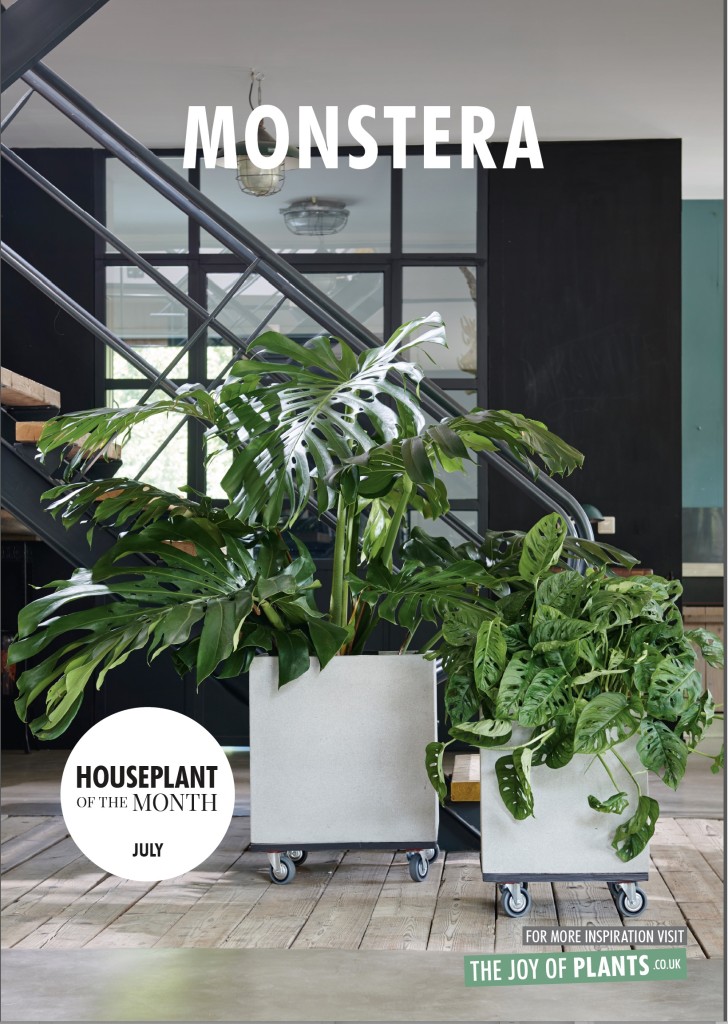
The Story of the Monstera
For a plant, the monstera or Swiss cheese plant (Monstera deliciosa) has a lot to offer: a thick stem, sometimes a moss pole, usually impressive aerial roots … there’s plenty to see! That has made it an enormous hit on Instagram and a very popular element for creating the popular urban jungle look, amongst other things.
The most fascinating aspect, though, are the leaves. Young leaves are simply heart-shaped, like the monstera’s close relative, the philodendron. They only develop the characteristic incisions later, when they’ve had some life experience.
The plant’s air-purifying properties mean that the monstera also helps create a pleasant environment in the home: another unique selling point for this attractive houseplant.
Origin


Monstera deliciosa is a member of the arum family (Araceae). It’s actually a liana found from southern Mexico to Panama in the wild, although widely grown in the tropics all over the world. It uses its fleshy aerial roots to secure itself to tree trunks, rocks and cliff faces and can climb trees to a height of 65 feet (20 meters). Its roots wrap right around trunks as it clambers upwards, growing its gigantic leaves. The more light the plant gets, the larger the leaves—up to 3 feet (90 cm) in diameter!—and the more cuts and perforations they have.
There are several theories as to why monstera leaves develop holes. One is that they’re designed so strong winds, that could otherwise tear the leaves to shreds, can pass through the leaf without damage. Another says it lets rainfall through to the roots. Yet another suggests that the leaves get bigger so the plant can capture more sunlight, but a huge entire leaf would require more resources from the plant. With cut leaves, it manages to capture more light without using as many resources.
Monstera Varieties


There are some 50 species of Monstera, all from the jungles of the New World. The best known is the one described so far, M. deliciosa, called Swiss cheese plant or split-leaf philodendron (although it is not a philodendron) for its leaves filled with cuts and holes. The green-leafed is usually sold, but occasionally variegated cultivars, such as ‘Variegata’ or ‘Thai Constellation’, are available. It’s offered in both small pot sizes without a moss pole and as sizable specimens 3 feet (1 m) or so tall attached to moss poles or other decorative supports.
M. obliqua is less well known but also very attractive. The plant has small bright green leaves with attractive holes. It can be used as a hanging or climbing plant. Others to look for are M. friedrichstahlii and M. adansonii.
What to Look for When Buying a Monstera


- The pot size, plant height and thickness should be in proportion.
- Check whether it’s a hanging or climbing plant. With a climbing specimen, the moss pole should be higher than the foliage to allow for future growth.
- Monsteras should have even leaf spacing: all sides ought to be attractively and evenly covered. If the plants have been placed too close together at the nursery, the plant shape will sometimes be one-sided or have fewer leaves and be less desirable.
- Monsteras are generally a healthy, strong plants not particularly prone to pests and diseases. Do check for scale insects and mealybugs, though. They’ll attack almost any plant and are hard to eradicate.
- The plant should have no brown patches on the leaves. This is a sign of having stood in wet soil for too long.
- Lime stains or water marks on the leaf diminish the decorative value, but are otherwise harmless and can be carefully removed with a damp cloth dipped in vinegar.
- If you bring your plant home in winter, make sure it is protected against the cold with a sleeve or sealed inside a bag.
Care Tips


- Monsteras prefer good light, but don’t need full sun.
- The plant doesn’t cope well with cold; don’t place it in temperatures of 55 °F (13 °C) or less. It will take down to freezing in a pinch… but it won’t like it!
- Water moderately; the soil can be kept slightly damp, but not drenched.
- Apply a bit of fertilizer monthly during the spring to early fall growing season.
- Aerial roots can be seen as an interesting curiosity … or as a nuisance. In a home setting, they give nothing to the plant and can simply be clipped off.
- Monsteras rarely flowers indoors. If ever yours does bloom, expect a white sail-shaped bloom much like the flower of the peace lily (Spathiphyllum). After it blooms, M. deliciosa will even produce, as its name suggests, an edible fruit tasting like a blend of pineapple and banana.
- All parts of monsteras other than the ripe fruit are poisonous. Serious poisonings due to monsteras are however almost unheard of, be it with pets or children, the first taste being so dreadful it is immediately spat out.
Showing Off Your Monstera


You can create your own little monstera display by placing large, medium and small plants next to one another. Or try setting medium and small plants together in a bowl for an attractive appearance. And you can place the large pots of big specimens on castors. That way you can move them around easily.
Text and photos adapted from a press release by Thejoyofplants.co.uk.
Styling by Elize Eveleens, Klimprodukties