


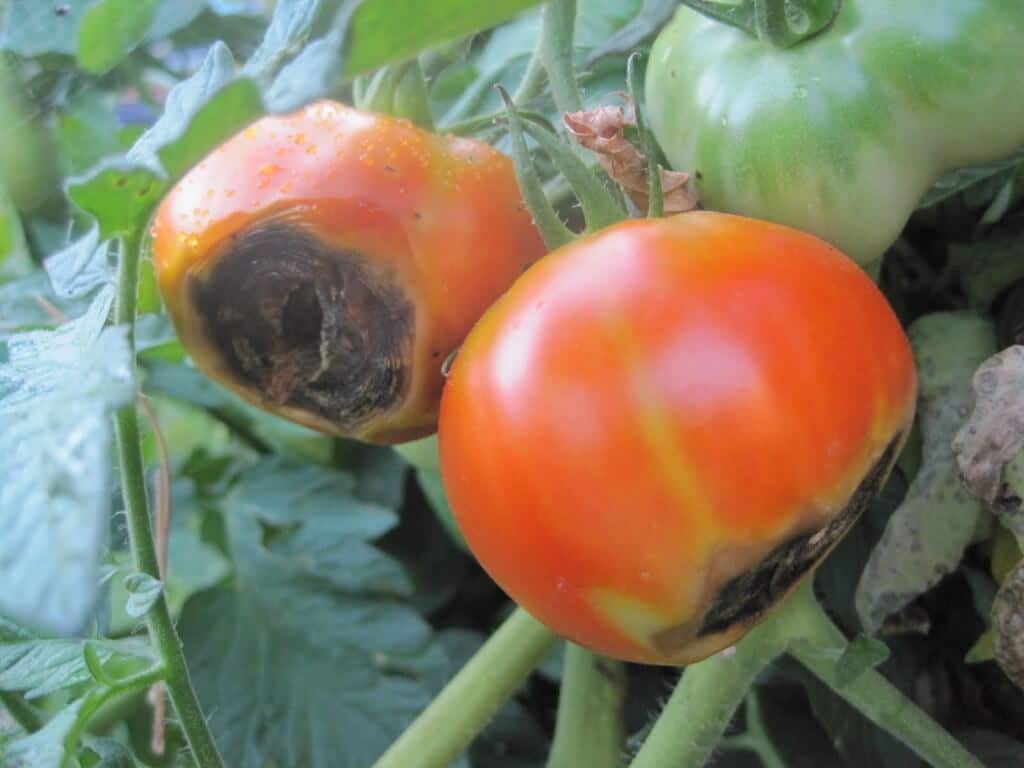
Blossom end rot is a common deficiency disease seen in tomatoes, but also peppers and squashes. It’s characterized by a lesion that forms on the tip of a young fruit ready to ripen, on the opposite side to where it is attached to the plant. This is the point where the flower was originally found, thus the name “blossom-end” rot.

What is Blossom-End Rot?
The lesion is light brown, small and watery at first, then grows and becomes dark brown or black, sunken and hardens. The lesion may eventually cover more than half of the fruit and can be invaded by other organisms.
Blossom-end rot occurs when fruits are growing rapidly and therefore have a high need for calcium, yet are unable to get enough. The solution might seem to treat the plant with a calcium-rich fertilizer, such as chicken manure or almost any other organic fertilizer (nearly all contain calcium). In fact, applying calcium is often recommended as a treatment. However, studies show that simply applying calcium has no significant effect. Even if the calcium-rich fertilizer is sprayed directly on the plant’s foliage and no other treatment is applied, the calcium tends to remain in the foliage and very little reaches the fruit.

The Real Culprit: Moisture Stress
In fact, blossom end rot is almost never due to the absence of calcium (calcium is abundant in most garden soils). It is due to the inability of the plant to absorb calcium from the soil. And that is most often due to irregular watering. If the plant lacks water during the critical period of fruit formation, less sap reaches the fruit which will therefore not receive its share of calcium and voilà! Blossom end rot sets in. Typically, blossom-end rot occurs when the plant is repeatedly stressed by irregular watering or rainfall, going from very dry to moist to very dry again. It tends to occur more often in container-grown plants … because they dry out very quickly.

The solution? Always ensure constant moisture to the roots of tomatoes, peppers and squashes and blossom-end rot is unlikely to occur. Applying mulch to the soil at the base of the plant is ideal because it helps keep the soil evenly moist.
Epsom Salts Aren’t Helpful… At All!
My dad used to treat blossom-end rot by watering his tomatoes with a solution of Epsom salts … and it worked! But not because of the salts! Epsom salts are simply magnesium sulfate. They can add sulfur and magnesium to the soil. But, as you’ve read, it’s due to a lack of calcium, a very different mineral. Watering with a solution of Epsom salts can therefore help tomato plants. But it’s not because of the salts themselves, rather because of the H2O they were diluted in. Read more about Epsom salts in the garden here: Garden Myth: Read Epsom Salts as a Cure-All.
Other factors to consider are:
- Adjusting the soil’s pH to close to 6.5. Calcium tends to remain insoluble and thus unavailable in soil that is either too acid (pH below 6) or too alkaline (pH above 7).
- Avoiding the excessive use of nitrogen-rich fertilizers (those with a higher first number, such as 15-10-10). They cause overly rapid green growth, draining calcium to the plant’s foliage rather than its fruit.
- Avoiding hoeing at the foot of the plant. This severs plant roots and thus disrupts the flow of calcium-bearing sap to the fruit. Here again, mulch can come to the rescue! A good mulch prevents weeds from growing, so there will be no need to hoe the soil around the plant and blossom end rot will therefore be less likely.
- Some varieties, like ‘Big Boy’, ‘Fantastic’ and ‘Whopper’ and most paste tomatoes (‘Roma’, for example), are more sensitive to blossom-end rot than others.
Adapted from an article originally published on August 5, 2015.