


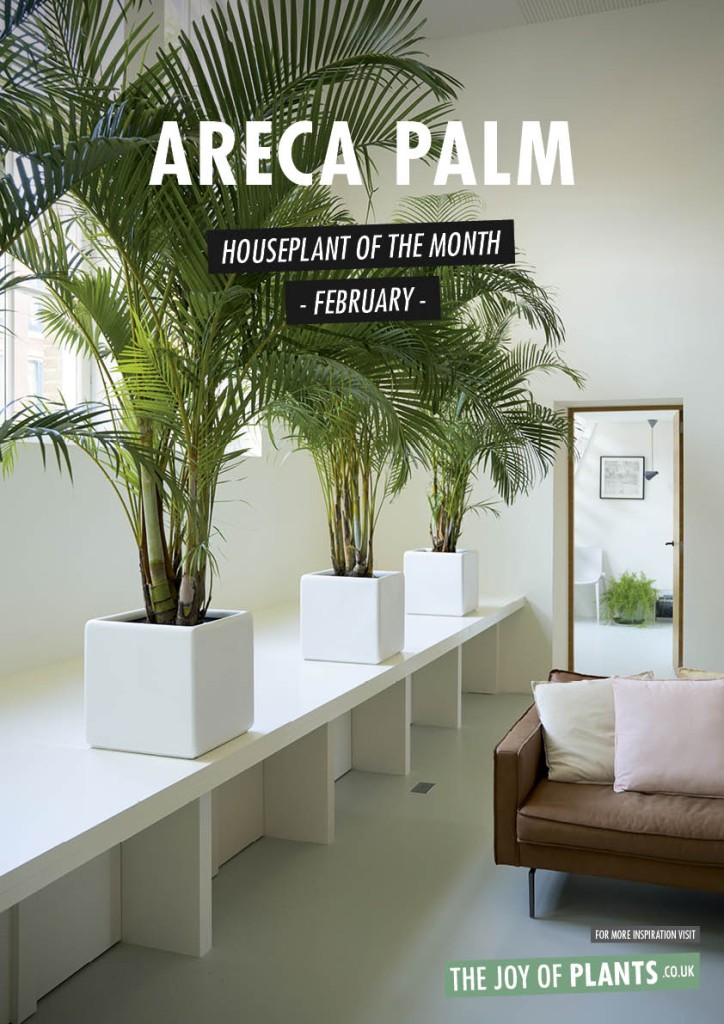
The areca palm or butterfly palm (Dypsis lutescens) projects a sense of calmness on the entire décor. The palm has no central stem at first: the reed-like petioles all emerge directly from the soil and grow upwards forming numerous light green narrow pointed leaflets. The fronds spread outwards in an attractive green fountain shape that looks cheerful, creates plenty of atmosphere and also lends a touch of grace to the interior. Only mature specimens show bamboolike stems.
Research by NASA also shows that the areca palm has an air-purifying effect in the home and help create good humidity—another good reason to grow it.
Origin


The Areca palm is a member of the Arecaceae or palm family, which also includes all true palms. The plant had been sold for generations under the botanical name Chysalidocarpus lutescens. However, recent studies show that the Madagascar native is closely related to other Dypsis species of that island and so was renamed Dypsis lutescens. The epithet lutescens means yellowish, a reference to the yellow coloration of the petioles of mature specimens.
Curiously, in spite of the common name areca palm, this plant is not at all closely related to Areca catechu, the betel nut palm, famous for its narcotic nut that is chewed in South Asian countries, leading to euphoria, but also bright red saliva and permanently blackened teeth. The name “areca palm” was given to D. lutescens due to an error in identification over a century ago and has stuck ever since.
Areca Palm Assortment


There is just one species of areca palm, but it is sold in various sizes, from young plants in small pots with only one stem to clumps (it naturally produces offsets) of larger plants. It can range in size height from about 40 cm (16 inches) to 3 m (10 feet). The larger the plant, the more you can expect to pay. Outdoors in the tropics, it can reach 12 m (40 feet) in height.
What to Look for When Buying an Areca Palm
- First check that you have the right species. Younger plants in particular can sometimes be confused with kentia palms (Howea forsteriana). The difference can be most easily seen in the petioles at the base of the fronds. Kentia petioles are green and surrounded by brown fibres while areca petioles are smooth and bear red spots. Also, the areca palm’s fronds are thinner and narrower than a kentia’s. The species particularly differ in terms of price (areca palm is considerately cheaper), so it’s worth paying close attention.
- Also check for a pleasing proportion between the pot size, thickness and height of the plant. Sometimes areca palms are underpotted to save on shipping costs and that can lead to problems later.
- Before purchase, make sure that your areca palm is free of mealybugs and scale insects. These are hard for houseplant lovers to get rid of.
- The plant can also suffer from red spider mites, identifiable by a greyish look to the fronds. They mostly pop up when the palm is kept in overly dry air.
- Plants should be free of yellow leaves or brown leaf tips, caused by dry air ou underwatering.
- Black spots, particularly in older plants, often indicate a too high salt concentration in the potting soil, which can be corrected by leaching the root ball with water.
- Make sure your plant has not been subjected to cold temperatures which cause dark spots on the leaves. It should have been kept at 12°C (54°F) or higher during shipping.
- Although it naturally produces offsets over time, the areca palm is propagated from seed. Thus, young plants already growing in dense clumps were likely produced by sowing many seeds in the same pot.
Care Tips


- Wrap the plant for the journey home during cold weather.
- The areca palm requires a spot in bright light. However, it’s best to avoid intense daylong sunlight in the summer months.
- The bigger the plant is, the easier it is to look after: just adjust the watering to its size. Water the plant regularly, avoiding cold water, so that the potting soil never dries out completely.
- In most homes, you’ll need to increase the atmospheric humidity during the winter, as central heating dries the air. It might be worthwhile using a room humidifier… something that will benefit most other houseplants as well.
- Fertilize only very lightly, with an all-purpose fertilizer, from spring through early fall.
- As the plant grows, it will produce new fronds from the top, while older ones (those at the base of the plant) will turn yellow. When this happens, simply pull them off.
- You can place your areca palm on the patio or balcony in the summer, giving it a tropical look, provided that temperatures don’t drop below 12°C (54°F). Areca palm are tropical plants and don’t cope well with cold.
- You can also put your areca palm outdoors on a rainy summer day to help remove dust and grime.
Display Tips

Areca palms are ideally suited for the modern trend toward plants with light, airy foliage that soften external influences. Opt for neutral cache-pots such as matt glass, matt ceramic or smooth polished wood. The more serene the look, the more calming the impact of the display will be.
Larger specimens can be used on their own, while the smaller plants look more attractive in a row or as screening.
Try setting your areca palm behind a screen of tulle or very thin rice paper, then use soft backlighting to reinforce the areca palm’s calming, buffering effect, creating a striking filter for your décor.
The areca palm: a classic indoor palm with an ever-so-modern appeal!
Text and photos adapted from a press release by Thejoyofplants.co.uk.
Styling by Elize Eveleens, Klimprodukties