


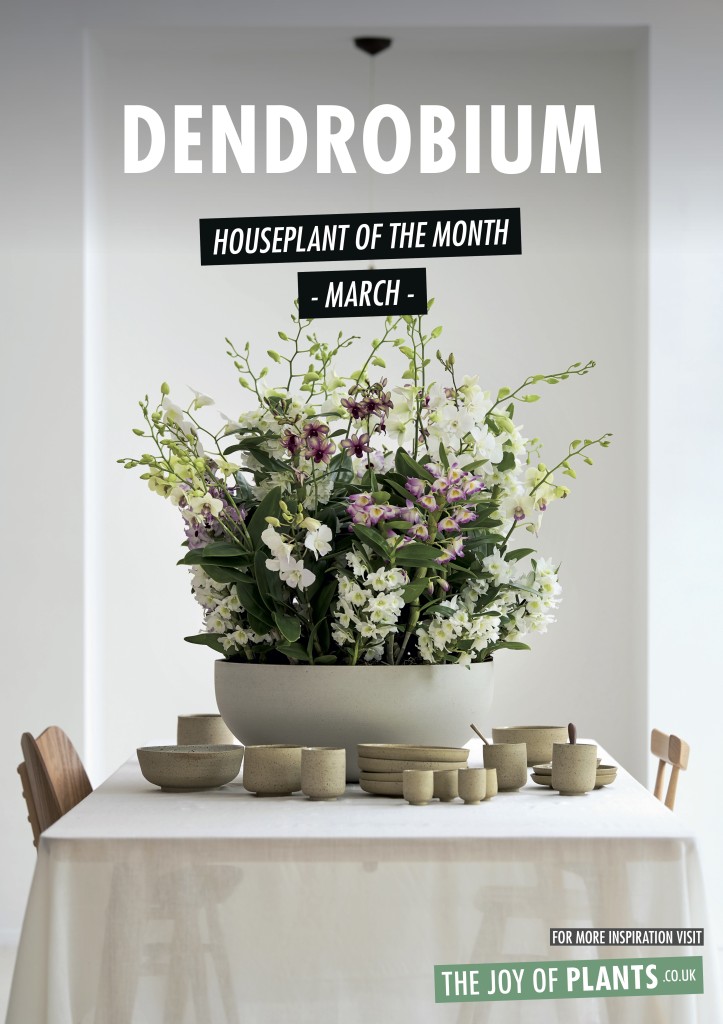
Dendrobiums (Dendrobium spp.) feature a bamboolike, usually upright pseudobulb called a cane with leaves arranged in two ranks from which emerges a cluster of idiosyncratic flowers which may have a light scent depending on the variety. The structure means that this orchid has an attractive full look: it’s a houseplant that really does offer value for money.
The Dendrobium is a popular orchid from the Epidendroideae, the same subfamily as Phalaenopsis, Vanda, Epidendrum and Cymbidium. All these orchids are characterized by the classic structure of the flower with five tepals (sepals and petals), an attractive lip (labellum) and in the center of the flower, a column combining both male and female sex organs.


In the wild, dendrobiums generally grow as epiphytes on trees or rocks. In fact, the name dendrobium is derived from the Ancient Greek words dendron meaning “tree” and bios meaning “life,” thus “living on trees.” They do no harm to their tree host, as they draw no nutrients from them. Instead, their aerial roots obtain the nutrients they need from the air. As potted plants, they are therefore planted in well-drained, airy potting mixes often largely composed of bark.
The best-known species is Dendrobium nobile, bearing sprays of beautifully patterned flowers.
Origin
Dendrobium is a popular genus from the Orchidaceae family. Around 1200 Dendrobium species grow in the wild across a fairly large territory shaped like an enormous triangle, from the Himalayas and southern Japan to Australia and New Zealand.
Dendrobium Assortment


As one can expect in such a vast and varied genus, there are many subgroups of dendrobiums. Two types of Dendrobium are most often grown, though: the Compactum and the Den-Phal hybrids.
The Compactum species and cultivars often have multiple thin canes (lengthened pseudobulbs) and small flowers (1 to 7 cm). The best-known species is Dendrobium nobile, whose abundant flowers vary in color, but with a characteristic dark blotch in the center. There are a number of series among Compactum dendrobiums, of which the Star Class is the best known.
The Den-Phal hybrid dendrobiums get their name from their broad, rather flattened flower, much like those of the popular Phalaenopsis or moth orchid. However, they are not the result of a cross between a dendrobium and a phalaenopsis: they are pure dendrobiums, largely derived from the species D. bigibbum, formerly called D. phalaenopsis.
They generally bear one or two stems with larger flowers (7 cm or more). The best known of this category is the Sa-Nook series in many different colors ranging from yellow, green and white through to purple, pink and bicolored. The lip color can also vary.
There are also a number botanical species that can be grown as well as many “other” dendrobiums, like D. Berry ‘Oda’.
What to Look for When Buying a Dendrobium


- It’s important to pay attention to the state of maturity of the blossoms. They can range from buds just showing color to plants with all flowers fully open. Ideally, you’d choose a plant with only one or two open flowers, enough so you can see the final color and appearance, but with plenty of buds yet to open, guaranteeing a long blooming period ahead.
- Also consider the plant’s overall appearance. Is the size of the plant proportional to the pot it’s sold in. How tall are the canes? And how many canes are there per plant? A large number of buds and flowers create quite an impact, but will up the price.
- Naturally, flower color will probably be a factor. Do pick your favorite shade! However, beware that there is an increasing number of color-modified dendrobiums, particularly D. nobile, on the market where a dye has been injected into the stems to artificially color the flowers. (Blue is the trendiest of the dyes.) If you buy such a plant, remember that, when it blooms again, it will return to its original shade.
- The plant should be free of pests and disease when purchased. The flowers sometimes suffer from botrytis (gray mold), a fungus that greatly diminishes their decorative value.
- The potting mix should be neither completely dry nor sopping wet, but just moist enough in order to prevent the canes (pseudobulbs) and buds from drying out.
- Like many orchids, dendrobiums are sensitive to ethylene damage during shipping. Ethylene is an ageing hormone that encourages bud drop, the failure of the flowers to open and accelerated ageing. Dendrobiums should not be displayed at the point of sale sealed inside clear plastic, as this leads to ethylene buildup.
- Yellowing leaves can indicate the plant was kept too wet or too dry.
- Pests such as scale insects and mealybug sometimes also occur and are a challenge to eradicate. Carefully inspect the plant before purchase.
- Dendrobiums are easily damaged by the cold, so in the winter months, make sure the plants are protected in a box or sleeve before you leave the store.
Care Tips
- Dendrobiums prefer room temperatures of 18–25 °C (65–77 °F). Avoid cold drafts and wind.
- They require a spot in bright light. They’ll enjoy direct sunlight in the winter months, but need some protection from direct midday sun from early April to early October. The plant does not get any direct sunlight in its places of origin, the tropical rainforest.
- Dendrobiums do not need a lot of water. Usually, watering once a week is enough, but don’t let them dry out completely either. Too much water is more damaging than too little, and results in yellow leaves.
- Give the plant a rest for 6–8 weeks after flowering, keeping it drier and cooler at 15 °C (60 °F): in a bedroom or utility room, for example. The plant will respond to the low temperature by producing buds as a survival strategy. The plant does not need much water during this cool period. Once the new buds are visible, the plant can be given the normal care again, so that it can show off its fabulous flowers once more.
- Never place dendrobiums near sources of ethylene such as fruit and vegetables. This will cause bud drop, the failure of buds to open or accelerated ageing.
Display Tips


Dendrobium fits with the interior trend in which the home is furnished in such a way that it appears to absorb and soften impacts from the outside.
Choose pots in colors such as nude, powder pink, gray-green with some dark green as a contrast and mat surfaces to create a calming effect.
Place the orchids in ceramic bowls, mat glass pots or in a pot carved out of pink salt.
Additions such as feathers, tulle, photographs and paintings with mist themes help reinforce the feeling.
The characteristic vertical growth habit also makes the plant ideal for an arrangement as a flowering screen.
Text and photos adapted from a press release by Thejoyofplants.co.uk.
Styling by Elize Eveleens, Klimprodukties