


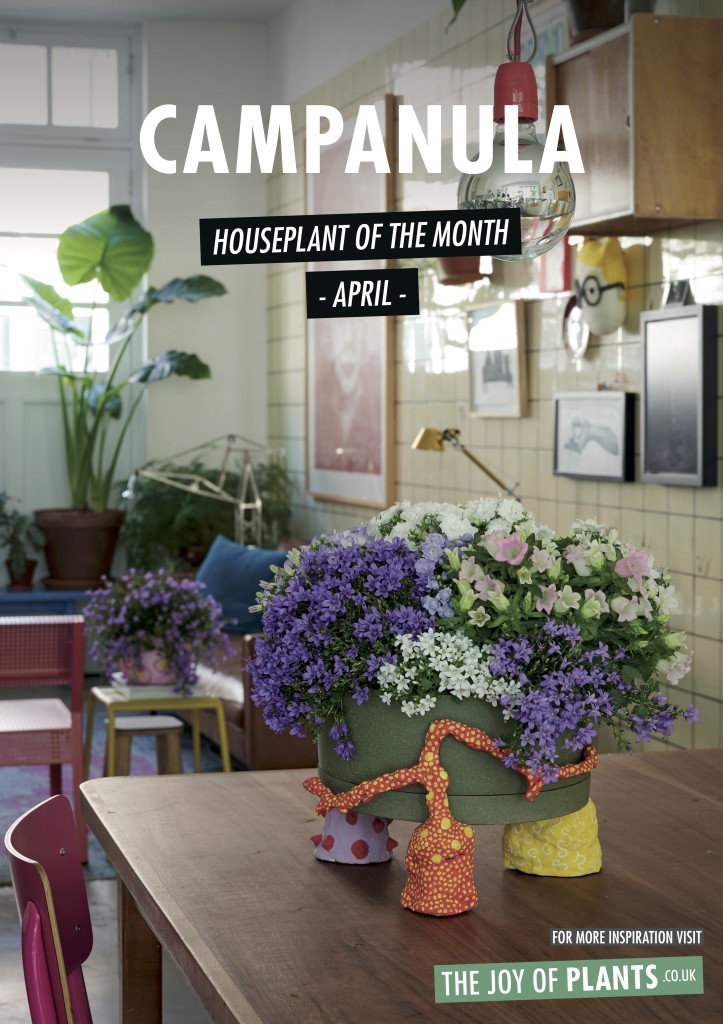
The campanula or bellflower is a plant with a fresh look, mainly in shades of blue, purple and white. The name bellflower suggests a plant with bell-shaped flowers and this is also reflected in the scientific name: campana means “bell,” and Campanula is the diminutive: little bell. There are also varieties that have star-shaped flowers, such as the star of Bethlehem, and species with bowl-shaped or tubular flowers.
Think of campanulas as pretty but temporary houseplants that can then be moved outdoors for use as garden and patio plants when temperatures allow.
Origin


The genus Campanula includes several hundred species that mainly originate from the temperate regions in the Northern hemisphere and the countries around the Mediterranean. Many species are also used in the garden or on the balcony and are suitable for a temporary display in the living room. It’s amazing how long they keep looking beautiful indoors with their bell or star-shaped flowers.
Assortment
The Campanula range is diverse, but only smaller species are used indoors. All are seasonal plants, variously are offered from late winter through to autumn.


Among the various Campanula species that are popular as houseplants is C. isophylla (star of Bethlehem or Italian bellflower) with mainly white and blue colors forming fairly large stars. It’s a trailing plant best used in a hanging basket. If faded flowers are removed, it can rebloom over much of the summer. It’s hard to overwinter, though, being hardy enough for outdoor planting in mild climates (USDA zones 8–10). Try cutting it back in the fall and placing it in a sunny but cold spot (40–50?F/4–10?C) indoors, perhaps a heated garage or unheated room, for the winter. Although it will be dormant at that season, some watering will be required: it must never dry out entirely.


C. portenschlagiana, formerly C. muralis (wall bellflower) has smaller bell-shaped flowers. It’s a trailer or can, if you want, be trained up a trellis. This rock garden species is much hardier (USDA zones 2 to 8) and after being enjoyed indoors, you can plant it outdoors in the rock garden where it can shine as a perennial in spring and summer for years. The range is constantly being expanded, including with purple, white and lavender blue.


However, the hybrid bellflower (C. × haylodgensis) is the most popular houseplant variety. A cross between two rock garden plants, Carpathian bellflower (C. carpatica) and thimble bellflower (C. cochlearifolia), it’s a compact, mounding plant generally sold covered with small blue to white bells, most often double. If you keep removing the faded flowers, it will rebloom for much of the summer. And it’s very hardy (USDA zones 3 to 8), so you can plant it outdoors permanently as a container, border or rock garden plant in most climates.
Campanulas make excellent gift plants for Easter (12 April 2020) and Mother’s Day.
What to Look for When Buying Campanulas


- Check the proportions between the pot size, shape of the plant and plant height.
- Look for a plant with plenty of buds, but only a few flowers open. That way, you know the bloom will last as long as possible.
- Avoid plants that look wilted and whose soil is dry to the touch, a sign they have been neglected.
Care tips
- Place campanulas in full sun or partial shade indoors, but avoid the hot midday of a south-facing window.
- While campanulas are in heavy bloom, they use a lot of water. You may need to water them twice a week to keep them in top form.
- Preferably water from below so that the foliage and flowers don’t get wet. Briefly immersing the pot is also an option. Allow it to drain well in order to ensure that the soil does not stay too wet.
- Always remove wilted flowers to ensure that the plant blooms for a long time.
- Apply a soluble all-purpose fertilizer at a quarter of the recommended rate every second watering to help maintain flowering. Some species can flower several times a year.
- After being displayed in the living room, plant hardy Campanula species in the outdoor garden.
Display Tips


Plant campanulas in attractive dish or patio containers, possibly with other plants that require the same care.
Text and photos (unless otherwise mentioned) adapted from a press release by Thejoyofplants.co.uk.