


The Story Behind the Calla
Like the anthurium and the spathiphyllum, the calla—botanically known as Zantedeschia—is a member of the Arum family (Araceae) and is characterized by its pitcher-shaped bract (spathe), now available in a wide range of colors. The actual flowers, on the tubular spike in the centre of the inflorescence, are tiny and less eye-catching.


Although often called calla lily, it is not, of course, in any way related to the true lily (Lilium spp.) of the Lily family (Liliaceae). It’s also called the arum lily … but so are a half dozen other plants.


Many arums have a preference for swamps. Zantedeschia species are also swamp plants that embed themselves firmly on river banks. The different species originate from southern Africa as far north as Malawi, and often grow in places where rainwater drainage is obstructed. These are periodically saturated swampy spots, but for relatively short periods, then they dry out. The plant can easily survive subsequent long periods of drought.
Behind the Name
Zantedeschia was originally called Arum aethiopicum or Ethiopian arum lily, although it in fact grows nowhere near Ethiopia. At that time (18th century), Africa was largely unknown and Ethiopia was commonly thought to refer to the entire continent. The plant was later renamed Calla aethiopica, “calla” being Greek for beautiful, since the plant was believed to be a close relative of the bog arum, Calla palustris, but it turned out to be only a very distant relative. Even so, the name calla clung on as a common name for the genus.


However, botanists now had to find a new name for the plant. Richardia africana was also used for a while, after the French botanist Louis Claude Richard (1754–1821), but it turned it had already been used for an obscure genus of New World plants, so yet another name was needed. Finally, botanists adopted the name Zantedeschia, after the Italian doctor and botanist Giovanni Zantedeschi (1773–1846) and that name stuck.


The first calla grown was the white calla (Zantedeschia aethiopica) and it remains popular as a garden plant in mild climates, although, due to its large size, is rarely grown indoors. Its huge white flowers became very popular with florists and soon became particularly associated with mourning. Other calla colors, though, don’t have that negative connotation.
What to Look for When Buying a Calla


- Pricing is generally based on pot size, number of flowers per plant and the plant’s volume.
- It is also important to consider maturity. Avoid plants showing mostly green buds, particularly during the months with low light levels. Such flowers often struggle reach their full size and coloration due to lack of light.
- Ensure that the plant is free of pests and diseases. This includes botrytis—a fungus that greatly detracts from the decorative value—on the leaves or flower. The tubers and the plant itself can also be infected with bacteria in the form of slimy stems and rapid decline of the plant. Yellow or drooping leaves are likewise not a good sign.
- Callas are stored cool during shipping (8–12°C), but only for short periods. After that, they need more warmth. Beware of plants stored too long in sleeves during the shipping and storage phase, as flowers and foliage can become damp due to excessive humidity and condensation inside the cellophane, leading to disease. Only the potting soil should be damp.
- If you buy tubers, look for large ones. The tuber’s diameter (given in cm) largely determines the number of flowers that will be produced by each plant.
Not for Consumption
Obviously, callas are for decoration only and not for human consumption. Like most other arums, they are toxic to people and pets and should be kept out of the reach of small children.
Assortment


The calla is most widely available in the spring and summer months. Its range has expanded considerably in recent years, so that there are many flower colors and leaf markings available. Flowers can be white, pink, yellow, orange, red, purple, green and even nearly black. Bicolors are also available. They are usually single, but can also be double. The foliage can be narrow or arrow-shaped, green or spotted with white. The most popular varieties these days are the smaller-flowered hybrids, which produce more compact plants better suited to indoor growing.
Besides being used as a gift plant and houseplant, callas also make great garden plants and as such are often sold as dry tubers for planting outdoors in the late spring or early summer.
Care Tips


Callas are easy to care for and can be enjoyed for a long time.
- Indoors, the plant requires a bright spot which is as cool as possible. This will ensure the longest flowering.
- The plant is undemanding in the garden and, once in bloom, can be placed in either sun or shade. The temperature must remain above 5–8 °C (40–46 °F).
- Indoors, callas can bloom for 2–12 weeks. The plants can flower for longer outdoors, particularly when the temperatures are cool.
- Make sure the soil never dries out by watering regularly.
- Apply fertilizer every two weeks to ensure lavish flowering.
- Most gardeners treat cannas as temporary plants and buy new ones each year. However, they can be rebloomed by giving them a rest period during the winter, when the plant is kept dry and the leaves are allowed to die back. The tubers will produce plenty of new flowers during the next growing season.
Display Tips


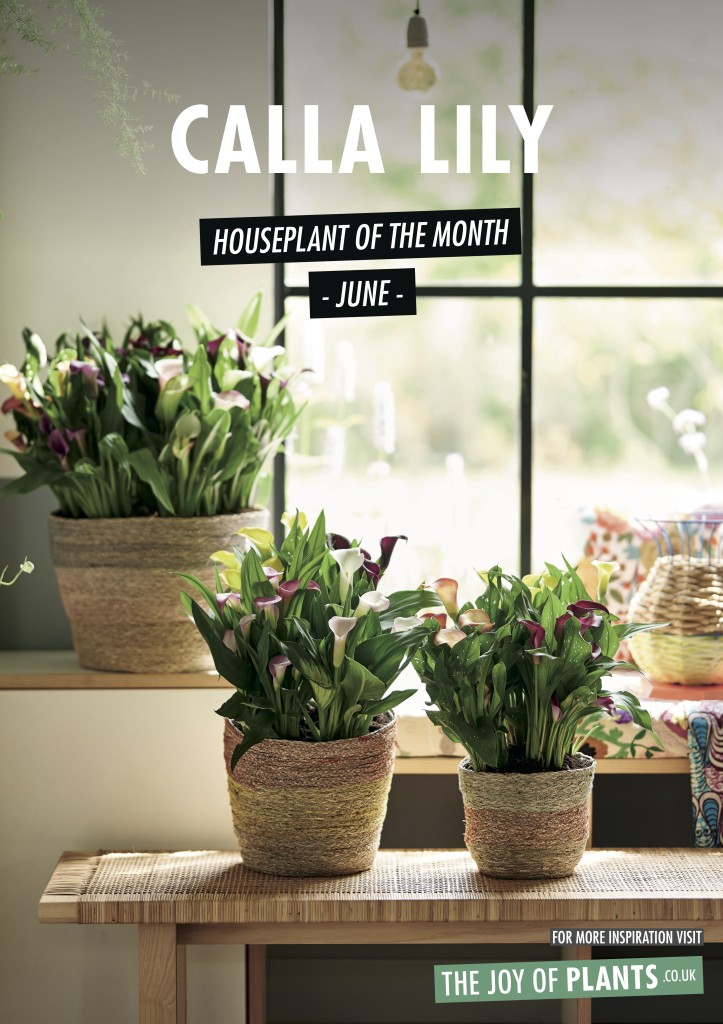
Their attractive often bright colors mean that callas work very well in cheerful ‘handmade’ interiors. The plant, which already appears to be a mixture of local and exotic, looks fabulous in artisanal pots with colorful ethnic patterns.
The Calla Lily can also be placed in a simple earthenware pot, which looks attractive on the balcony or patio (a gift idea for Father’s Day). The attractive shape of the spathe makes it a fabulous eyecatcher anywhere.
The Calla Lily also combines readily with other foliage and flowering plants.
Start a trend and grow a calla today!
Text adapted from a press release by Thejoyofplants.co.uk
Unless otherwise mentioned, photos from Thejoyofplants.co.uk.
Styling by Elize Eveleens, Klimprodukties.