


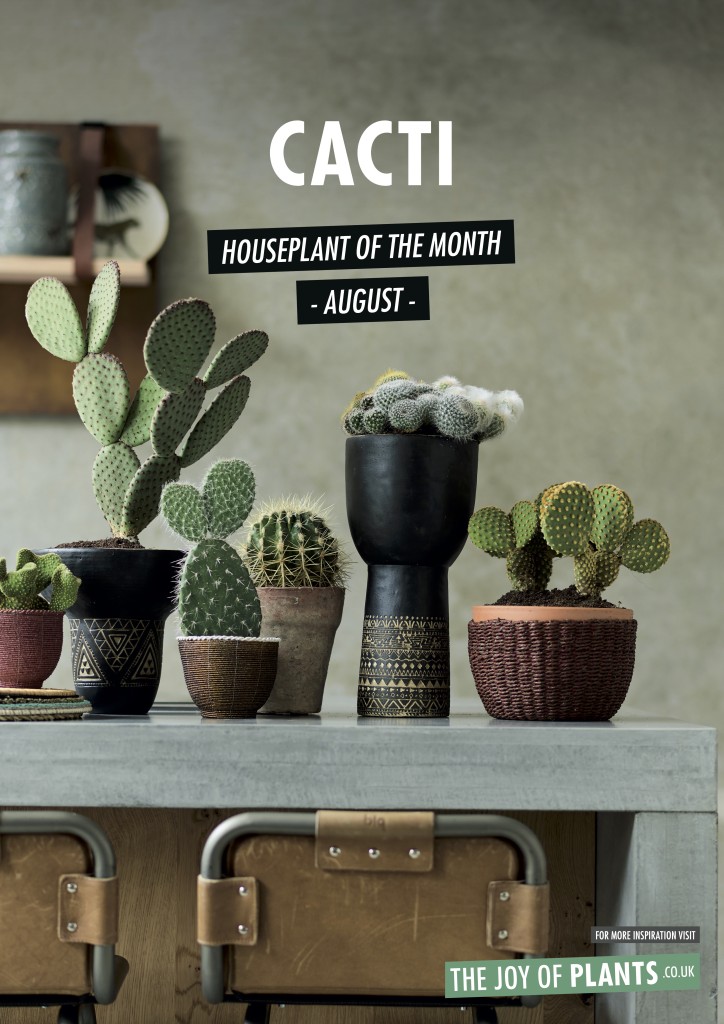
Whether it’s their trendy geometric shapes or their air of unapproachability, cacti are exciting houseplants that have a big impact on an interior decor and often live alongside their owners for decades. This classic plant’s comeback is particularly due to its (undeserved) reputation as needing no care as well as its unusual appearance.
Origin of Cacti


The spiky plants that we call cactuses or cacti (both plurals are acceptable) are from the Cactaceae, a large plant family native throughout much of North and South America, with a strong concentration in Mexico. The plants mainly grow in dry or desert regions where they have adapted brilliantly to the extremely arid conditions and positively thrive where most other plants would have trouble surviving.
The name cactus is derived from the Greek word “kaktos”, which means “spiky plant”. Every cactus is a succulent, but not all succulents are cacti. What cacti share with other succulents is the ability to store moisture in their thick fleshy stems. These reservoirs are used to bridge periods of drought.
Cactus roots may be confined in a pot in culture, but in the wild, they are far-reaching and are usually found just below the surface in order to slurp up as much water as possible during those rare rainy periods that allow them to grow.
Notice that, with very few exceptions, cacti have no leaves. They lost them as they adapted to growing under conditions of great aridity. Instead, they carry out photosynthesis via their green stems. The cactus’ outer skin has a layer of wax that minimizes evaporation.


What distinguishes cacti from all other succulents is that their stems bear areoles: the place where the leaves should actually be. These look like fuzzy little pads usually placed quite symmetrically on the stems. From these areoles grow spines, long hairs, new stems and, eventually, flowers. No other plant has areoles and looking for them is the best way to tell a cactus from other stem succulents, like euphorbias.
Cacti have been cultivated for centuries, as outdoor plants in mild climates, but elsewhere mostly as houseplants. That said, there are hardy cacti, some tolerant of extreme cold, but most cactus species are best grown as indoor plants everywhere outside of the very mildest climates.
What to Look for When Buying Cacti


- Price is largely determined by size. Small cacti are less expensive than large ones as they cost less to ship. Some cacti are naturally small and will always remain so; others will grow considerably over time. If you want a small cactus that will grow large, a young columnar cactus (see below) would make a good choice.
- Age is also a factor in pricing. Cacti that take years to grow to a saleable size will cost much more than fast-growing cacti. That often explains why two similar-sized cacti can have such a difference in price.
- Check that the cacti are free of mealybugs on both the plant itself (the body) and the root system. With their woolly white waxy coating, these oval sap-sucking insects are one of the most common pests in cactuses and are difficult to get rid of. Leave infected plants in the store.
- Also check for red spider mites (looking like dust particles moving over fine webbing), aphids, scale insects and thrips.
- Check for damages to the plant’s stem and make sure that the root system is intact. If the plant has been kept too wet for a long time, it may show a soft spot at the base of its stem, the first sign of rot caused by fungi and bacteria. Avoid such plants.


- Look at any cactus flowers with suspicion. Often such blooms are simply dried strawflowers glued onto the stem and the glue used permanently damages the plant. To check, gently push the petals upward and check underneath the blossom. Real cactus flowers will be attached to the main stem by a shorter, usually spiny stem, not by glue.
- If you want a cactus that will bloom readily, ask the clerk to help you choose. Many cacti are reluctant to bloom indoors.


- Be wary too of plants with oddly colored spines. White, golden yellow, gray and brown are normal spine colors, but purple, blue, orange, fluorescent yellow, etc. are not. It has become popular to “enhance” cacti by spray-painting them. This is harmful to the plant and such plants should be left in the store.


- Avoid cacti planted in terrariums and bell jars. With no drainage hole, they are almost impossible to water, and they hate the high humidity and poor air circulation found there. They usually die slowly over a period of several months.
- Spiny cacti can be hard to handle. Have the clerk handle and wrap your plant for you.
Cacti Range
With some 1,800 species, the range of cacti is enormous and extends from tiny sleek shapes through bizarre massive pillars, and from soft gray hairs through to big sharp spines. Many cacti are sold in mixed trays, particularly the smaller sizes. The species that are most commonly sold by name are Echinocactus, Ferocactus, Gymnocalycium, Opuntia and Mammillaria.


Succulent Euphorbia species closely resemble cactuses and are often sold in the same mixed trays. It’s easy to spot the difference: euphorbias thorns grow directly out of the green body, while those of cactuses they grow out of the areoles, the fuzzy bumps mentioned above. Also, many euphorbias have small leaves while cactus rarely do.
Desert Cacti or Forest Cacti?


Most cacti are desert dwellers or at least adapted to intense sun and arid conditions. These usually have the thickest stems, abundant spines or hairs, and will require full sun and well-spaced watering indoors. They are listed below as (dc).


Another group of cacti lives in forests in the wild. Most are epiphytes (grow on tree branches) and have thin or flattened branches, few or no spines and a trailing habit. In culture, they require less light and more regular waterings, more like a spider plant than a typical cactus. Below, they are indicated by the abbreviation (fc).
A Wide Range of Shapes
Cacti can be classified by genus, origin or shape. The following groupings can give you an idea of their shapes:


- Prickly pears, also called beavertail or bunny ear cactus (dc): They have flattened, paddle shape pads. Only the genus Opuntia has this form. They have either long spines or apparently no spines at all. Beware, though, as their seemly innocuous areoles hide tiny spines called glochids that break off and penetrate the skin.


- Columnar cacti (dc): Upright shapes that start small and develop a real pillar shape later (Pachycereus, Cereus and others).


- Globe cacti (dc): Attractive globe shape. May grow individually or in columns. (Echinocactus, Mamillaria).


- Trailing cacti (dc and fc): With long stems arching down (Aporocactus, Rhipsalis).

- Orchid cacti (fc). Epiphytic cacti with spreading, trailing, triangular or flat stems, usually spineless (Epiphyllum, Selenicereus). Grown for their huge flowers (seasonal).


- Holiday cacti (fc): Arching, flattened, spineless stems bearing bright flowers at Thanksgiving, Christmas and Easter (Schlumbergera).

- Crested cacti (dc): Mutated cacti taking on a brainlike shape (Mammillaria elongata ‘Cristata’ and many others).

- Grafted cacti (dc): Two species grafted onto one another. Often the top cactus (Gymnocalycium), brilliantly colored (red, pink, orange, yellow, etc.) is actually an albino and can’t grow on its own.
Care Tips


Cacti are often said to be easy-to-grow plants that will thrive anywhere. This myth is largely based on their capacity to “hold on” for months, sometimes even years, even under the most inappropriate conditions. Even as the owner is pleased with the results, the plant is often dying, living on its reserves, but not clearly showing its distress. When death finally comes, it often stuns the owner.
If treated as a throwaway plant, designed to be tossed into the trash when it stops looking good, a cactus can be placed anywhere, sun or shade, in heat or in cold. Water it when you feel like it or not at all. If you find that acceptable, why not buy a plastic plant? It will last longer and won’t have to suffer a lingering death.
Here are some tips on how to really keep cacti happy and healthy:


- Desert cacti require intense light (full sun), especially spiny and hairy ones. Forest cacti, like holiday cacti, tend to be better choices for lower-light situations. Given the proper light, most cacti are easy to maintain and can live for decades.
- But proper watering is also necessary. Desert cacti will not tolerate overwatering and have to be allowed to dry out thoroughly before watering again. So, benign neglect is best. If you’re not sure whether a cactus needs watering, it probably doesn’t. Lift the pot to tell: it will be considerably lighter when it is fully dry. Or use a moisture meter, watering only when the dial is well into the red zone (dry).
- Water forest cacti more regularly, although still only when the soil is dry to the touch. You can water them when the soil is barely dry rather than waiting until it is bone dry.
- When you do water, do so thoroughly, soaking the root ball, although never letting the plant sit in water. Giving just a spoonful or two of water at a time is a common error and causes long-term stress.
- Cacti can tolerate hot, sunny spots in the summer and also thrive outdoors on the patio or balcony. They prefer cool conditions, although still with intense light, in the winter. A cold, dry winter, down to nearly freezing, can encourage some desert cacti to bloom.
- Cactus are very tolerant of negligence and can be left on their own with no care at all on a bright windowsill when you’re absent. All will tolerate at least a month without watering; desert cacti, often 5 months or more, making them an ideal choice for Snowbirds.
- If the plant needs repotting, use a well-drained, fairly nutrient-poor soil. Special cactus soil is available for this. Since cactus don’t tolerate overwatering, the pot must have a drainage hole.
- Place the prickly cacti in a safe place if there are children or pets around. Those spiny can be nasty!
Display Tips


- One cactus is never enough! The plants speak to the imagination best if different species are displayed together.
- Cacti make great choices for a student room or an office, as they can tolerate long periods of negligence.
- The various sizes on offer—from mini to massive—make them ideal gifts.
- Cactus gardens combining various species are attractive and exotic. They do best in open bowls rather than terrariums.

- Cacti can be used both in traditional interiors and in a modern setting. A folkloric look is the bang-on trend and doesn’t need to be restricted to South American decors. Artisan pots with folklore patterns and colors create a cheerful setting for the rather stoical cactus.
- The plants can also be used for certain summer or holiday themes (beach, Mexico, indoor rock garden, etc.).
Enjoy your cactus and … long may it live!
Text adapted from a press release by Thejoyofplants.co.uk.
Unless otherwise mention, photos also by Thejoyofplants.co.uk.
Styling by Elize Eveleens, Klimprodukties