


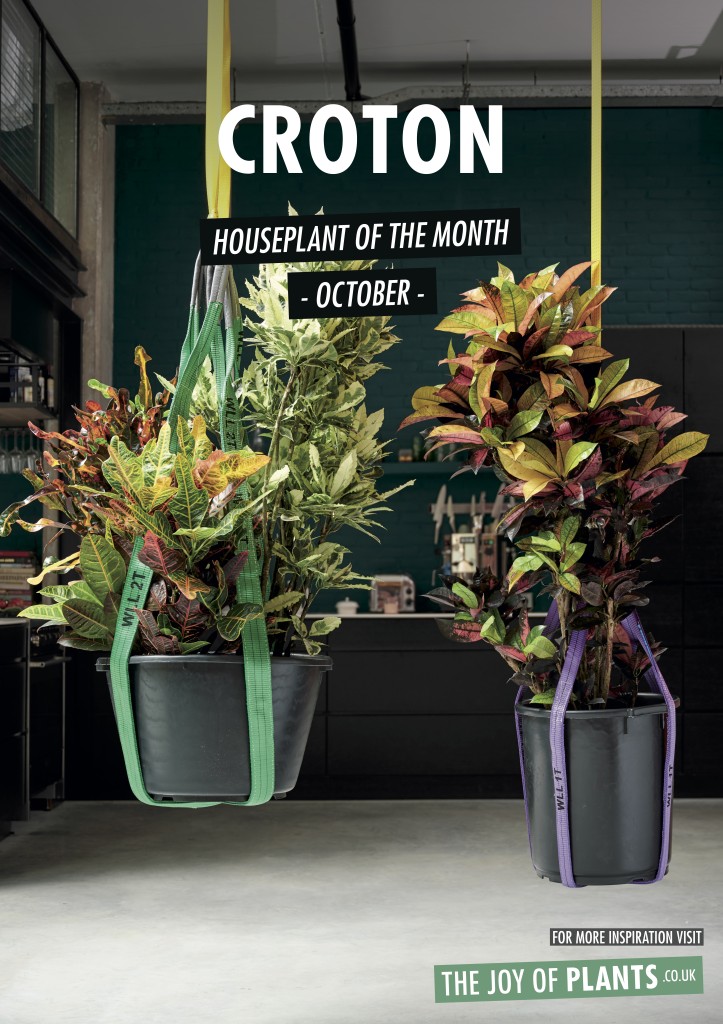
Green, yellow, red, orange, brown, purple, black—the flamboyant croton brings autumn’s glow into your home. It’s a very eye-catching plant with thick, shiny leaves that proclaim that Mother Nature had an exceptionally good day when she came up with this beauty.


The best-known crotons have multicoloured leaves, but there are also varieties with just yellow and green markings. The leaf color often changes as the leaves mature. You have the choice of leaves: small or large, broad or narrow, entire or lobed, violin or spatula-shaped and so much more. Some even have leaves twisted into spiral!


Crotons also bloom indoors, with narrow stems of puffy white male flowers and rather stark female ones borne separately on the same plant. They’re much less attractive than the leaves and some people simply cut them off.
Origin


The croton comes originally from southeast Asia, the Pacific islands and Australia, but is now grown worldwide in tropical countries where it’s a shrub or small tree often used as a hedge. It can become huge indoors as well, but most specimens sold are of modest size.
The plant’s botanical name is Codiaeum variegatum, but the name croton is so well established that it’s used almost universally. Variegatum, of course, means variegated or multicolored, a very appropriate epithet indeed for such a colorfully leaved plant!


The common name croton is derived from the Greek word “kroton”, which means “tick” and refers to the plant’s seeds, which look like ticks, although you’re unlikely to ever see seeds on plants grown indoors.
The genus Codiaeum belongs to the Euphorbiaceae family, which also includes other familiar houseplants such as the poinsettia (Euphorbia pulcherrima) and the crown of thorns (E. milii).
There is actually a genus called Croton in the same family, with more than 700 species including everything from annuals to trees, but the genus Codiaeum is much smaller, just 17 species, all leathery-leaved shrubs. Our croton (Codiaeum variegatum) is the only one commonly grown.
Croton Range


There are literally hundreds of varieties of croton, although only a few dozen are commonly seen in garden centers. Some large-leaved cultivars are: ‘Excellent’, ‘Petra’, ‘Norma’, ‘Mrs. Iceton’, ‘Nervia’, ‘Tamara’ and ‘Wilma’. Small-leaved cultivars include: ‘Gold Star’, ‘Gold Finger’, ‘Gold Sun’, ‘Mammi’ and ‘Yellow Banana’.
What to Look for When Buying Crotons


- Choose a specimen where the plant, its structure and its pot are in proportion.
- Decide what form pleases you: some are treelike with a thick trunk that can be single, braided or twisted into a corkscrew, others are grown as shrubs with multiple branches right to the base and still more are grown as a “tuft”: several plants of one cultivar in a single pot.
- The plant should be well rooted and have sufficiently hardened leaves. Avoid plants with brown leaf tips or edges, a sign of insufficient humidity.
- If possible, reserve your croton when it arrives in the store, but don’t take it home right away. It will have traveled to the garden center from a hot, humid tropical country and needs to adapt to indoor conditions in your area and will do so better in a garden center greenhouse than your living room. So, arrange to pick it up a month or two later; by then it will be thoroughly acclimatized.
- The plant must be free of pests and diseases. Especially look out for mealybug and scale insects.
- The croton is very sensitive to cold and will drop its leaves at temperatures below 55 °F (13 °C). It will even die if left at such temperatures too long! During the cold months, make sure the plants are carefully wrapped in a sleeve for transportation home.
Care Tips


- The croton prefers bright light or full sun. It will adapt to medium light, although will be less colorful there.
- Water when the soil is slightly dry to the touch, but never allow the soil to dry out completely. Watering with cold water in winter can cause leaf drop.
- Crotons will (eventually) adapt to fairly low atmospheric humidity, but ideally, you’d grow them in room where the air is humid at all times. Thus, a humidifier would be wise.
- Croton leaves remain on the plant for several years and can therefore pick up dust. They appreciate a good shower every now and then or, in the summer, can also be placed outside in the rain.
- Remove yellow or damaged leaves.
- If the plant becomes too tall or less attractive, prune it back. It’s best to do this at the end of winter or in early spring.
- Fertilize lightly with an all-purpose fertilizer from spring through fall.
- Although it prefers warm temperatures at all times, a croton will do well in a cooler room (but never below 55 °F [13 °C]) during the winter months, in which case it will need less frequent waterings until temperatures warm up.
- During the summer months, you can move your croton to the patio or balcony, acclimatizing it gradually to full sun, provided that the temperature does not drop below 55 °F (13 °C).
- Crotons can be multiplied by stem cuttings or air layering. They’re very slow to root and require rooting hormones and warm temperatures, so are best rooted under glass in the spring or summer.


The sap of the croton is mildly poisonous, so keep it out of reach of children and pets.
Preventing Leaf Drop
Crotons react badly to change, dropping their leaves by the dozens as a sign of protest, which is why it is best to buy an acclimatized plant (see What to Look for When Buying Crotons). However, that isn’t always possible, so you may have to acclimatize your own plant. And that’s easy enough to do.


Simply enclose it inside a large transparent plastic bag (a bag recuperated from the cleaners or a transparent trash bag would be perfect). Or build a frame around it and cover the frame with sheets of transparent plastic. This will create an individual greenhouse where the humidity automatically will be very high, just what it needs as it adapts to local day length and light intensities. You won’t likely need to water your croton while it’s in its greenhouse.
Temporarily move the plant away from direct sun, or it will overheat inside its shelter. You’ll be able to move the plant nearer to the window at the end of the treatment.
Keep your croton “under glass” for a month or so, until leaf drop stops, then gradually remove the greenhouse cover over a week or two so it can complete its acclimatization.
Display Tips


The croton fits with the urban interiors trend that rejects the perfectible world and embraces a hint of street culture with its bright colors. Display it in a recycled tin can, in a rubber pot made out of recycled car tires or in a container that is as colorful as the plant itself.
It can be industrial and bold to make the croton a contemporary showstopper.
The croton: yours to discover!
Text and photos, unless otherwise mentioned, adapted from a press release by Thejoyofplants.co.uk.
Styling by Elize Eveleens, Klimprodukties