


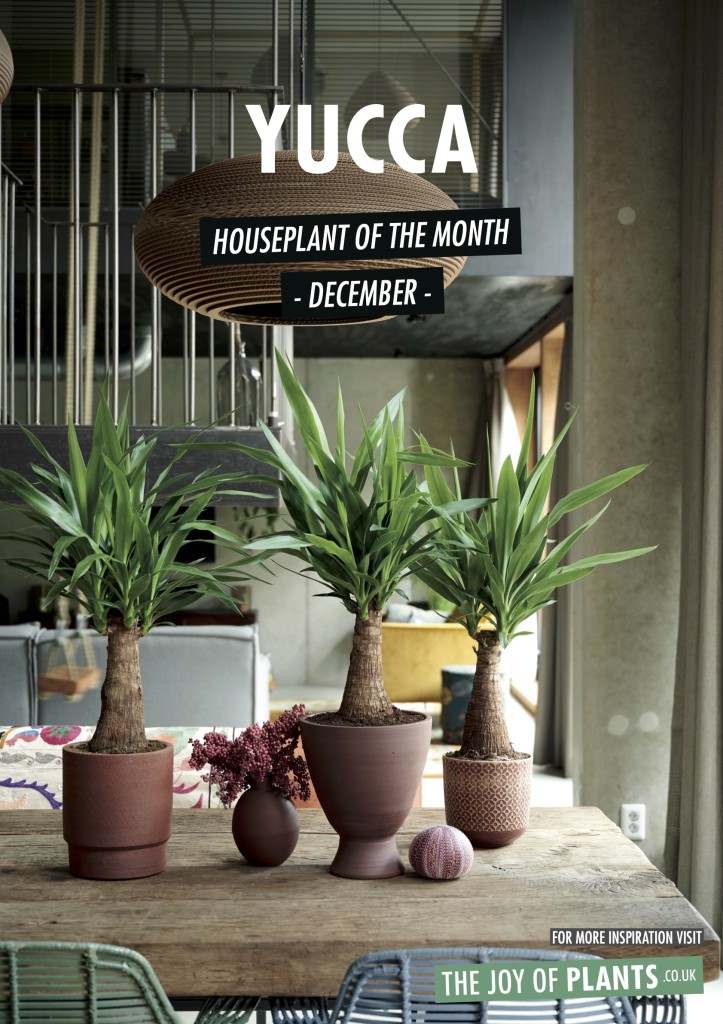
The Story of the Yucca
The yucca is a member of the asparagus family (Asparagaceae), belonging more specifically to the Agavoideae subfamily, which also includes another well-known houseplant, the agave (Agave spp.).
In the wild, yuccas grow in hot dry regions in North and South America and the Caribbean. The plants usually have thick, leathery sword-shaped leaves with a sharp tip and dense stems of white flowers. The leaves may grow as a ground-hugging rosette or on single or branching stems.
Origin of the Yucca

The common houseplant yucca is the spineless yucca, Yucca gigantea (although it is sold as Y. elephantipes in the trade), with unusually soft and flexible leaves (for a yucca), lacking the usually nasty spine at the leaf tip. It’s also a tall, treelike yucca up to 20 feet (6 m) in height, with a thick brown trunk often cloaked in dead leaves in the wild. Over time, the base can become swollen like an elephant’s foot.
Spineless yucca plants are commonly grown on coffee plantations in Central and South America where they provide shade for coffee plants. They’re also used as living fences, planted closely together in a hedgelike fashion.
Since spineless yuccas can grow about 1 foot (30 cm) a year, they eventually require pruning. Thus, the top of the plant is chopped off with a machete, the trunk is cut into sections and the pruned stems are then often shipped to European or Floridian greenhouses, planted in a pot, rooted and, after leaf rosettes have formed, the resulting yuccas are sold as houseplants.


Did you know … that the flower of the spineless yucca is edible? It’s sold under the name izote in Central America. It’s also the national flower of El Salvador.
Photo: zoom50.wordpress.com
What to Look for When Buying a Yucca

- Size: The pot size should be correctly proportioned in relation to the number of heads per stem or stems per pot, the shape of the stem, the height of the plant and the age of the plant.
- Growth Habits: Several different forms of spineless yucca are commonly available. It may be a single stem with just one cluster of leaves on top, a stemless rosette not yet having formed a trunk at all, a tuft (several plants planted together in a single pot), branched (two or more side branches at the top of the main stem) or, more rarely, a thick, elephant foot stump with multiple shoots.
- Roots: Since yuccas are started from thick stem cuttings set into a pot, they can sometimes be poorly rooted. Give the plant a bit of a tug to make sure it is solidly rooted into its container.
- Leaf Tips: There should be no leaf tip damage longer than ¼ in (5 mm).
- Health: The plant should be healthy, free of pests and diseases. Particularly look for mealybugs, scale insects and stem borers.

- Stem Head: The cut head of the stem is probably sealed in wax. This was applied in order to prevent rot caused by moisture or water penetration under greenhouse conditions and is not a sign of damage.
Other Yuccas

There are some 40 to 50 species of yucca, most notable for their rosettes of hard, tough, spiny-tipped leaves (the spineless yucca is among the few species with a soft, spineless leaf), but few are offered as houseplants, probably because of their nasty leaf tips, although you do see Spanish bayonet (Y. aloifolia) and beaked yucca (Y. rostrata) in specialist nurseries.
Several species are commonly grown in outdoor gardens, though, especially weak-leaf yucca (Y. flaccida) and Adam’s needle (Y. filamentosa), both adapted to USDA hardiness zones 5 to 10. Soapweed yucca (Y. glauca), the northernmost species, native as far north as Alberta and Saskatchewan, is even hardier, from zones 3 to 10.

There is also several variegated forms of spineless yuccas, such as Y. gigantea ‘Variegated’, with variable yellow stripes, and ‘Jewel’, with broad cream-colored edges.
Care Tips
The bigger and thicker the stem, the easier the plant is to look after.

- A yucca needs bright light to full sun. It will tolerate low light for years, but will slowly decline if so treated. Weak, pale new growth and stems that are thinner towards their tip than at their base are sure signs the plant is not getting the light it needs.
- It’s a succulent, so water thoroughly, but then let the soil dry out well before watering again. Do not keep the soil evenly moist: that can lead to stem rot.
- You can place your yucca outdoors in a sunny spot between May and October, depending on your local climate. Allow the plant to acclimatize to the sun in order to prevent scorching.

- During the winter, you can keep it at normal room temperatures or move it to a cooler spot (down to 50?F/10 C), in which case it will require even less frequent watering.
- Remove yellowing or unsightly leaves.
- Repot as needed into larger, probably heavier pots, as spineless yuccas tend to become top-heavy over time. You can use cactus and succulent mix or any well-drained potting soil. Repotting is best done from late winter to late summer.
- If your yucca becomes too large, don’t hesitate to prune it, preferably towards the end of winter, although this may require a saw! It will produce new branches from below the wound. There is no need to seal the cut end with wax or pruning paste: there is little danger of stem rot under average home conditions.
- Stems removed during pruning can be easily rooted in potting soil (not in water!) to form new plants, although rooting can take months.
- The plant is very unlikely to ever flower under indoor conditions.
Display Tips for Spineless Yucca

Its robust nature and easy care make the yucca an ideal plant for those who lack green thumbs. It’s a great gift for student dormitories, as it can tolerate quite a bit of neglect.
Yuccas look good in a rugged stone pot. To make the plant utterly trendy, consider boho chic: placing it in a colorful cachepot with an ethnic design.
Article based on a press release by Thejoyofplants.co.uk.
Unless otherwise mentioned, photos from Thejoyofplants.co.uk.
Styling by Elize Eveleens, Klimprodukties.