


By Larry Hodgson
Most climbing plants cling to their support by twining, that is wrapping themselves around it. And most twining plants will readily climb fairly thin supports, but can’t always twine around a thick pole, a tree trunk or even the fairly wide bars of many trellises.

Most vines with twining stems, such as morning glories and pole beans, prefer supports that are no more than 1 ½ inches (4 cm) in diameter.

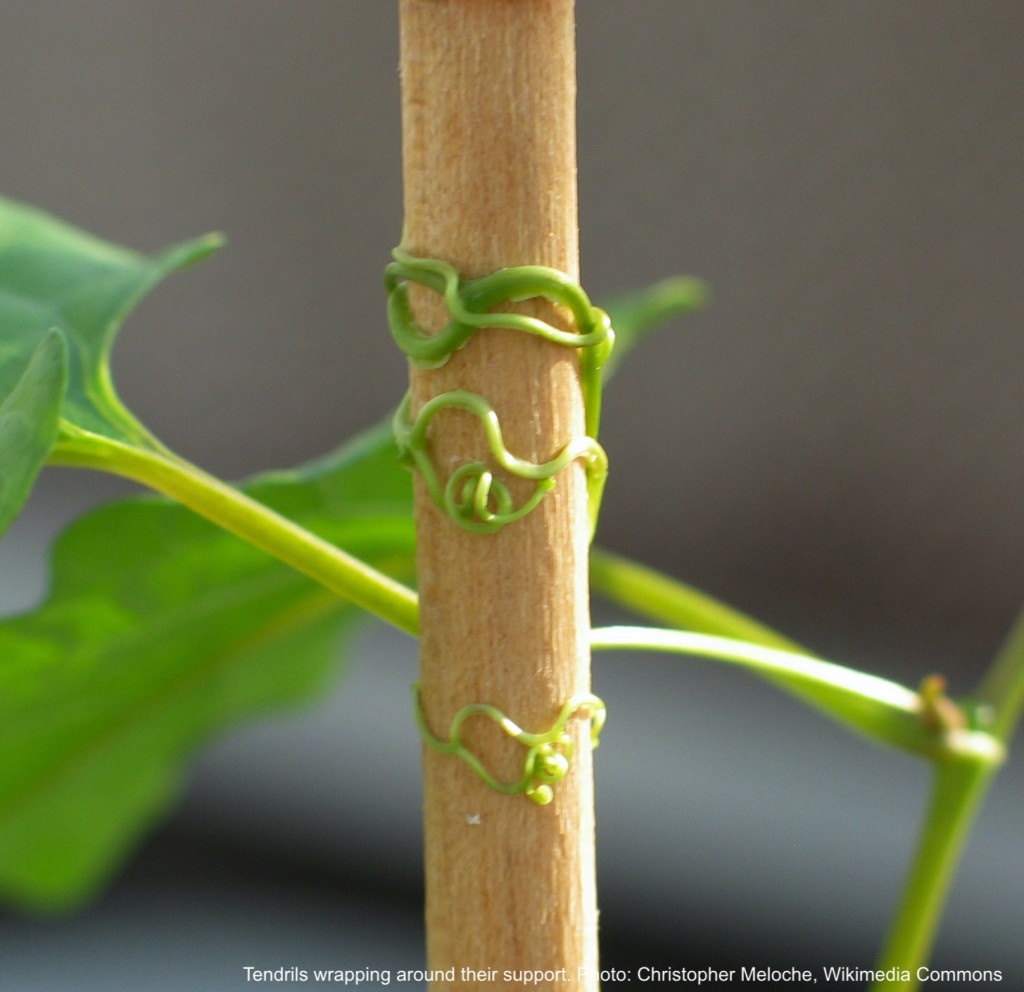
As for vines that climb by means of tendrils (specialized threadlike stems that twist like a corkscrew), such as peas, grapes and clematis, most are even less capable of clinging to thick supports: ¼ inch (5 mm) is about the widest they can handle.

In spite of this obvious need for thin supports, many if not most supports sold for climbing plants (trellises, obelisks, pergolas, etc.), although in theory designed for vines, are simply too thick for them to cling to, forcing the gardener to attach them to their support by other means, with clips, twist ties or pieces of old pantyhose.
An even easier solution is to fix metal or plastic mesh (like garden netting or bird netting) to the support. Vines will climb netting with no difficulty. Or simply run a taut cord or wire from the ground to the top of the support so they can wrap around that.
But why should you have to work at fixing a design flaw in a commercial product? Make your life easier by choosing an appropriate support from the start: one with poles or bars that are thin enough for vines to wrap around them all on their own. Bring your measuring tape next time you shop for a trellis: think 1 ½ inches (4 cm) for twiners and ¼ inch (5 mm) for tendril climbers.
In gardening as it any other activity, you’ll always have less work to do when you use the right tool!
Article derived from one first appearing in this blog on June 8, 2015.