


By Larry Hodgson
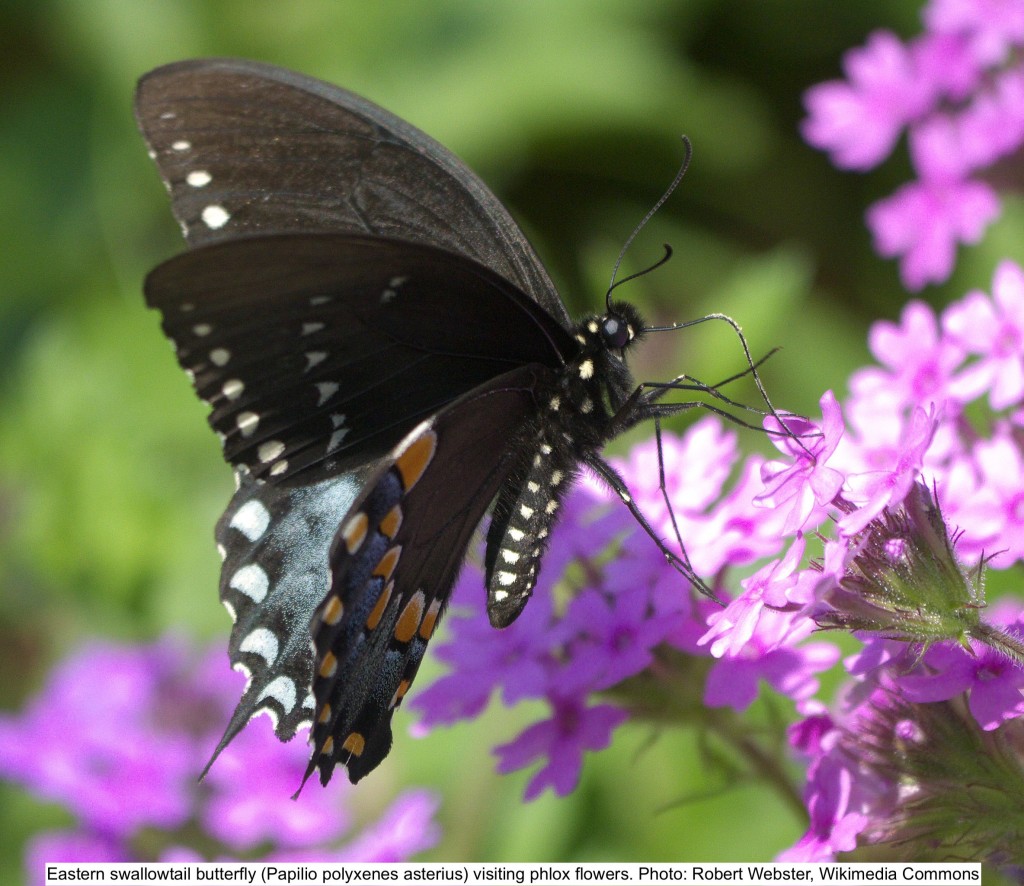
Like all good pollinators, butterflies have preferences about the flowers they visit. In particular, most are less adept than bees and hummingbirds at flitting from flower to flower, a movement that requires quite a bit of energy. They therefore prefer flowers where they can perch for a while, flowers that contain nectar that they can slurp up slowly rather than in a mad rush. That’s why they favour clustered flowers.

Asteraceae flowers (daisies, coneflowers, zinnias, etc.) are the perfect example of what a “butterfly flower” looks like. Each “bloom” may look like a single flower, but is in fact a composite flower, that is an inflorescence composed of a dense disc of fertile florets in the center (disc flowers) and surrounded by sterile flowers called ray flowers. Ray flowers evolved specifically to attract the attention of insects like butterflies: first their color draws butterflies from afar, then they are placed in a ring all around the fertile florets, allowing them to act as a landing platform. When a butterfly alights on the platform, it’s offered a large number of fertile florets filled with nectar. So, it stays there awhile, dipping its proboscis into floret after floret. And as it drinks, the butterfly is covered with pollen that will fertilize the next inflorescence it lands on.

Obviously, it’s not just plants in the Asteraceae that have grouped flowers and pretty much any plant with that feature will attract butterflies. Flowers with umbels (dome-shaped clusters), notably, like those of wild carrots, milkweeds, and clovers, will also attract butterflies.
Finally, butterflies are also attracted to large flowers that are filled with nectar, like daylilies and lilies. Their enormous petals also make great landing platforms.
Perfume Helps Too
Most butterflies are also attracted to fragrant flowers. In general, butterflies prefer flowers with an intense, sweet fragrance over ones with a musky scent.
A List of “Butterfly Flowers”
There are literally thousands of flowers that you can plant to attract butterflies: here is a very partial list.
- Ageratum (Ageratum houstonianum) annual
- Allium (Allium spp.) hardiness zones 3–9
- Anise hyssop (Agastache spp.) variable hardiness zones
- Arabis (Arabis spp.) hardiness zones 4–7
- Aster (Aster spp., Eurybia spp., Symphyotrichum spp., ) hardiness zones 4–8
- Astilbe (Astilbe spp.) hardiness zones 4–8
- Aubrieta (Aubrieta deltoidea) hardiness zones 4–7
- Azalea (Rhododendron spp.) variable hardiness zones
- Bachelor’s buttons (Centaurea cyanus) annual
- Bee balm (Monarda spp.) hardiness zones 3–9
- Black-eyed Susan (Rudbeckia spp.) annual or hardiness zones 3–7
- Blanket flower (Gaillardia spp.) annual or hardiness zones 3–9
- Blazing star (Liatris spp.) hardiness zones 3–8
- Blueberry (Vaccinium spp.) variable hardiness zones
- Blue mist flower (Conoclinium coelestinum) hardiness zones 5–8
- Blue porterweed (Stachytarpheta jamaicensis) hardiness zones 9–11
- Bottlebrush (Callistemon spp.) hardiness zones 9–11
- Buddleia (Buddleia davidii) hardiness zones 6b–10
- Butterfly bush (Buddleia davidii) hardiness zones 6b–10
- Buttonbush (Cephalanthus occidentalis) hardiness zones 4–10
- Candytuft (Iberis spp.) annual or hardiness zones 3–8
- Carnation (Dianthus spp.) annual or hardiness zones 4–9
- Catmint (Nepeta spp.) annual or hardiness zones 4–8
- Chrysanthemum (Chrysanthemum spp.) annual or variable hardiness zones
- Cleome (Cleome hasslerana) annual
- Clover (Trifolium spp.) variable hardiness zones
- Common lilac (Syringa vulgaris) hardiness zones 2b–7
- Coneflower (Rudbeckia spp.) annual or hardiness zones 3–7
- Coreopsis (Coreopsis spp.) annual or hardiness zones 3–9
- Cosmos (Cosmos bipinnatus) annual
- Dahlia (Dahlia spp.) tender bulb
- Daisy (Leucanthemum spp.) hardiness zones 3–9
- Dame’s rocket (Hesperis matronalis) hardiness zones 3–9
- Dandelion (Taraxacum officinale) hardiness zones 3–9
- Daylily (Hemerocallis spp.) hardiness zones 3–9
- Dill (Anethum graveolens) annual
- Echinacea (Echinacea purpurea) hardiness zones 3–8
- Egyptian starcluster (Pentas lanceolata) annual or hardiness zones 9-11
- False aster (Boltonia asteroides) hardiness zones 3–10
- False indigo (Baptisia spp.) hardiness zones 4–9
- Fennel (Foeniculum vulgare) hardiness zones 5–9
- Fleabane (Erigeron spp.) annual and hardiness zones 3–7
- Gaillardia (Gaillardia spp.) annual or hardiness zones 3–9
- Globe thistle (Echinops ritro) hardiness zones 3–8
- Golden alexanders (Zizia aurea) hardiness zones 3–8
- Golden dewdrop (Duranta erecta) hardiness zones 9–11
- Golden marguerite (Anthemis tinctoria) hardiness zones 3–7
- Goldenrod (Solidago spp.) hardiness zones 3–9
- Helen’s flower (Helenium spp.) hardiness zones 3–10
- Heliotrope (Heliotropium arborescens) annual or hardiness zones 10–11
- Hollyhock (Alcea spp.) hardiness zones 3–9
- Honeysuckle (Lonicera spp.) hardiness zones 3–8
- Impatiens (Impatiens spp.) annual
- Indian hemp (Apocynum spp.) hardiness zones 3–9
- Joe Pye-weed (Eupatorium spp.) hardiness zones 3–8
- Lantana (Lantana camara) annual or hardiness zones 10–11
- Lavender (Lavandula spp.) hardiness zones 5–9
- Liatris (Liatris spp.) hardiness zones 3–8
- Lily (Lilium spp.) variable hardiness zones
- Lupine (Lupinus spp.) annual or zones 2–8
- Lychnis (Lychnis spp.) hardiness zones 3–8
- Mallow (Malva spp.) hardiness zones 3–9
- Marigold (Tagetes spp.) annual
- Mexican sunflower (Tithonia rotundifolia) annual
- Mignonette (Reseda odorata) annual
- Milkweed (Asclepias spp.) variable hardiness zones
- Nasturtium (Tropaeolum majus) annual
- Nepeta (Nepeta spp.) hardiness zones 4–8
- Pansy (Viola × wittrockiana) annual or hardiness zones 5–9
- Passionflower (Passiflora spp.) hardiness zones 9–11
- Pearly everlasting (Anaphalis margaritacea) hardiness zones 3–8
- Petunia (Petunia × hybrida) annual
- Phlox (Phlox spp.) annual or hardiness zones 3b–8
- Pincushion flower (Scabiosa spp.) annual or hardiness zones 3–9
- Pink (Dianthus spp.) annual or hardiness zones 4–9
- Primula (Primula spp.) variable hardiness zones
- Privet (Ligustrum spp.) variable hardiness zones
- Pussytoes (Antennaria spp.) hardiness zones 2–9
- Rhododendron (Rhododendron spp.) variable hardiness zones
- Rudbeckia (Rudbeckia spp.) annual or hardiness zones 3–7
- Rue (Ruta graveolens) hardiness zones 4–8
- Ruellia (Ruellia spp.) annual or hardiness zones 6–8
- Russian sage (Perovskia spp.) hardiness zones 3–9
- Sage (Salvia spp.) annual or variable hardiness zones
- Scabiosa (Scabiosa spp.) annual or hardiness zones 3–9
- Sedum (Sedum spp.) variable hardiness zones
- Spider flower (Cleome hasslerana) annual
- Staghorn sumac (Rhus typhina) hardiness zones 3–8
- Sunflower (Helianthus annuus) annual
- Sweet alyssum (Lobularia maritima) annual
- Thistle (Cirsium spp.) hardiness zones 2–8
- Verbena (Verbena spp.) annual or hardiness zones 3–8
- Viburnum (Viburnum spp.) variable hardiness zones
- Violet (Viola spp.) variable hardiness zones
- Viper’s bugloss (Echium spp.) annual or hardiness zones 4–9
- Yarrow (Achillea spp.) hardiness zones 3–8
- Zinnia (Zinnia spp.) annual

In closing, attracting butterflies can be even simpler than following a list of flowers. Simply plant more blooms, of any kind, and less lawn, and you’ll soon find yourself with a butterfly haven!
Article originally published on April 2, 2016.