


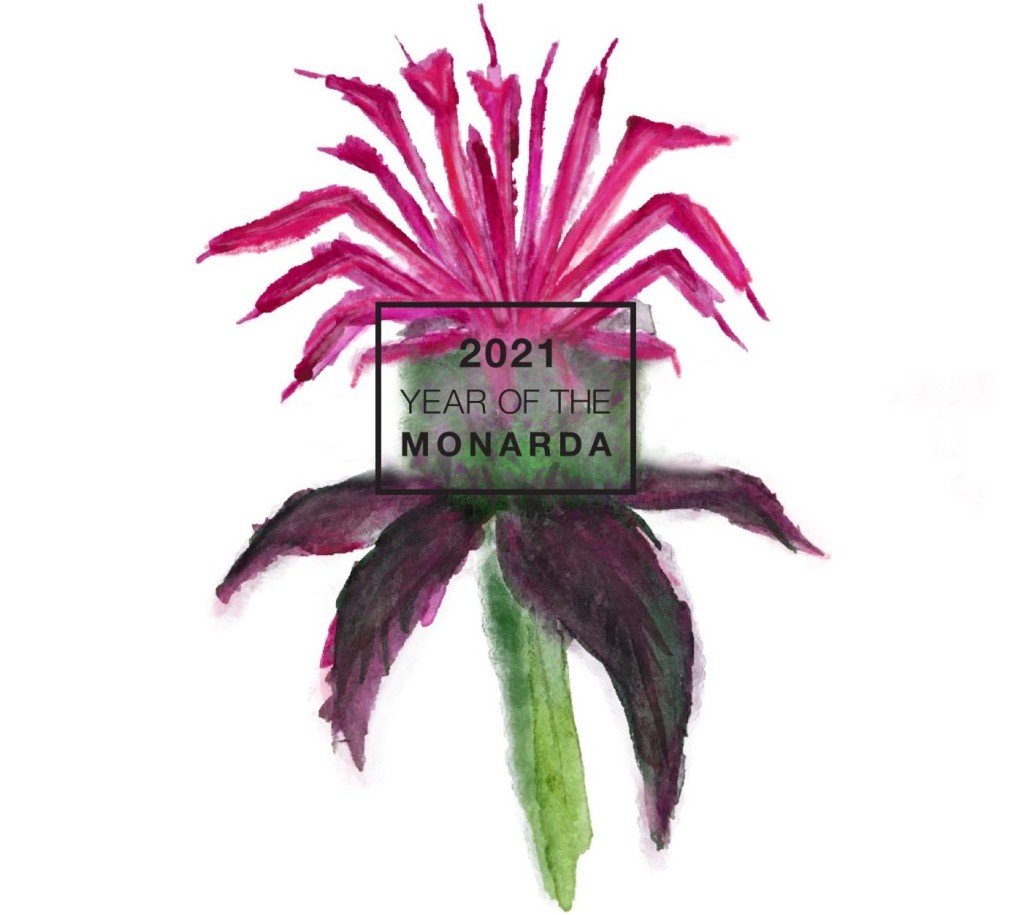
Every year, the National Garden Bureau, a non-profit organization promoting the pleasures of home gardening, selects one annual, one perennial, one vegetable, one shrub and one bulb to celebrate. It’s a great way to discover a new plant or to learn a bit more about a plant you may already be growing.
Let’s look at the perennial chosen for 2021, the monarda.

Monarda is a genus that has a long history as a medicinal herb. As the common name bee balm implies, it has also been used to soothe bee stings.
But did you know the Oswego Indian tribe used this plant to make an herbal tea and they taught the early American settlers how to do so as well? This just happened to come in very handy following the Boston Tea Party. As the settlers revolted against the British tax on tea, they drank tea made from monarda instead, thus thumbing their noses at the British and their taxes.
Monarda is a member of the mint family and consists of 16 different species, most of which are hardy perennials and all of which are native to certain regions of North America. Summertime flowering on all these species is quite attractive to humans and pollinators.


Monarda Species:

Monarda punctata, aka horsemint or dotted mint, is a somewhat unruly native prairie plant characterized by tall unbranched stems topped with rounded clusters of pink or lavender tubular flowers. The stacked combination of speckled flowers and colorful bracts make this distinctive and unusual.

Monarda fistulosa, or wild bergamot, is one species commonly used for medicinal purposes. Being highly aromatic with showy lavender-pink flowers, it is also used as a honey plant.

Monarda didyma (scarlet bee balm) has long been cherished for not only its use for tea, but also its ornamental value. The bright scarlet/red flowers of M. didyma are still a part of many ongoing breeding programs with monarda.

It has been a long road from these native species of Monarda to the prized ornamental cultivars available today. Some of the first hybrids of M. didyma × M. fistulosa produced vibrant flower colors with a more well-behaved plant, but they continued to be plagued by their native attributes of being highly susceptible to mildew, somewhat tall and leggy and had a tendency to spread by rhizomes.


Monarda New Varieties:
Modern breeding has introduced many new cultivars that are much more suitable in the ornamental landscape. Along with many stand-alone varieties with notable attributes of their own:

‘Marshall’s Delight’—Received Award of Merit from Royal Horticultural Society
‘Gardenview Scarlet’—Selected by the Chicago Botanic Garden as an outstanding perennial for the Midwest.
‘Petite Delight’ — The first of its kind dwarf introduction of monarda at just 12–15 in. (30–40 cm) tall.


Monarda didyma makes a great tea. It was a popular substitute for real tea (Camellia sinensis) after the Boston Tea Party. It’s also known as Oswego tea, named for the Oswego Native American tribe of New York, who used the leaves for tea.
There are several newer Monarda with formidable attributes:

- Monarda didyma Grand™ is from the Morden Breeding Program in Manitoba and an exceptionally hardy monarda. Characterized by a profusion of bright flowers atop mid-sized plants, these also offer very good mildew resistance.
- The Sugar Buzz monardas form a solid dome of color. The 2 to 2 ½-in. (5–6.5 cm) flowers top off the strong stems and deep green foliage of this series. Medium in height at around 20 in. (50 cm), the eight colors in this series display above-average mildew resistance and stay well contained in the garden.
- Balmy™ monardas have relatively large flowers on a fully compact plant. Balmy comes in at just 10–12 in. (25–30 cm) with exceptional mildew resistance and deep green foliage. They are dwarf and mounded and bring fun new uses to the landscape.


Monarda Home Gardening Tips:

- While some Monarda species come from seed, most newer selections are vegetatively propagated. This makes them easy to care for in rich and organic, or just average soils.
- Monarda will die back to the ground in colder climates. It is a good idea to remove dead leaves and stems from the area, especially if mildew has been observed on the foliage.
- As monarda emerges from the roots/rhizomes in the spring, pinching will create a bushier habit.
- In the full sun, they will produce a plethora of brilliant flowers beginning in mid-summer. Pair these with Achillea, Agastache, or Phlox for a smooth transition of garden color into fall.
- As flowers fade, deadheading is beneficial to encourage additional flowering.
- Don’t let them dry out. Drought stress is a main factor in the appearance of powdery mildew.
- Most monarda species are very hardy and will survive winters in climates as cold as USDA zone 3.
- Monarda makes a perfect addition to pollinator gardens, not only for its nectar-rich bright, beautiful blooms that attract not only attract bees, hummingbirds and butterflies, but also as a larval food source for several moth species including hermit sphinx, orange mint moth and raspberry pyrausta moth. In addition to the flowers attracting pollinators, they beckon other beneficial insects, such as parasitic wasps, that help reduce pest populations in the garden.
- The plant is deer and rabbit resistant.


Monarda brings a lot of charm and interest to the garden. En masse plantings in naturalized areas are a showstopper and create a high-traffic area for butterflies, hummingbirds, and bees.

Enjoy these as specimen plants paired with your favorite summer-into-fall bloomers in the middle of the garden. When they are in full flower (with a few to spare), you can pick a few flowers and leaves to make a batch of iced Bee Balm tea and watch the garden grow. Or dry some and save it for hot Oswego tea on a cold winter’s night!
This article was based on the Year of the Monarda fact sheet from the National Garden Bureau. All photos from the National garden Bureau.