


By Larry Hodgson
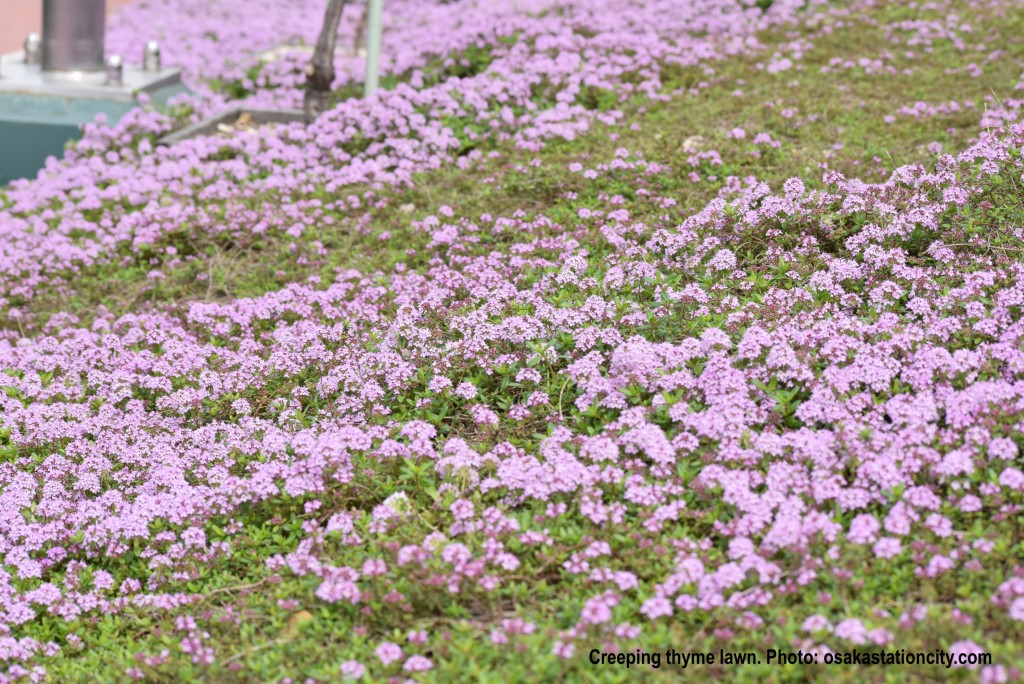
Tired of mowing your turf lawn again and again? Of fertilizing it repeatedly? Of treating it against its many enemies? Of constantly pampering it? Perhaps a lawn that doesn’t need mowing or fussy maintenance would better suit your needs … like a thyme lawn.
But is a thyme lawn really a good choice? Let’s take a look at the pros and cons of owning one.
Pros

A thyme lawn offers several advantages.
- Usually there is no need to mow a thyme lawn, at least in the case of groundcover thymes, although it may be useful to mow bushy types annually, after they finish flowering, for a more even effect. But, of course, that’s still only once a year compared to the dozens of mowings a turf lawn requires.
- It gives off a pleasant aroma when you walk on it.
- It remains green all year round.
- It blooms very attractively, whereas a turf lawn is flowerless, since it is mowed before it reaches flowering. (Even if it did bloom, the flowers of lawn grasses are not particularly attractive.)
- It tolerates poor, dry soils, growing very well in places, such as slopes and sandy or dry locations, where turf grasses fail to thrive.
- Once established, a thyme lawn doesn’t require any fertilization nor even watering, except in the driest climates.
- It is usually unaffected by harmful insects (such as white grubs and chinch bugs) and diseases.
- Unlike lawn grasses, thyme adapts quite well to saline soils, thus thriving along roads treated with road salt as well as near the seashore.
- It attracts a lot of bees, pollinators who are in difficulty these days and whose presence gardeners need to encourage. Their gentle buzz, so soft on the ear, is one of the joys of a thyme lawn!
Cons

As for the disadvantages of a thyme lawn:
- It requires full sun. Even in partial shade, it won’t be as dense nor as resistant to weed infestations.
- It needs perfect drainage. You simply can’t grow a thyme lawn successfully on a location that remains soggy for weeks in the spring or after the slightest rain.
- It’s more complicated to install than a turf lawn. After all, no nursery offers ready-to-install rolls of thyme sod such as you can readily find for a turf lawn!
- It costs more to install than a turf lawn. To start with, most people will have to remove their existing lawn before they even think about installing a thyme one and that costs time if not money. But even in a situation where you have in front of you a brand-new planting area devoid of vegetation and covered in soft, workable soil ready for planting, thyme will still cost much more than turf grass.
- It will take time (often 2–3 years) before a thyme lawn completely fills in.

- It is less tolerant of foot traffic than a grass lawn. Yes, you can walk on it, but you shouldn’t overdo it: places where you put your feet regularly will be damaged. It may therefore be wise to install pavers to act as stepping stones in places where foot traffic is repeated. And certainly, a thyme lawn won’t be able to support children’s game or sports the way a turf lawn can. There’ll never be a thyme lawn at Wimbledon, for example.
- A thyme lawn will attract a lot of bees. Of course, I listed that as an advantage, but it isn’t always one. For example, it wouldn’t be wise to walk barefoot on your thyme lawn when it’s in bloom. And if you are one of those people who is terrified of bees or allergic to their stings, don’t even think of putting in a thyme lawn: you’ll never feel comfortable with a large number of bees buzzing about right next to your patio!
Should You Start With Seeds or Plants?
You’ll have to make a few decisions if you do decide to install a thyme lawn. And the most important one is: are you going to sow it or plant it?

Seeds are the least expensive choice (although they still cost more than lawn grass seed), but take longer to establish (2 or 3 years) and most importantly, thyme seedlings sown on the spot can easily become infested with fast-growing weeds and will then require hand weeding
You can also buy thyme plants from the nursery (usually sold in 3-inch or 4-inch/7.5 or 10 cm pots) and transplant those to create a lawn, but you’ll need a lot of them (you need to plant them at a spacing of about 12 to 16 inches/30 to 40 cm). As a result, the price will be astronomical for anything by a very small lawn!

A great alternative is to buy plugs. These are young plants offered in trays (plug trays) with very narrow planting cells. Typical plug trays contain 84, 96 or 128 plants. These are much, much less expensive than plants in individual pots, yet the success rate is just as good, certainly better than with seed sown on the spot.
You rarely find plug trays of thyme in garden centers, though. You usually have to order them by catalog. For example, in Canada, Richters Herbs offers a wide choice as does Mountain Valley Growers in the United States. I would assume there are sources in the United Kingdom and Australia as well. Note that you’ll probably have to pre-order plug trays, so take into consideration the season when you intend to plant (spring or fall) and give the supplier at least an 8-week notice.
Or you can combine the two methods: buy seed and sow it indoors in plug trays in the spring, then acclimatize the plants to outdoor growing. This will give you plug plants ready to transplant into the ground in the fall.

Or buy a few pots of thyme, then take stem cuttings in the spring, rooting them in an appropriately sized plug tray, filling the cells with regular potting soil. Again, this will give you plenty of plants for fall planting at very little expense.
Installing a Thyme Lawn
Logically, you should sow or plant your thyme lawn either in the spring after all risk of frost has passed or in the fall, at least 5 weeks before the first hard frost is expected.

No matter whether you’ll be sowing or planting your thyme, you must still remove whatever is already growing on the site of the future lawn first. It’s unrealistic to think that you’ll be able to sow thyme or transplant thyme plants into an established lawn, even a sparse one. Lawn grasses (and the weeds that accompany them) will suffocate young thyme plants, as they won’t tolerate much competition, especially when they’re just getting started. You therefore need to start by making a clean sweep.
You can cut and remove sod with a spade, of course, but that’s quite an effort! Removing the existing lawn would be much easier with a rented sod cutter. In both cases, replace the layer of soil that was removed along with the sod by weed-free soil from a reliable source.
Or use the traditional laidback method just by covering the current lawn with cardboard or 7–10 sheets of newspaper to smother any plants already there, then cover this barrier with 6 inches (15 cm) well-drained, weed-free soil. (Read How to Sow a Low-Maintenance Lawn for more details on the technique.)
If you have decided to sow thyme seeds directly in the new lawn, sow lightly over the entire surface, broadcasting the seed by hand or with a spreader. You can lightly roll the soil with a rented lawn roller to ensure they’re well in contact with it, but don’t cover the seeds to any extent: they need sunlight to germinate. After that, just keep the soil moist until germination, which takes 15 to 30 days, and a little less moist (but never thoroughly dry) for the next month or so. After that, the seedlings will be able to take care of themselves.
If you are planting plugs, a spacing of about 8 inches (20 cm) should be fine. If you are transplanting “plants,” therefore more mature specimens, you can space them further apart—about 12 to 16 inches (30 to 40 cm), as they’ll give faster coverage. Young plants should be watered well after planting and for the following month if there is little rain. After that, as with seedlings, they should be well enough established to take care of themselves.
Do remember that any bare spots (and there will be plenty until the plants fill in!) will be subject to weed invasion. Hand weed while the unwanted plants are still seedlings to keep them in check.
Once the lawn fills in, there will be almost no maintenance to do.
Choosing the Right Thyme

There are plenty of varieties of thyme on the market and they can be found in two main categories:
- Groundcover thymes, that is, small plants with a distinctly creeping habit, such as creeping thyme (Thymus serpyllum), red creeping thyme (T. Coccineus Group) and woolly thyme (T. pseudolanuginosus). There are literally dozens of cultivars of creeping thyme, for example.
- Bushy thymes. They form a low rounded dome rather than a sprawling carpet. This group includes common thyme (T. vulgaris), broadleaf thyme (T. pulegioides) and lemon thyme (T. citriodorus).

If you think it would make sense to choose a groundcover thyme, one word of warning: these thymes are so low-growing (they rarely exceed 2 inches/5 cm in height) that weed seedlings often manage to germinate in among their rampant branches. Thus, they will require regular weeding, while bushy thymes, being taller (6 to 8 inches/15 to 20 cm), create a denser cover that unwanted plants find difficult to invade.
Helpful Hint

You can even mix different thymes in the same lawn to create a variegated effect, especially evident at the time of flowering. Such a multicolored thyme lawn is sometimes called a “Persian carpet.”
Most thymes are quite hardy and are suitable for areas USDA hardiness zones 3 or 4 to 8 or 9.
Now that you have a better idea of the possibilities, it’s up to you to decide if it’s time for a thyme lawn in your garden!