


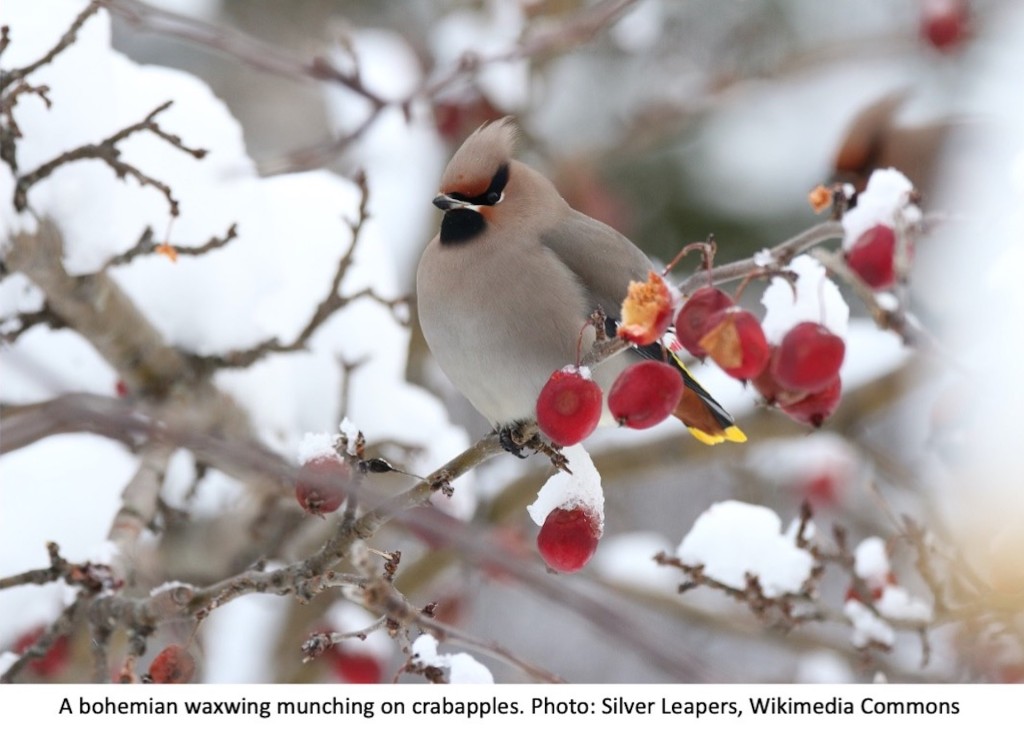
If you want to attract beautiful birds to your garden, feeders won’t suffice. You’ll also need to grow plants with berries.
By Larry Hodgson
Bird feeders are great for attracting seed-eating birds like chickadees, mourning doves, starlings, and sparrows. And of course, hummingbird feeders will attract hummingbirds. But there is a whole group of birds that most feeders just don’t reach: frugivorous or fruit-eating birds.

This group, which includes robins, mockingbirds, thrashers, tanagers, orioles, waxwings, and others, are particularly fond of berries and other small fruits. They also eat insects, especially during the summer, because that’s what they feed their young and thus need extra protein, but when the brood is gone, they start to look for fruit to eat again. If you can supply the berries they want, you’ll be able to draw them into your yard.
In the wild, wild berries abound: on the edges of fields, in clearings in woods, along streams, etc. In cities, though, more space is given over to asphalt and concrete than berry bushes and fruit trees. And in suburbs, the ever-present “green lawn” creates a bird desert that only a few worm-eating species will visit. But it’s easy enough to change that! Just integrate some of the following plants into your landscaping and you’ll see. To paraphrase the movie Field of Dreams, “if you plant them, they will come.”
A major plus is that berries are ornamental too, plus many of these plants offer beautiful flowers and often attractive foliage too, green in summer and brilliantly colorful in fall. Of course, many are also delicious … but you have a decision to make here: if you choose to harvest the berries yourself, you won’t attract birds!
Here are some fruit-producing plants—shrubs, trees, perennials and climbers—that birds love and are well worth trying in a temperate climate:

- Actaea spp. (baneberry)
- Actindia spp. (kiwi)
- Amelancher spp. (serviceberry)
- Ampelopsis spp. (porcelain vine)
- Arctostaphylos spp. (bearberry)
- Aronia spp. (chokeberry)
- Asparagus spp. (asparagus)
- Berberis spp. (barberry)
- Callicarpa spp. (beautyberry)
- Celastrus spp. (bittersweet)
- Chaenomeles spp. (Japanese quince)

- Cornus spp. (dogwood)
- Cotoneaster spp. (cotoneaster)
- Crataegus spp. (hawthorn)
- Elaeagnus spp. (Russian olive, silverberry)
- Empetrum spp. (crowberry)
- Euonymus spp. (euonymus, burning bush)
- Fragaria spp. (strawberry)
- Gaultheria spp. (wintergreen)
- Hippophae rhamnoides (sea buckthorn)
- Ilex spp. (holly)

- Juniperus spp. (juniper)
- Lonicera spp. (honeysuckle)
- Lycium barbarum (goji)
- Mahonia spp. (Oregon grape)
- Malus spp. (crabapple)
- Menispermum spp. (moonseed)
- Mitchella repens (partridge berry)
- Morus spp. (mulberry)
- Myrica spp. (bayberry)
- Nandina domestica (sacred bamboo, heavenly bamboo)
- Parthenocissus spp. (Boston ivy, Virginia creeper)
- Physocarpus spp. (ninebark)

- Phytolacca americana (pokeweed)
- Prunus spp. (cherry, chokecherry, plum, etc.)
- Pyracantha spp. (burning bush)
- Rhus spp. (sumac)
- Ribes spp. (currant, gooseberry)
- Rosa spp. (rose)
- Rubus spp. (blackberry, raspberry)
- Sambucus spp. (elderberry)
- Skimmia spp. (skimmia)
- Smilax spp. (sarsaparilla)

- Solanum spp. (tomato, bittersweet nightshade)
- Sorbus spp. (mountain ash, rowan)
- Symphoricarpos spp. (coralberry, snowberry)
- Vaccinium spp. (blueberry, lingonberry, cranberry)
- Viburnum spp. (viburnum)
- Viscum spp. (mistletoe)
- Vitis spp. (grape)
Text based on an article originally published in this blog on September 17, 2015.