


By Larry Hodgson
Why is it so many gardeners insist on trying to bring their herb plants indoors for the winter? Don’t they realize the poor plants are only going to go downhill? Most will be dead well before spring. Why do they mistreat their plants like that?

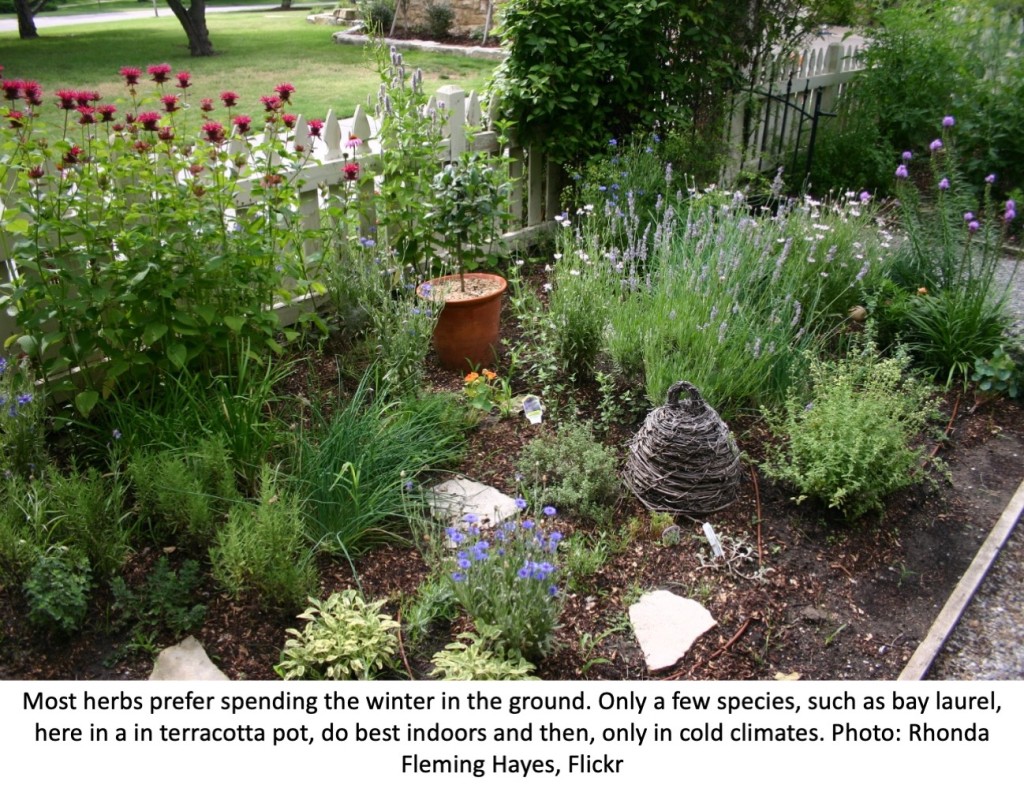
Most of the herbs we commonly grow are perfectly happy outdoors in the winter. They evolved in a temperate climate and do fine in the winter cold. What they don’t like is being brought indoors to low light, low air humidity and excessive heat (most need at least a reasonably cold winter in order to thrive).
A herb dragged indoors against its will usually looks alright for a month or two, perhaps giving you some hope, but by Christmas, decline will have set in. Leaves wilt and dry. Diseases suddenly appear. Insects show up out of nowhere. Soon, they’re pretty much ready for the trash bin. And even if you do manage to coax them through the winter, they’ll be in much worse shape than plants of the same species that spent the winter outdoors.
Exceptions
There are, of course, a few exceptions: herbs that do reasonably well indoors. Maybe they don’t put on much growth over the winter, but at least they don’t keel over. In its small but precious group, you find plants like bay laurel (Laurus nobilis), scented pelargoniums (Pelargonium graveolens and others), rosemary (Salvia rosmarinus, syn. Rosmarinus officinalis), Japanese coriander (Persicaria odorata), stevia (Stevia rebaudiana) and lemon verbena (Aloysia citrodora, syn. Lippia citriodora). These plants overwinter relatively well in the house in the winter, especially if you grow them under very bright artificial light, but most others would prefer staying outside in the winter.
Herbs That Like It Cold

The herbs listed below are perennials, biennials or even shrubs adapted to temperate climates. They prefer to spend the winter in the cold. Bringing them indoors stresses them and can even kill them. Even if they do survive this mistreatment, they won’t produce much in the way of useable herbage indoors.
| Plant | Hardiness zones |
| Angelica (Angelica archangelica) | 2 to 9 |
| Anise hyssop (Agastache foeniculum) | 4 to 8 |
| Caraway (Carum carvi) | 4 to 9 |
| Chives (Allium schoenoprasum) | 2 to 9 |
| Fennel (Foeniculum vulgare) | 6 to 9 |
| French tarragon (Artemisia dracunculus sativa) | 5 to 9 |
| Garlic chives (Allium tuberosum) | 3 to 9 |
| Horseradish (Armoracia rusticana) | 3 to 8 |
| Hyssop (Hyssopus officinalis) | 3 to 8 |
| Lavender (Lavandula angustifolia) | 6 to 9 (4 to 9 for some cultivars) |
| Lemon balm (Melissa officinalis) | 4 to 7 |
| Lovage (Levisticum officinale) | 3 to 8 |
| Marjoram (Origanum majorana) | 7 to 10 |
| Mint (Mentha spp.) | 2, 3 or 5 to 9 or 10 |
| Oregano (Origanum vulgare) | 3 to 9 |
| Parsley (Petroselinum crispum) | 3 to 11 |
| Rue (Ruta graveolens) | 5 to 9 |
| Sage (Salvia officinalis) | 5 to 9 |
| Sweet cecily (Myrrhis odorata) | 4 to 9 |
| Sweet woodruff (Galium odoratum) | 3 to 8 |
| Thyme (Thymus vulgaris) | 3 to 9 |
| Winter savoury (Satureja montana) | 3 to 9 |
If you live in an area that is too cold for any plant listed (for example, you live in zone 3 while the plant’s hardiness zone is 5), it’s still better to keep it cold, but without exposing it to the worst winter weather. For example, bringing it into a barely heated garage or a cold room, never a spot at room temperature. No lighting will be necessary in winter for these plants if they’re kept as cold as they prefer to be: they’ll be dormant.
Annual Herbs
Finally, there are still other herbs that are either annuals or are best treated as annuals. The best way to save these from winter is to collect their seeds and sow them again early in the spring.
- Anise (Pimpinella anisum)
- Basil (Ocimum basilicum)
- Borage (Borago officinalis)
- Chervil (Anthriscus cerefolium)
- Coriander or cilantro (Coriandrum sativum)
- Dill (Anethum graveolens)
- Hot pepper (Capsicum annuum)
- Summer savory (Satureja hortensis)