


By Larry Hodgson
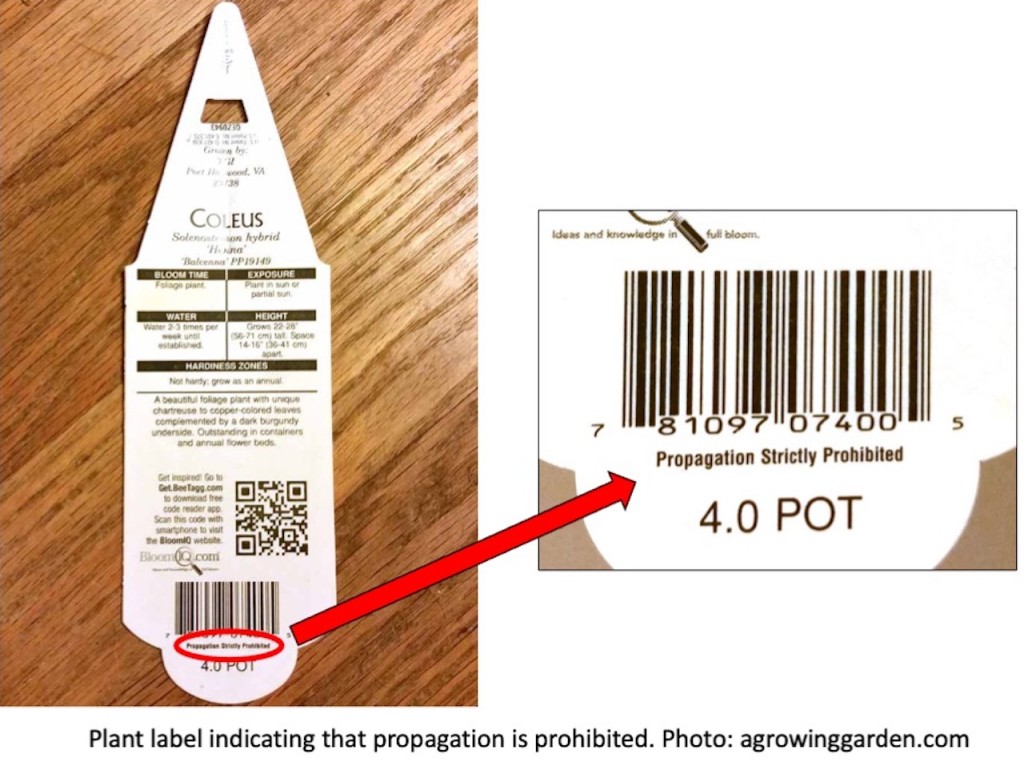
Question: I was taking cuttings of my coleus as I do each spring and saw on the original label a mention, “Propagation strictly prohibited.” I’d never noticed this before. Does this mean I can’t take cuttings from this plant? Because if I had known that, I would never have bought it. Half the fun of growing plants is multiplying them!
Darlene Leblanc
Answer: More and more plants these days are protected by plant patents. The label might bear a trademark symbol (™) or indicate “PPAF,” which stands for Plant Patent Applied For. Or maybe it has a plant patent number. Often, you’ll also see on the label a mention like “propagation strictly prohibited” or “asexual propagation prohibited.”
Although you might see other interpretations on the Internet, a legal opinion from the Garden Writers Association (now Garden Communicators International) several years ago asserts that the asexual multiplication of a patented plant without the permission of the patent owner, usually a nursery, is indeed illegal. And this even applies to amateur gardeners. So, legally speaking, you’re not allowed to divide it, take cuttings or multiply it by grafting or tissue culture.
You could theoretically harvest seeds from your plant and sow those, as this type of plant patent only covers asexual reproduction, but then such plant are hybrids and don’t come true to type and that rather defeats the purpose.
No Jail Time

That said, you will never be taken to court for such an offense, nor will you even be fined . . . as long as you don’t try to sell the plant you propagated. In other words, what worries the patent owner is when an unauthorized company starts selling its protected plant on a commercial scale. A gardener taking 10 cuttings to decorate their garden really isn’t on the owner’s radar, but a nursery producing and selling 10,000 plants of a patented variety without permission would certainly be taken to court.
I checked this out with a representative of a nursery that owns numerous plant patents, and effectively, she told me her company has no intention of taking home gardeners to court over plant patent infringements. They are well aware that amateur gardeners get a lot of pleasure out of multiplying plants and that dividing plants and taking cuttings are part and parcel of gardening. While they don’t actively encourage home gardeners to reproduce their plants, the company’s policy is to not react when it happens. However, she insisted they will prosecute fully any commercial dealer caught propagating their plants without permission.
So, while multiplying patented plants asexually for personal use remains theoretically illegal, it is not likely ever to be prosecuted. You’ll have to look at your own moral compass to decide whether you find that acceptable.