


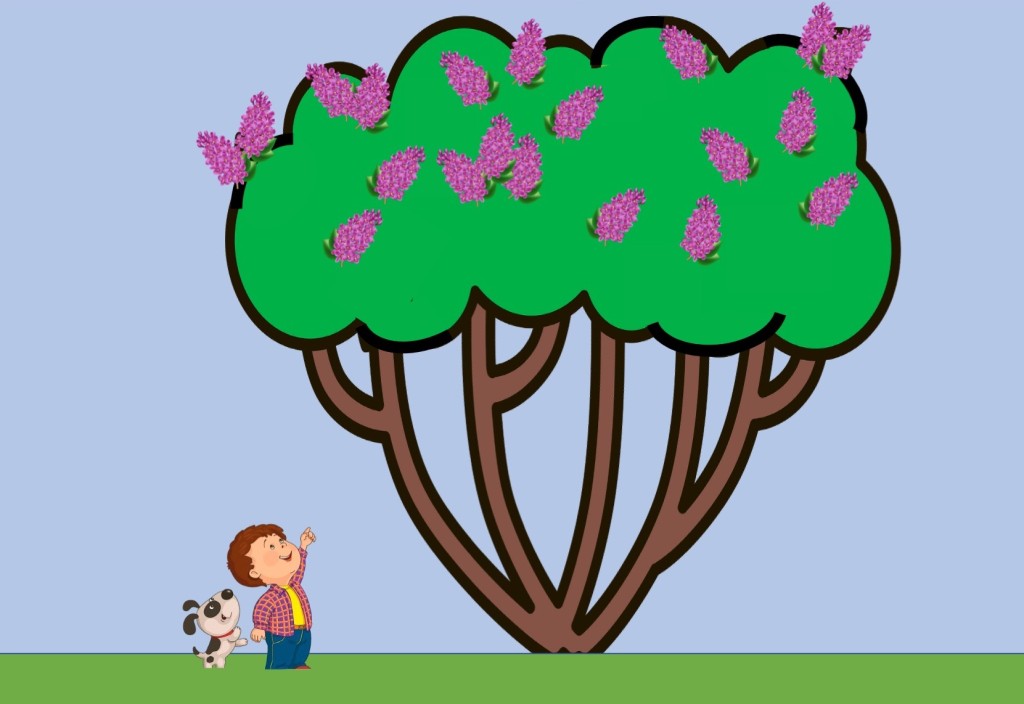
Selectively remove the oldest branch each year
will help keep your lilac young and vigorous.
By Larry Hodgson
Lilac season is one of my favorite times of the year. The heady perfume of their flowers brings back memories of my great-aunt Sadie who grew two of them in the front yard of her old farmhouse. And they’re so long-lived that, if the house is still standing, I’ll bet the lilacs are too.
My father always pruned hers for her after they finished blooming, so in late spring. No, he didn’t deadhead (go over the whole plant selectively removing faded flowers). That seems to be a thing these days, but it takes forever. And really doesn’t give anything to the old-fashioned common or French lilac (Syringa vulgaris), other than removing its seed capsules.

And those are the same seed capsules that would otherwise feed beautiful evening grosbeaks in the winter. So, I really don’t get it.
Plus, deadheading lilacs leaves you open to injury as you struggle up a stepladder to reach those always-just-out-of-reach faded blooms.
To learn more about why deadheading lilacs is largely a waste of time, read Garden Myth: Deadheading Lilacs Improves Bloom.
Daddy’s Way
My dad never wasted time with deadheading. Instead, he did was in fact a sort of maintenance pruning. Each year, he’d cut off one branch (two on a very vigorous specimen). Always the tallest one . . . and the oldest. And I’ve been doing the same thing.
The idea behind this annual rejuvenation pruning is to keep the shrub at a reasonable height while encouraging healthy younger shoots that will become the heaviest bloomers.
Most common lilacs will reach up to 20–23 ft (6–7 m) in height if left unpruned. That’s 2 stories! And that puts their deliciously scented flowers well above your head. I mean, you can barely see them, let alone smell them.

But removing one of the older, taller, out-of-reach branches that shades out the others gives renewed life to the entire shrub. It will respond to harsh pruning by sending up one or more new and vigorous branches. Do this every year to an overgrown lilac* and within 5 years, it will be within an easy to reach 6 to 10 feet (1.8 to 3 m) tall with a denser, more floriferous habit. And it’ll maintain that height as long as you keep the pruning up!
*If a lilac is really seriously overgrown, you might indeed want to take out 2 branches a year for the first 3 or 4 years. Just to get things started.
Take It All Off!
How far back to you need to prune these big branches? To the ground or as close as you can get to the ground. Say, 6 inches (15 cm), 1 foot (30 cm)? Something in that range. You’ll need a saw. Maybe even a small chainsaw (lilac wood is hard). And while you’re at it, you can remove suckers too. At any season. Most common lilacs produce far too many of them!
Removing old branches also helps solve another problem: dealing with lilac borers (Podosesia syringae). They pierce holes in lilac bark and empty out the inner wood, leading to weakened branches that bloom less and can break off. However, they rarely attack branches less than 1 inch (2.5 cm) in diameter. So, by removing larger, older branches, you’re also removing lilac borers . . . thus killing two birds with one stone!

Do note that newly sprouted lilac branches won’t reach blooming size for at least 3 years, and more likely 4. Even 5! So annual maintenance pruning will most affect seriously improve flowering in the medium and long term, not the short one.
But then, don’t they say, “Lilacs are forever?” Oh, was that diamonds? I could have sworn it was lilacs.
When to Do Maintenance Pruning?
Theoretically, the ideal time to cut back an old branch in order to stimulate regrowth would be in early spring, before the plant blooms. But . . . who wants to cut back a lilac in bud just about to flower? So, most gardeners compromise and instead prune right after the lilac blooms. That will still give the replacement branch time to grow and harden off so it will be ready to continue its growth in year two.
Laidback Lilac Rejuvenation in a Nutshell:
- Once a year;
- With 3 weeks after flowers fade;
- Cut the tallest, oldest branch back to the ground;
- Remove any dead or damaged branches;
- Go back to your hammock and have a snooze.
Passing On the Pruning Shears
I’ve always pruned my lilacs according to Dad’s method. For nearly 50 years now. But this year, I made a major change.
I had my stepdaughter, Mélissa, come over last weekend and handed her the electric chainsaw. I can longer handle the job, so it will be up to her to take care of her mom’s lilacs. She has clear instructions to come back every year after the lilacs have stopped blooming. And to cut back the tallest branch on each shrub.

And her mom, Marie, does love her lilacs. I planted them for her. She brings in huge bouquets annually and gives others to our less fortunate neighbors. Especially the gorgeous double ‘Krasavitsa Moskvy’, with pink buds opening into ever-so-scented pale pink to white rose-shaped flowers. She adores it!