


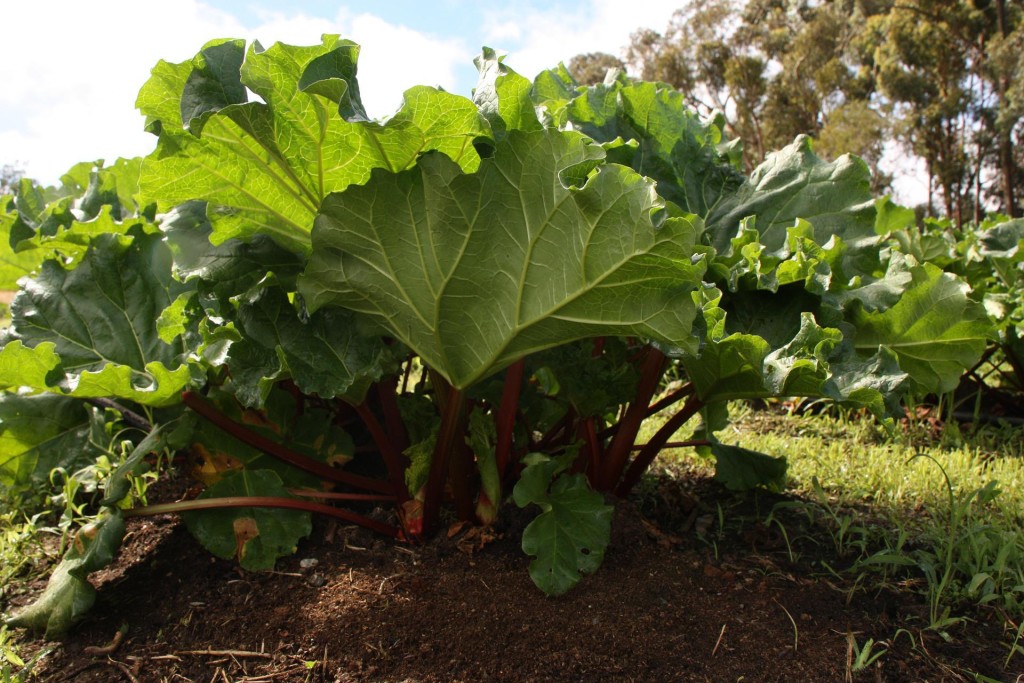
Unlike almost all other common vegetables (the other main exception being asparagus), rhubarb (Rheum × hybridum) is neither an annual or biennial, but a very long-lived perennial.
It can live for 20 years and more. And that makes it poorly suited for the classic vegetable garden, which gardeners traditionally empty in the fall to make room for a new crop of fast-growing vegetables the following spring. Plus, due its large size and its huge leaves, rhubarb creates enough shade to hinder the growth of neighboring vegetables.

On the other hand, rhubarb is entirely appropriate for the perennial border where, due to its huge, wonderfully textured leaves, its (often) red petioles and its spectacular creamy white flowers*. In fact, it can even steal the show!
*Despite a persistent belief to the contrary, it causes absolutely no harm to rhubarb to let it bloom. Read Rhubarb: Just Let It Bloom for more information on that subject.
All it takes for rhubarb to be happy is rich, moist but well-drained soil and sun. And it will grow in almost any temperate climate (USDA hardiness zones 2 to 8)! Just be patient, as it is a very slow grower, taking 4 to 6 years to reach maturity.
If only all the vegetables were this easy!
Article adapted from one originally published on June 16, 2015.