


The article below is truly a blast from the past! It’s the very first plant article I ever wrote. It was published 40 years ago in the May-June 1982 edition of the Light Garden, the newsletter of the Indoor Light Garden Society of America, a plant society devoted to the culture of plants indoors under artificial light. By that, I mean fluorescent lights, not LED lamps (they’re mostly a 21st-century phenomenon). I was a member of the ILGSA and, indeed, a member of just about every houseplant society that existed at the time: ones for bromeliads, orchids, gesneriads, begonias, hoyas, African violets, succulents, aroids and greenhouse gardening. You name it, I grew it! So, I submitted this piece in my first attempt to get an article in print.
You seed, secretly I had a dream. I wanted to make my living writing about plants and gardening. So, I was thrilled when the newsletter’s editor, Phyllis Banucci, wrote back to say she’d accepted the article and would publish it.
I must have appeared overly enthusiastic, as she warned me not to get too excited. There was no money to be made in writing about plants. Indeed, the ILGSA was a volunteer organistion: I received nothing for the piece. But I didn’t listen to her. Within two years, I did exactly what I dreamed of doing: I quit my day job and set out to make a living as a garden writer! I had no contract, no idea how to sell an article, no idea who to contact. Besides, who was I to succeed as a garden writer? I had no training (I’m self-taught) and was only a passionate hobbyist. But I was young, naive and had the will to succeed. Would you believe that was exactly 40 years ago? And I’ve lived from my writing ever since.
So, what did I have to say about the golden nerve plant 40 years ago? Read on and you’ll see.
Larry Hodgson

THE GOLDEN NERVE PLANT
When I first got a cutting of this plant, I was pleased, but not overly so. I hadn’t heard any glowing reports about it from plant magazines or other houseplant collectors, so it wasn’t on my list of “must-haves.” In fact, I have since found very little information about this plant in any of my research texts. It was just another cute little plant with pretty foliage.
That was two years ago! Now it is on the very top of my list of plants that I recommend for light gardeners, even for beginners. I still don’t understand why such a magnificent and easy houseplant has been overlooked for so long, but I am hoping that this article will at least whet your appetite. Do put it on your own list of “must-haves”!

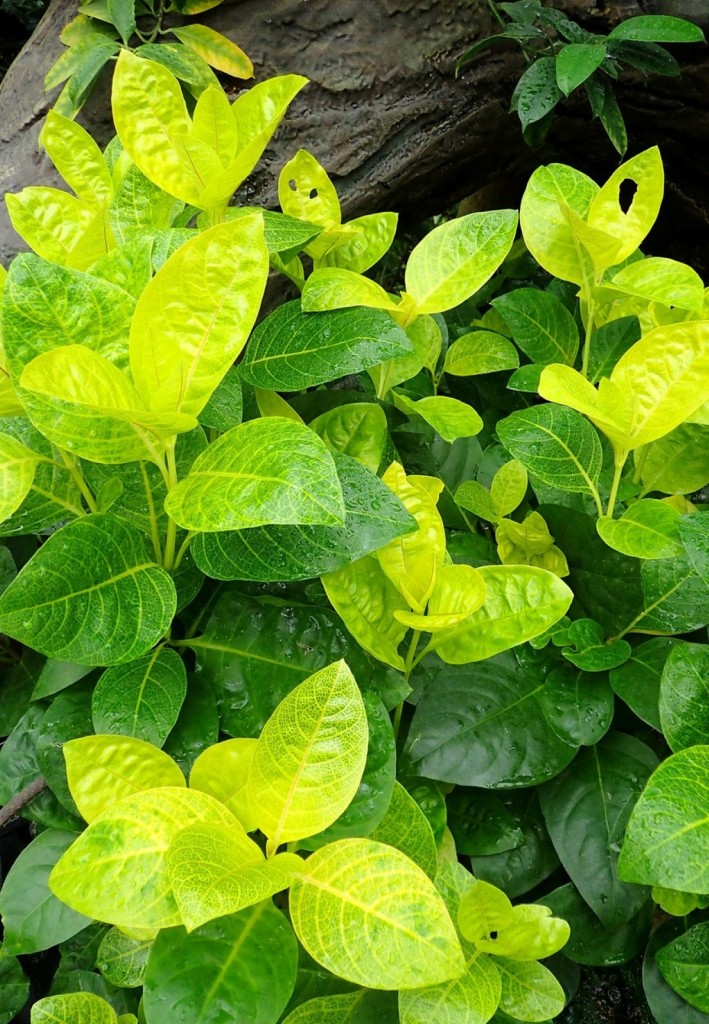
The golden nerve plant (Pseuderanthemum reticulatum, now P. carruthersii ‘Reticulatum’ ) is a small shrub in its native New Hebrides, and is widely planted as a decorative plant in Polynesia and other humid tropical areas. As far as I know, until now it has been considered in North America more a plant for heated greenhouses than a houseplant. It has shiny oblong to lanceolate leaves with bright yellow veins, resembling a rather small-leaved, bushy croton when not in flower. A member of the Acanthaceae family, it is therefore a close relative of the Crossandra, the zebra plant (Aphelandra squarrosa), and the Fittonia, which is also known as the nerve plant.
This plant really seems to have been created for light gardens. In a window, where it requires at least three hours of sun a day, it tends to grow slowly or to look too rangy. Under fluorescent lights, it just grows and grows and grows! The key to this success seems to be its preference for regular light intensities and long days. Give the golden nerve plant from 12 to 15 hours of light daily and it will grow well. Any position under the lights seems to do equally well, so why not grow it near the ends of your tubes and save the center space for those plants that really need the extra light?

Pinch back and trim this beauty regularly to keep it in check, and keep the cuttings for friends and neighbours. These root rapidly in artificial soil mixes, even without rooting hormones. I continue growing it in artificial mixes which I keep moist at all times. If I forget a watering, however, it shows its distress by promptly wilting. The first time this happened, I thought I had lost the plant, but I watered it thoroughly and it came back perfectly. I have since found that it recovers from all but the most severe wiltings without losing a leaf. This is one of those plants which succeeds especially well with capillary watering.
As I grow my golden nerve plants in an artificial mix which contains no natural fertilizers, I add regular doses of diluted fertilizer. I try to vary the types of fertilizer I use so that all the essential elements are given to my plants. I suspect that this plant is not a heavy feeder, so when grown in regular potting soil, it would only require infrequent fertilizing. It does require good humidity, but this is rarely a problem in the light garden. Keep it warm (65°F/18°C or more) at all times.

Pseuderanthemum carruthersii ‘Reticulatum’ is more than just an easy to care for foliage plant, for it is also an excellent, freely flowering houseplant. The five-petaled flowers appear in large clusters at the end of the branches. They are white speckled with red, especially near the center of the flower and resemble nothing so much as garden phlox both in form, arrangement and color. The contrast between the yellow-veined foliage and the pinkish tinge of the flowers is both striking and unexpected. Flowering occurs in the springtime in windows, but can occur at any time under lights, and may occur several times a year. I keep half a dozen of these plants and generally have at least a few flowers at all times.
I have had no trouble with diseases or insects on this plant, although a few aphids wandered onto one branch from a neighbouring plant at one occasion. These were easily eliminated with a single treatment of insecticidal soap. I did worry at first when some of the uppermost leaves began coming in nearly completely yellowish green and I carefully removed all the branches. Since then I have found that this is almost a sure sign that flower buds are coming along, so I leave them on the plant. Cuttings can be taken, by the way, of budded branches, which root readily without losing their flowers.
Unfortunately, I cannot give any sources for this plant in the United States, but I imagine that it can be gotten hold of from specialists. If not, maybe some of the other pseuderanthemums (false eranthemums) might be available in your area.

The most common, tricolor false eranthemum (Pseuderanthemum carruthersii ‘Tricolor’), tends to be a rangy grower unless pinched back constantly, but has extraordinarily colorful leaves. These are mostly bright purple but are splotched in pink, white, and sometimes even green!

Then there is the spectacular near-black variety, P. carruthersii ‘Rubrum’, also called ‘Black Varnish’, ‘Atropurpureum’ and ‘Nigrum’.

The chocolate plant, P. alatum, is rarer but adds a rather unique color to the light garden, for its rounder leaves are chocolate brown, irregularly marked with silver.

P. sinuatum is one that I just managed to get a hold of and it promises to be quite spectacular. It makes a very bushy plant, with thin, scalloped leaves. These are olive green, with pale veins and a reddish underside. On the whole, it resembles the false aralia (Dizygotheca elegantissima, now Plerandra elegantissima). I suppose its common name would have to be “false false aralia”.
Start a fad! Give the golden nerve plant the chance it so richly deserves. You won’t regret it!
Two updates… well, other than the color photos (Light Garden was printed in black & white).
I did update the botanical names to current use. The golden nerve plant still went under the name Pseuderanthemum reticulatum in 1982, taking up its current name in 2015.
Also, back then, I didn’t know where to find this plant in the US. Thanks to the Internet, 21st-century gardeners can find just about anything. For example, you could try Glasshouse Works. They have pretty much all the pseuderanthemums. I’ve ordered from them several times over the decades (although they no longer ship to Canada, unfortunately) and have always had great results.