


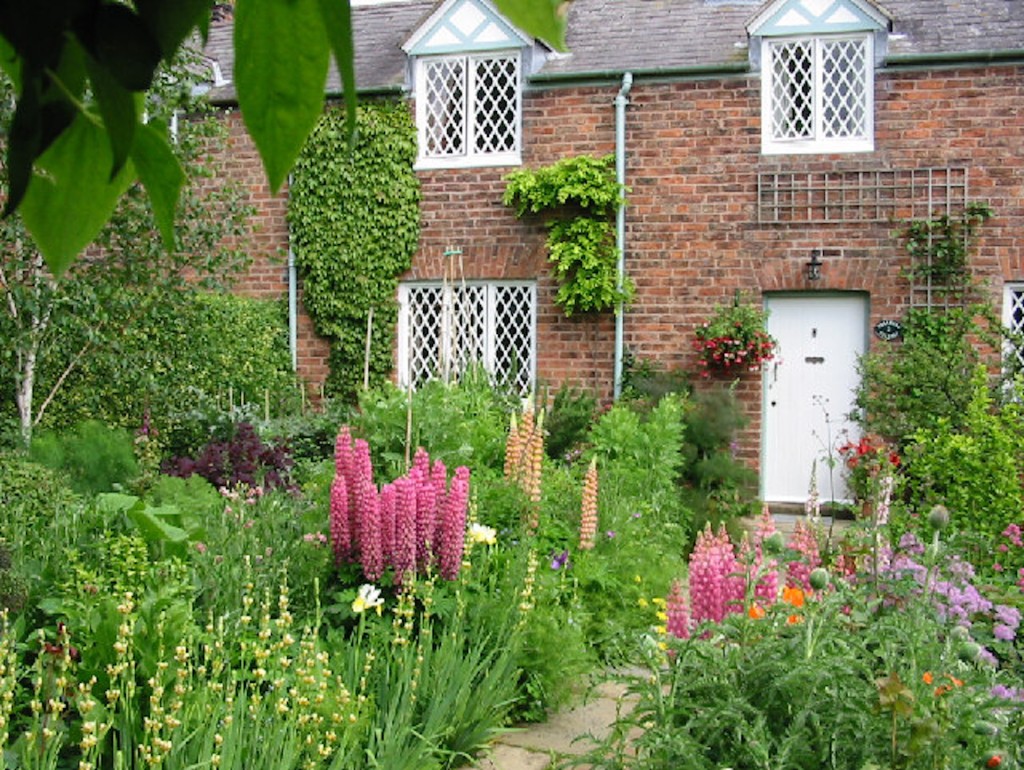
I’ve always had a soft spot for cottage gardens. And that’s not surprising. Show me a garden where plants grow all on their own and you can certainly count me in!
Rooted in the Past
Even if the history of cottage gardens can be traced back to the 14th century, we generally associate them with the middle of 19th century England, at a time when people sought to dissociate themselves from formal French gardens.
How best to describe the charm and interest of cottage gardens? I’ll just leave that up to British writer and garden designer Vita Sackville-West, who summed up the essence of these gardens to a tee:
“The plants grow in a jumble, flowering shrubs mingled with roses, herbaceous plants with bulbous subjects, climbers scrambling over hedges, seedlings coming up wherever they have chosen to sow themselves.”
Vita Sackville-West
Also, cottage gardens tended to be on the small side of the scale when it comes to garden dimensions. To start with, the cottage itself was usually a small country house with a garden large enough to support a family. Originally composed of vegetables and herbs, the cottage garden came to welcome more and more ornamental plants.
The combination of flowering plants and an apparent lack of planning also enter into the personality of this type of garden. The great lady of the “English mixed border,” Gertrude Jekyll, was inspired by cottage gardens when she developed the immense flowerbeds of mixed perennials of the great British estates.
All this being said, cottage gardens are perfect for the small facades of townhouses and city apartments. They could even completely replace the insipid lawn found in front of suburban bungalows. Imagine the scene if each house exhibited its own image of homespun cottage garden! Rows and rows of intermingling flowers!
Start With a Good Foundation
As in any successful garden design, you can’t limit your list of plants to annuals, biennials and perennials, though. Shrubs, evergreens and vines are needed to provide structure and interest over four seasons.
Due to their small size, the classic cottage garden often has no trees. But don’t let that prevent you from inserting an ornamental crabapple (‘Dolgo’, ’Pink Spires’ and ‘Prairifire’ are my personal favorites, but there are many others), serviceberry or tree lilac.

As for shrubs, the Brits certainly do love to fill their cottage gardens with shrub roses, don’t they? But they’re not a personal favorite because of their complicated growing requirements and their many insect and disease problems. So, let’s go for easier shrubs, like weigelas (Weigela spp.), ‘Snowmound’ spirea (Spiraea nipponica ‘Snowmound’), deutzias (Deutzia gracilis) and if space permits it, a beauty bush (Kolkwitzia amabilis).
Yews (Taxus spp.) and boxwoods (Buxus spp.) are also good options, as are dwarf conifers, such as mugo pines (Pinus mugo). (Many miniature varieties exist.)
Near the house, you could install, on attractive wood or wrought iron trellises, wisterias (Wisteria spp.) or climbing roses. They’re perfect in milder climates. Dutchman’s pipe (Aristolochia macrophylla) and clematis (Clematis spp.) are better choices for northern gardens.
And Finally, The Fun Part!
It’s in the total jumble of perennials, biennials and annuals that the cottage garden really takes on its full meaning. The idea here is to just go for it! No detailed plan, no rigorous weeding. The perfect opposite of the fully controlled garden. You mingle and plant without thinking, without reservation… and sow everywhere. Fill in all the holes!

In your plant list, there will be some annuals that self-seed freely, such as Shirley poppies (Papaver rhoeas), opium poppies (Papaver somniferum), cornflowers (Centaurea cyanus), cosmos (Cosmos bipinnatus and C. sulphureus) or borage (Borago officinalis). Here the selection will vary depending on your garden. A plant that reseeds itself generously in one garden won’t necessarily do so in another. You have to experiment.
Among the perennials and biennials, you absolutely have to try blazing star (Liatris spicata or L. aspera), Siberian larkspur (Delphinium grandiflorum), rose campion (Lychnis coronaria), Shasta daisies (Leucanthemum spp.) and catmints (Nepeta spp.).

If you find disease-resistant varieties, hollyhocks (Alcea rosea) and garden phloxes (Phlox paniculata) are also musts in any self-respecting cottage garden. Foxgloves (Digitalis purpurea) are also essential, but they aren’t always suitable for all gardens (well, not mine, anyway!). Some people find them hard to grow (me!) That said, straw foxglove (Digitalis lutea) is a great option, but it’s harder to find.
There are so many other fabulous plants you could include in a cottage garden. I would be curious to know about your personal favorites. Maybe you could share them in the comments?
Maintenance? You Choose!
In terms of maintenance, the cottage garden is fabulous. You can ignore it completely or spend sleepless nights polishing it to perfection. But no matter how many hours you or don’t devote to it, it remains charming and tinged with a romantic aura.
Of course, do complete the whole thing with a small white picket fence and a beautiful stylized garden bench where you could have tea. . . whenever you feel like it. After all, it’s always 4 pm somewhere in the world!