


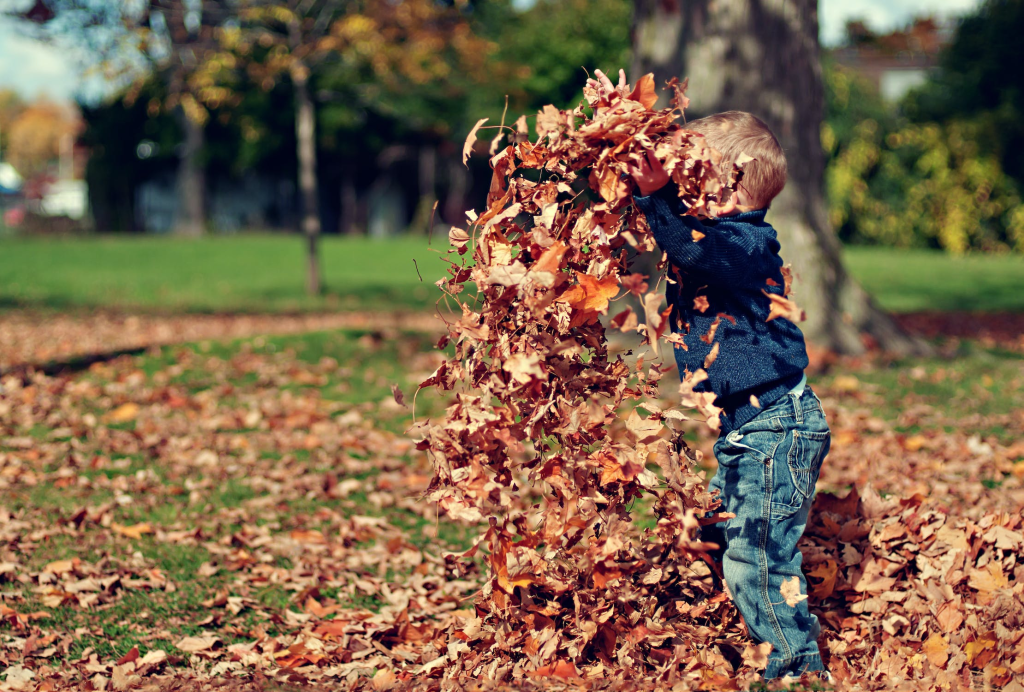
When I was a kid over 50 years ago, there was only one way to pick up the fall leaves that covered our lawn—with a steel-tine leaf rake.

It was a family affair. Dad would rake the leaves into big piles, the kids would jump into said piles, scattering the leaves, and Dad would rake them up again. Then we burned the whole mess. Yep, right out there on the lawn. I can remember how proud my father seemed of his dirty, dusty family and the project they worked on together.
And we weren’t the only ones! The entire neighbourhood would smell of burnt foliage for weeks at a time.

No Fires, New Rakes
Well, times have changed. In most towns, you can’t burn leaves anymore—it pollutes the air, annoys the neighbours and even constitutes a fire danger to fields, forests and homes. There are still a few people who choose to continue to do so, but it’s illegal in most municipalities. And why risk a fine for doing something we now know is environmentally unfriendly anyway?
Lawn rakes have changed as well. Nowadays they’re just as likely to be made of resin, plastic or aluminum as steel, and the old wood handle is now anything but. Find one that suits you (try a few in the store and use them in a raking movement to see how they feel). Plus, fewer and fewer people are using rakes at all—there are now so many other ways to clean up leaves.

Curb, Mulch or Compost?
Before deciding what to use to pick up your leaves, determine if you still intend to have them carted away.
The most popular option is still to bag fall leaves and put them on the curb for your municipality to handle. An increasing number of towns are composting fall leaves, but many still send them directly to the dump or the incinerator. This is information you’ll want to find out, because if your municipality does compost them, you’ll want to identify compostable leaves and garden refuse to distinguish it from plain trash. Check and see what your town recommends: it may be orange or transparent plastic bags or paper ones as opposed to dark plastic for waste. And recyclable wastes may have to be put out on special days.

Many gardeners, however, now use their fall leaves as mulch or material to feed their compost bin. Rather than overwhelm my compost pile with too many leaves in the fall, I always bag up a decent supply—4 or 5 trash bags full—to store away until next summer. That way I have some to add to my compost throughout the season. And nothing decomposes better than a mix of fresh green summer garden waste mixed with dry brown shredded fall leaves!

Getting Leaves Into a Bag
It isn’t easy getting leaves into a bag, especially a plastic one. Bags notoriously collapse in on themselves just as you arrive with an armful of leaves. Ideally, you’d have someone to hold the bag open for you.
There are also all sorts of ingenious devices designed to hold bags open, but they never seem to work as advertised. I prefer the old-fashioned trash can method: line a trash can with a bag, fold its top back over the rim and it will stay open.
The next step is picking up the leaves. You can grab armfuls of them, dumping them in the bag, but it’s impossible not to miss a few (or a lot). Then you’ll have to rake them up again. Plus, that’s a lot of bending, which isn’t always good for the back.

You’ll find various leaf grabbers on the market. Usually they look like a pair of paddles with teeth you can clamp together, though I’ve also seen rakes that fold in two and various other forms. I find them all a bit awkward and not too efficient. In the end, you often still find yourself do a lot of bending.
I prefer the sheet method for bagging whole leaves. Lay a fairly heavy plastic sheet (or a drop cloth or a tarp) on the ground (6 × 8 feet/1.8 m × 2.4 m is a practical size) and rake the leaves onto it. A blower is also efficient for this task. Grab three of the corners, lift and dump the leaves into the open bag via the remaining corner, and voila! Simple!

There are also a variety of lawn sweepers available. The push-types use a rotating brush to move leaves into a hopper as you push it over the lawn. Other models can be pulled behind a lawn tractor. Ideally, the hopper would be easy to detach and light enough that you could pour the leaves into a bag with little effort.
I find this option better suited to professional lawn companies or landowners with large acreages rather than the typical home gardener. This equipment can take up a lot of space in the garage.

Why Shred Leaves?
If you intend to use your leaves as mulch or compost, you need to shred them. There are several reasons why. Here are the main ones.
- Shredded leaves have smaller air spaces and so take up less space. Often half as much as whole leaves. That makes them easier to store.
- Chopped leaves make better mulch, as they don’t mat down and create an impervious layer that doesn’t “breathe” well or let water flow through.
- Shredded leaves have more edges and edges offer beneficial microbes more space to work from.
- Nor do chopped leaves blow away readily. After an initial watering, they tend to remain where you put them.
- Shredded leaves compost more rapidly and few minerals are lost.
- There is greater air circulation and therefore less risk of slow-working anaerobic organisms setting up shop. Aerobic ones are preferable for home composting.
- Shredding leaves kills many of the unwanted animals, weeds, diseases and seeds that might still inhabit the fallen leaves.

No Need to Move Thin Leaves
There is often no need to move leaves on a lawn. If they fall thinly enough that you can still see the green grass, just run the mulching mower over them and let them lay where they fall. That will reduce them to tiny pieces that fall to the ground between grass plants, so your lawn won’t be starved for sun. Then they decompose there, enriching the soil … and reducing your need to fertilize! And if Ma Nature offers you free fertilizer, I say take her up on the offer!
Of course, you’ve certainly seen lawns so thickly covered in fall leaves that not a blade of grass is visible and that may be the case in your yard. It certainly is in mine! If so, yes, of course, you should apply the methods explained below, under Moving and Shredding. Because your lawn is still growing late in the fall and the turf plants need their sun! Remove the overly thick layer of leaves the first time. If a thin layer of leaves is redeposited on the lawn, simply shred them the second time, leaving them to decompose on the spot.

Moving and Shredding
There are several ways of shredding fall leaves.
Leaf blower/vacs in vacuum mode will shred leaves. They suck up the leaves, chop them up and deposit them in the attached bag. You can then empty it when it fills. There are electric, cordless and gas-powered models. Most are quite noisy, so be sure to wear earplugs … and for your neighbours’ sake, not to use them early in the morning.
I use them mostly as a finishing tool, to remove leaves from flowerbeds, decks, paths and tight spaces that my preferred leaf picker-upper, the lawn mower, can’t reach.

Yes, the rotary lawn mower is my personal favourite for picking up leaves. To start with, you probably already have one, so there is no equipment to buy. There are mulching mowers designed to chop leaves, but you can add a mulching blade to any rotary mower, and mulching blades work fine when you’re mowing grass, too.
The easiest mower to use for leaf collection is the bagging type. Just detach the bag when it’s full and dump the leaves where you need them, be it in the compost bin, in plastic storage bags or in your flowerbeds as mulch.
My old lawn mower is a side-discharge model with no bagging attachment. I find I still get good results just by directing the blowing leaves into the surrounding flowerbeds as mulch.
There are hand push, riding and tractor-pulled mowers in electric, cordless or gas-powered models. They all work fine, so take your pick!

Unfortunately reel mowers (typically push mowers without a motor) won’t chop up leaves. Since these types of mowers are usually used on smaller lawns, you might want to add a blower/vac to your repertoire for leaf pick-up. Blower/vacs take up little storage space and are ideal for small surfaces.

Snowblower to the Rescue?
I have a neighbour who uses a snowblower to chop leaves. He runs over the lawn with it and uses the adjustable chute to send the leaves into their flowerbeds as mulch. He’s been doing this for years with no problem. I’d personally be a bit worried that if the machine broke down. The warranty might not be valid, but it’s a lot of fun to watch. I suspect if ever I bought a snowblower, I’d probably end up trying mine for leaf pick-up as well.
So have fun experimenting with some of these options. Just make sure you explain to your spouse that you’re experimenting with your leaf pick-up techniques on leaves before they call in the men with the white coats!
Derived from an article appearing in the magazine Gardens Central September 2013.