


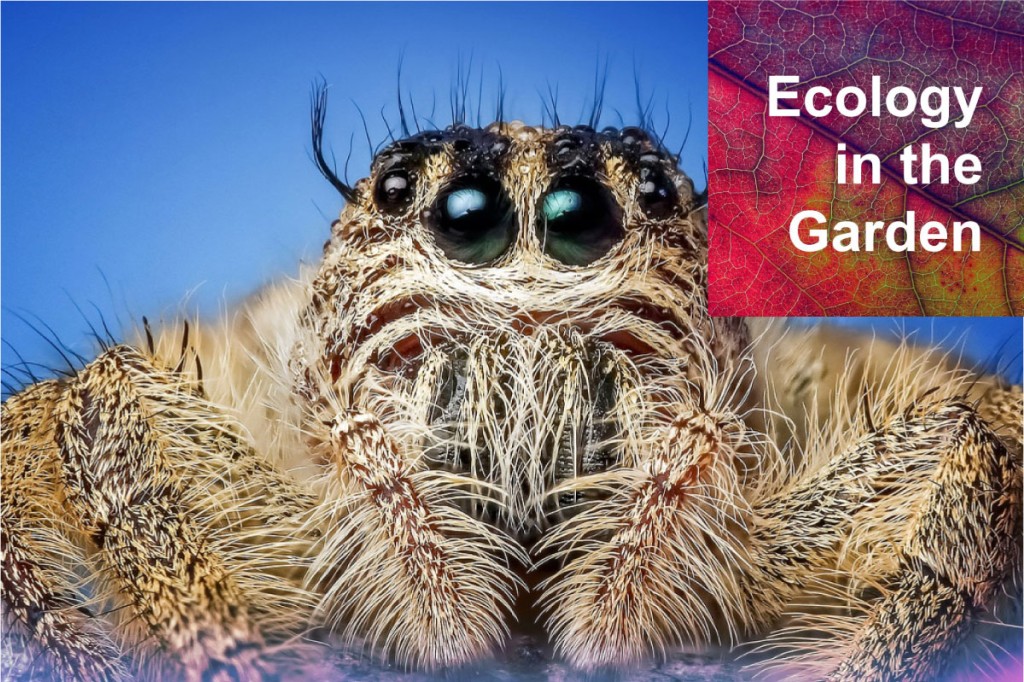

Today, I will brave my own phobia with you… it’s Halloween after all! So yes, I must confess: I, Audrey, biologist, have a phobia of spiders.
A shoemaker with bad shoes? Bet your ass I am!

Why Are We Afraid of Spiders?
Just like the phobia of snakes, this one would be written in our genes. I’ve already talked about the evolutionary advantage of this fear in the article It Slithers, It Hisses… Ugh! The Fear of Snakes!, so find out there about the method used to discover that this fear is innate.
Scientists measured the brain activity of babies by showing them different images. When the image of a spider was presented, the sensors detected an increase in the brain activity of these infants (who are too young to have experienced trauma or learned to fear certain animals).
For a less scientific (but just as convincing) method, you can always come to my home when I’m gardening… you’ll probably hear me scream. You may even see me rolling in the grass to get away from the terrible monster, cold sweat on my brow!

5 Things That Are Impossible, Except in Hollywood
1. Small Bugs Don’t Eat Big Bugs.
How many times did my mother repeat that to me? First of all, Mom, you should know that it’s not true: many spiders eat insects that are larger than themselves! But, grant you, they won’t eat me…
To feed, spiders bite their prey and inject it with venom. This liquefies the inside of the insect. Mrs. Eight Legs only has to come back later to drink up this delicious fly smoothie from the carcass. Yes, you can say it: yuck.

2. Eight legs, eight eyes
Not necessarily! Eight legs, yes (and that’s two too many in my opinion), but not always eight eyes. In fact, it depends on the kind of spider. Some have more, some have less, or even none! What’s interesting is that their eyes don’t all have the same function. Some are used to see during the day, and others to see at night. Moreover, they are not all on the front of the head, some can be on the sides or even on the top.

3. Photoshop
I sometimes see pictures on social media of spiders as big as a house. Thank you Photoshop for the joke. I’ll just go on with myday trying to forget this horror.

4. Spiders Are Not Insects


The confusion stems from the fact that both groups are arthropods. The latter can be recognized by their chitinous exoskeleton.
What?
Chitin (pronounced kitin) is a more or less hard material that looks a bit like your fingernails. It replaces the skin of arthropods and allows them to keep their shape since the inside is soft and without bones. Chitin therefore acts as a skeleton, but on the outside of the body: exoskeleton. Crustaceans are also arthropods, it is the exoskeleton that you remove before eating them.

5. Spider’s Web
We’ve all had the terrible experience of walking through a spider’s web. And, you’ll agree with me, this delicate thread may be called silk, but it’s anything but pleasant to feel its caress on our face. Hollywood likes to capture humans in giant spider webs.

In fact, Hollywood has a point here… If a spider that big existed, its webs could totally capture us. Welcome to my nightmares, everyone!
Spider silk is the strongest biological material (produced by a living being). Hard to imagine, isn’t it? It’s so fragile and delicate when you see it… And yet, a spider’s web has the ability to stop a large dragonfly in flight, without breaking. With enough threads, or with a big enough spider, a plane could be stopped in mid-air!

Studies are being carried out on this exceptional material. The difficulty lies in harvesting. The silk cannot be harvested already in the web nor can a large quantity be taken directly from the spider. It is not like traditional silk, which is harvested from a caterpillar cocoon then carefully unwound.
However, the shape of the fabric has also been studied and has even inspired architects to build more earthquake-resistant buildings.
Uses in the garden
Like many other animals, spiders are predators. Although we have several kinds, they are all useful because each specializes in different prey.
Snakes, birds, frogs, spiders, centipedes, bats or dragonflies don’t all feed on the same prey. That’s why you need to have spiders in your garden (to my horror).

Fortunately for us, very few spiders can harm us. Some hairy ones have what are called urticating hairs that itch for a few hours to a few days if they come in contact with human skin (especially tarantulas). Others have a bite that feels like an insect’s. And still others have a powerful venom that is dangerous and requires a trip to the hospital for antivenom. There are fortunately very few of these in the world!
In Quebec, we don’t have any spiders or tarantulas that are life threatening. Learn more about spiders in your area and wear gloves when gardening. If you see one, do what I do: throw a shovelful of dirt at it, roll it through the grass to another side of the garden and wait for it to disappear. Scream too. That won’t scare it, but it feels good… and it makes the neighbors laugh!
