


Larry Hodgson has published thousands of articles and 65 books over the course of his career, in both French and English. His son, Mathieu, has made it his mission to make his father’s writings available to the public. This article is taken from his book, More Beautiful Plants with Artificial Lighting, never published.
Since the fashion for growing orchids emerged in the last century, misinformation about them has spread so widely that most people firmly believe it. Here are a few of them.

1. Orchids Require a Warm Temperature All Year Round.
Most orchids, in fact, prefer cooler temperatures. Even “warm weather” orchids have difficulty tolerating temperatures above 27°C and will accept cooler temperatures on occasion. The majority of cultivated orchids can easily thrive in the temperatures that exist in our homes.

2. Orchids Only Flowers Every 3 to 5 Years
In fact, the vast majority of species flower annually, while many hybrids have two, or even three blooms per year. In some cases, a single plant can bloom for a total of 10 months per year. This myth comes from the fact that orchids take 3 to 7 years or more to bloom for the first time from seedlings, but since we mostly grow them from divisions, or buy plants already close to blooming, this shouldn’t be an issue. Also, orchids can take up to a year to get used to new conditions, which can compromise the next flowering in plants bought with flowers or buds. Also, hobbyists too often give orchids poor care, including too little light or humidity, which doesn’t encourage flowering and can easily delay it.

3. Orchids Need 100% Humidity to Flower
Orchids do require high humidity, but no more than most other houseplants. A relative humidity of 50% is usually sufficient and 60 to 70% is ideal.
Both are easily tolerated by humans. Extremely high humidity, such as 100%, is way too much for orchids. Try to achieve, at the very least, a humidity of 50% to ensure success.

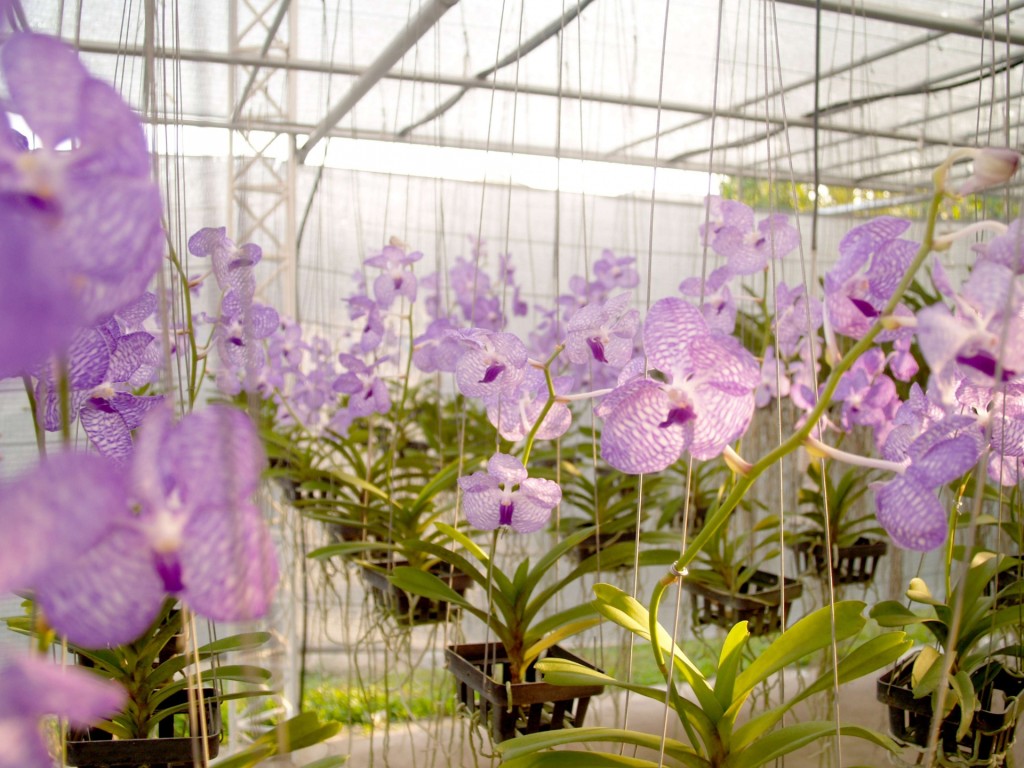
4. Orchids Only Flower in Greenhouses.
Some orchids are indeed difficult to grow outside of a greenhouse, but there are thousands of varieties that are perfectly suited to indoor environments. The advent of artificial lighting has done much to facilitate their cultivation outside of greenhouses, as most suffer greatly from the decrease in light duration and intensity that occurs during our winters. Many orchid hobbyists have hundreds of species at home, without the need for a greenhouse. Even many professional orchid growers use only artificial lighting.

5. Orchids Are Expensive
If some orchids are so expensive, it is an exception rather than the rule. Orchids are indeed more expensive than many other plants, as their cultivation and especially their slow multiplication make them rarer, but, for a fairly modest sum (about $25.00), one has no difficulty finding a plant in bud or in bloom that will give you great satisfaction for years to come. If you are more patient, vials of seedlings can be purchased for less than $0.25 each or over $5.00 each. It should be noted that growing orchids from seed is out of reach for most non-specialists for technical reasons.