


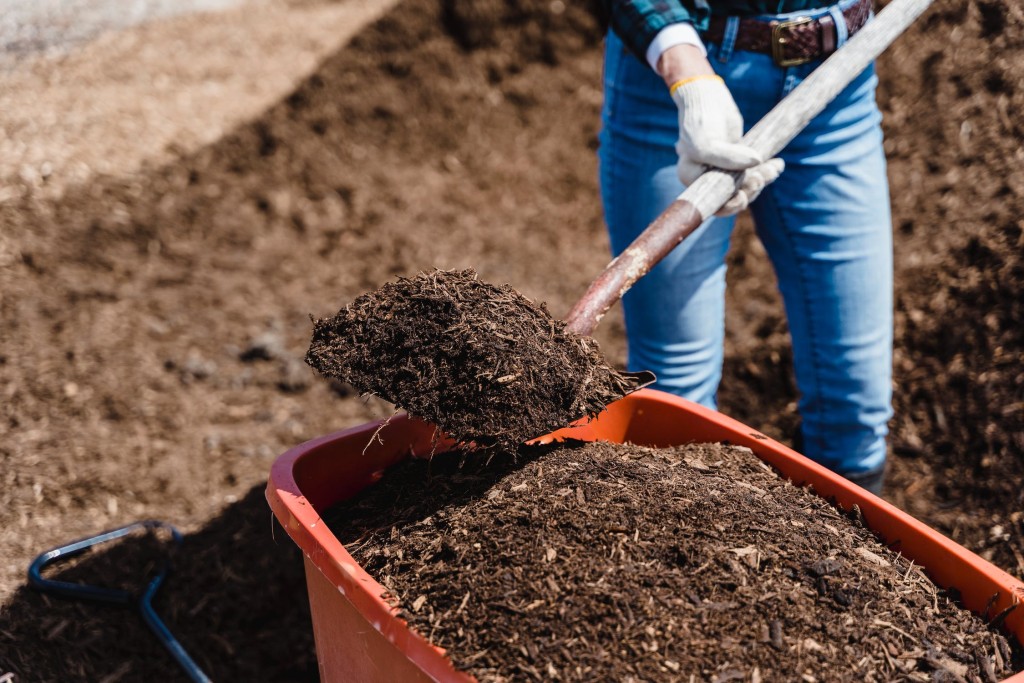
Since a laidback gardener has no need to cut back perennials in the fall or rake up dead leaves and drag them out to the street, what should we do at this time of year if we want to garden? Have you thought about putting compost in your vegetable garden this fall?

“Wouldn’t it be better to do it in the spring,” you ask, “when I transplant my seedlings or plant seeds to properly fertilize them?” Well… actually, no! The main issue is that compost is not really a fertilizer. “WHAT?!?!! You’ve been telling us to put compost in our garden for years, and now you’re telling us it’s useless!”
Compost is an Amendment
Hold your hostas! Just because compost isn’t a fertilizer (it is the equivalent of a 1-1-1 fertilizer) that doesn’t mean it’s useless. It’s more of a soil amendment. Compost is known for its ability to improve soil structure and add beneficial microbes to your soil. It also improves the circulation of air, water and nutrients in the soil which makes these nutrients more accessible to plants.

Compost in the Fall
But why apply compost in the fall? It’s simple: the nutrients contained in the compost are not immediately available to your plants. It can actually take up to 5 years for your compost to decompose completely.
The N-P-K of Compost
You’ll remember that the 3 main nutrients that plants require are nitrogen, phosphorus and potassium. Well, about 10 to 30% of the nitrogen in the compost is available to your plants in the first year. For phosphorus, we’re talking about 35% after one year. Potassium is in a class of its own and seems to be ready to feed your vegetables soon after its application.
Think of it this way: compost feeds your soil, which in turn feeds your plants.

How to Add Compost?
Typically, compost is added by mixing it into the soil to a depth of 6 inches (15 cm), but… it is just as effective when left on the surface as a mulch or topdressing. Apply it thickly, up to 3-4 inches (7 to 10 cm), if you have enough.
Compost? Anytime!
Is it bad to apply compost in the spring? Absolutely not! But you have to remember that its benefits will be delayed. If you do it in the fall, some of its nutrients will be available in the spring. Personally, in my vegetable garden, I use a slow release all purpose organic fertilizer for immediate needs in addition to compost. No stress! Compost can be applied anytime, even in the fall!