



Larry Hodgson has published thousands of articles and 65 books over the course of his career, in both French and English. His son, Mathieu, has made it his mission to make his father’s writings available to the public. This text was originally published in Canadian Garden News, Winter 1988.
Want to avoid buying a Christmas tree only to throw it away? You could buy a “living” Christmas tree. A spruce, fir or pine in a decorative pot that you buy for Christmas then plant in your back yard at New Year’s. That sounds perfectly nice… for those of us who live in climates that make January plantings possible.
However, even if I felt like preparing a planting hole in October before the ground freezes, then carefully protecting it with mulch, somehow, by January, where temperatures average around 0°F (-18° C). I don’t feel like tunneling through a meter of snow to find the planting hole, so I’d rather pass on the idea. Besides, no matter how carefully I try to plan it. I can’t see squeezing a spruce tree which can potentially reach 100 ft (30 m) or more in height and 15 ft (5 m) in diameter into my postage stamp back yard.

A Subtropical Christmas tree?
That doesn’t mean I can’t have a “living” Christmas tree. It simply means I can’t have a living hardy Christmas tree. What I can and do grow is a living subtropical Christmas tree.
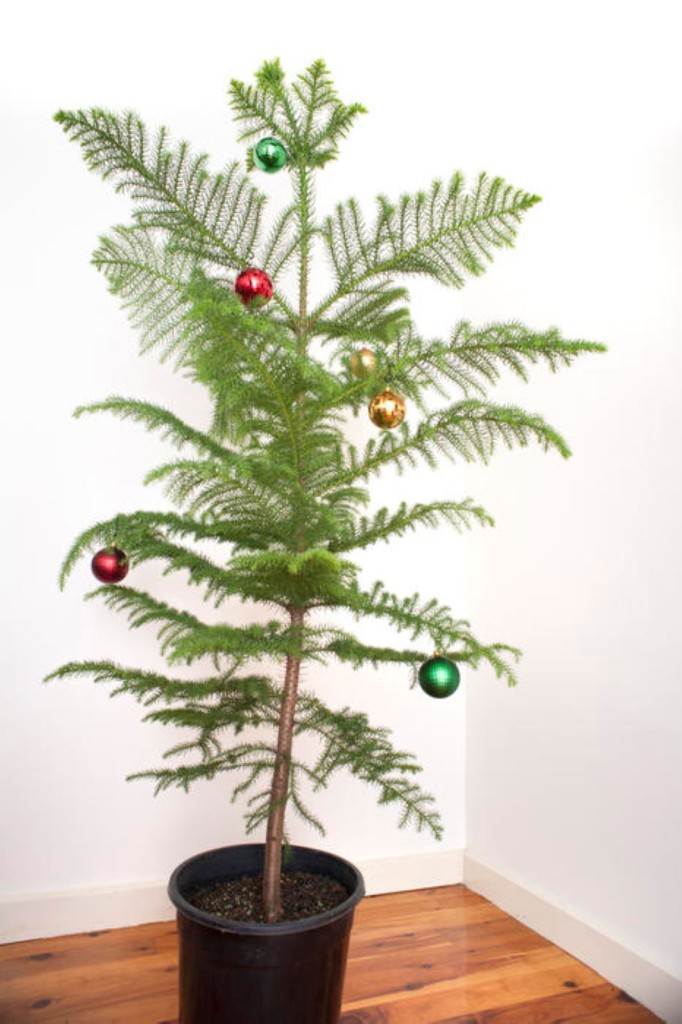
I bought my Norfolk Island pine or Norfolk pine (Araucaria heterophylla) as a tiny plant in a 4-inch pot over 10 years ago. It is now almost 2 meters high and is one of the most magnificent foliage plants you can imagine. It bears long, dark-needled branches which, on older stems, have a slightly pendant habit. Each year, in spring, it produces a short stem (about 6 inches/15 cm) in height from the tip of the plant, then a new tier of branches which spiral out from the main stem like the spokes on a wheel.
Of course, mine is now so tall it is reaching the limit of its useful indoor life. It will probably have to be donated to a local greenhouse within a few years. I don’t feel that 12 years of use is all that bad for a plant that only cost me $1.49 (and possibly, in all that time, half a bottle of fertilizer and two bags of potting soil). Do you? In fact. I doubt if most artificial trees stay in good shape that long!

Decorations On a Norfolk Pine?
Do I dare decorate this living object at Christmas time? You bet I do! In fact. I started decorating it the first year, when it was barely a seedling, with tiny ornaments too light to do any damage. Now that it is big. I don’t hesitate to use any ornament that would normally be used on a Christmas tree. The only exception is the medium size Christmas lights that are usually used on cut indoor trees. I feel these give off too much heat and could damage the needles, so I use the tiny twinkle lights instead. I also avoid artificial snow. When my tree is fully decorated and lit for all the world to see. I doubt if anyone would notice it wasn’t a traditional fir or pine.

Growing Conditions
Norfolk Island pine is not even a difficult houseplant to grow. It prefers bright light at all times and even full sun in the winter, and a soil that is kept constantly moist but not soaking wet. In other words, about the same care as the average foliage plant. Feeding is only necessary from spring to summer, when the plant is actively growing. I repot about every two years into regular potting soil. Interestingly, the root ball has remained quite small for the size of the tree, giving the impression that it is underpotted.
Humidity Is the Key
High humidity (which I get for free simply because I have so many plants in my apartment) is an important factor, as it helps keep the lower branches from drying out. Although most books will tell you that cool winter temperatures are a must. I haven’t found this to be tru. My apartment stays pretty well between 68° and 80°F (18° and 27°C) year-round. I believe, though, that the secret is my high humidity. If your home is dry and nothing can be done about it, it is better to keep night temperatures quite cool (50° to 60°F 10 to 15°C) if you want your Norfolk pine to stay in good condition. Once the lower branches do dry out and fall off, they will not be replaced.

Room to Grow
When your Norfolk pine does get too big for the available space – 12 years from now!—there isn’t much you can do. You could try rooting the top shoot, but this is very difficult and home conditions are not ideal for this procedure. Side branches are easier to root, if only because there are so many of them that, out of a dozen cuttings, one is bound to take. Unfortunately, side branch cuttings result in creeping plants rather than upright ones: not at all the effect you would want. The only solution is to buy a new plant. (Commercially, araucarias are grown from seed.)

Alternatives to Norfolk Pine
Araucaria heterophylla is not hard to find. Most greenhouses offer it, especially at Christmas time. Should you want more variety in indoor evergreens, there are few other subtropical varieties around. A. bidwillii is one. Called bunya pine, it is a spiny version of A. heterophylla with a less well-defined form. There is also Podocarpus macrophyllus, the “yew plum” or “Buddhist pine”, a conifer with long, flat needles that is particularly easy to grow indoors, although it may need a bit of pruning (which it readily supports) to change it from a bushy form to a pyramidal Christmas tree one. Finally, Hesperocyparis macrophylla ‘Goldcrest’ (formerly known as Cupressus macrocarpa ‘Goldcrest’) is a pyramidal golden cypress which can also be grown with great success indoors and makes an attractive Christmas tree.