


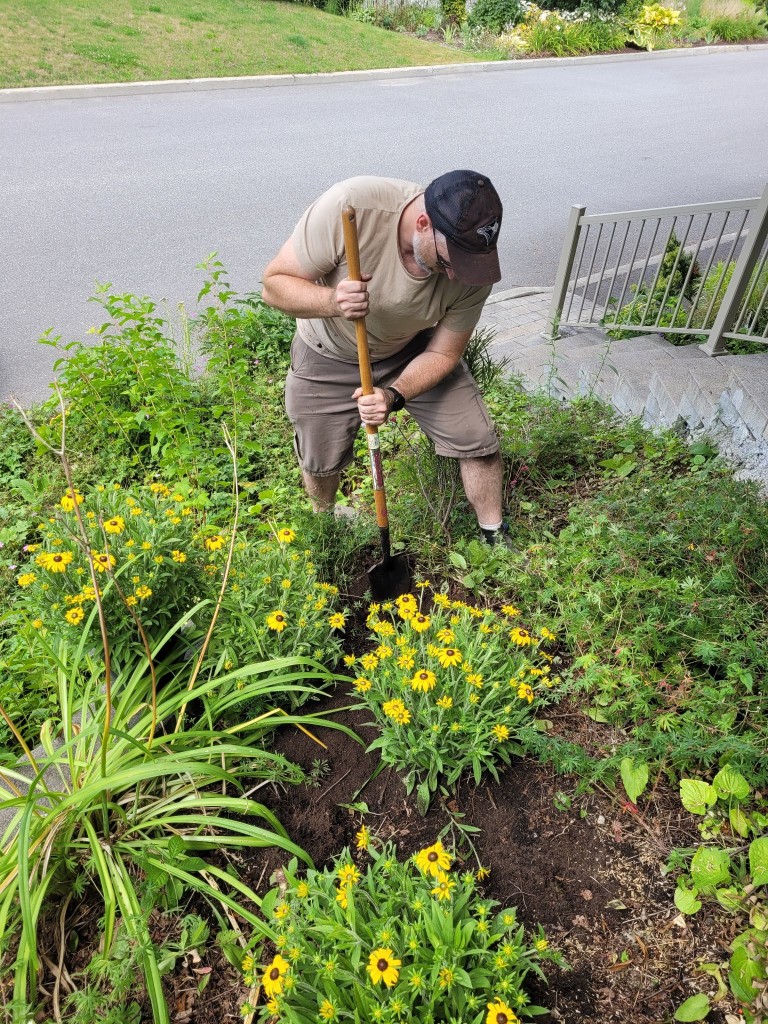

I have, in a way, inherited my father’s garden which is now my step-mother’s. I have become the gardener for the Laidback Gardener’s wife. When I walk through her garden, I observe everything that happens here more carefully than before. I also think about what I would like to change. In one place, a geranium has taken over, reseeding itself all over the place; it’s a ‘Jester’s Jacket’ (this isn’t a joke, this jester has played a nasty trick on us). In another place, the light has changed after a diseased spruce was cut down. There’s a lot to think about, to plan, to do.

Being a laidback gardener isn’t always easy! Sometimes it’s a lot of work! As the American poet Walt Whitman said so well :
“Do I contradict myself?
Very well then I contradict myself,
(I am large, I contain multitudes.)”

A Garden for Whom?
In my work as a garden designer, I have learned that creating a low-maintenance garden usually requires a lot of work.
When I set out to create a garden, I always start by doing a site analysis. There is, of course, measurements to take in order to create a plan of what already exists. But it’s much more than that. You also have to look at the garden: What do you like, what don’t you like? Are there any problems to solve? Are there materials or plants that could be reused? Determining the degree of luminosity in each part of the garden is also essential! Ideally, we would also do a soil analysis. At the very least, I put a shovel in the ground to observe the soil, to touch it. Then, I go back home and transcribe everything.
Afterwards, I talk to the clients about their projects, but also about their lives. It’s important to know who will be living in the garden. A couple, a single person, a family? Don’t forget the pets. What activities do they enjoy? What do they do or hope to do in their garden? Those who like to entertain will prefer a place to cook and eat. Readers might enjoy a bench in a shady nook.
Teamwork
We take this information and start drawing whatever comes to mind. I say “we” because, at this stage, it’s a team effort. The most beautiful gardens I’ve done have been because I listened to my clients, their ideas and their needs. They often had the most original ideas. They only needed someone to guide them. So we let our imagination run wild.

Then we cut! We keep the good ideas, we make decisions that sometimes break our hearts. We decide what is in our budget or what will fit in our space. The drawings become more and more technical: measurements, slopes, planes, choice of materials.
Finally, Some Plants!
Then we start thinking about plants! It is always a personal choice, but we must adapt our choices to the conditions in our garden. It’s rarely possible or feasible to change the type of soil or amount. It’s much easier to adapt to our garden than to change it.

Thus, it is necessary to choose plants that can adapt to their environment. The Right Plant in the Right Place, as my father would say. One must think about the hardiness of plants, not only in general in our region, but also in the small corner of the garden where a specific plant will grow. The conditions are not the same in a sheltered corner or on the edge of a long straight street exposed to the wind. Before choosing a plant, we must also make sure it isn’t prone to diseases or other problems. I make charts to ensure that there will always be something in bloom in every corner of the garden. Don’t forget to choose plants for your type of soil and amount of water in the soil!
The reason I spend a lot of time on planting designs is because it is important to make good plant choices for them to be successful. Healthy, happy plants need less maintenance. Those that are out of place are stunted, don’t bloom, are prone to disease. If I want the owners of these gardens to be laidback, I can’t afford to be lazy when designing.

Designing Your Own Garden
It may seem like a huge task to create your own garden. But remember, you don’t have to do it all at once. You can do one section at a time. You can do the back yard, then the front yard. Or even one plant bed at a time.
The truth is that even with all these plans and charts, we sometimes make mistakes. Or we change our mind, carried away by the inspiration of the moment. The garden I drew is rarely the one that I install, and that’s fine. If I could, each plan would take years to design, to give my ideas and those of my clients time to mature. So take your time!

Very well, then I contradict myself…
Do I listen to my own advice? Not all the time! Yes, I contradict myself. I usually jump into a project without necessarily having thought about everything. Then I realize I’ve made a mistake and I correct it. A poorly chosen plant taunts me every time I see it out of the corner of my eye. And I say to myself, one day I will get you! But not today…
By repeating this cycle, we achieve something beautiful. Gardening is an evolving process. A garden doesn’t happen overnight. Sometimes it is the work of a lifetime. Or several lifetimes.
I was my father’s gardener and now I am my step-mother’s gardener. I love this garden, but it has to change, to adapt. Just as I too will change. A garden is the result of everything that came before it, and what it is now will contribute to everything it will become.
A garden is always large even when it’s small. It contains multitudes!