


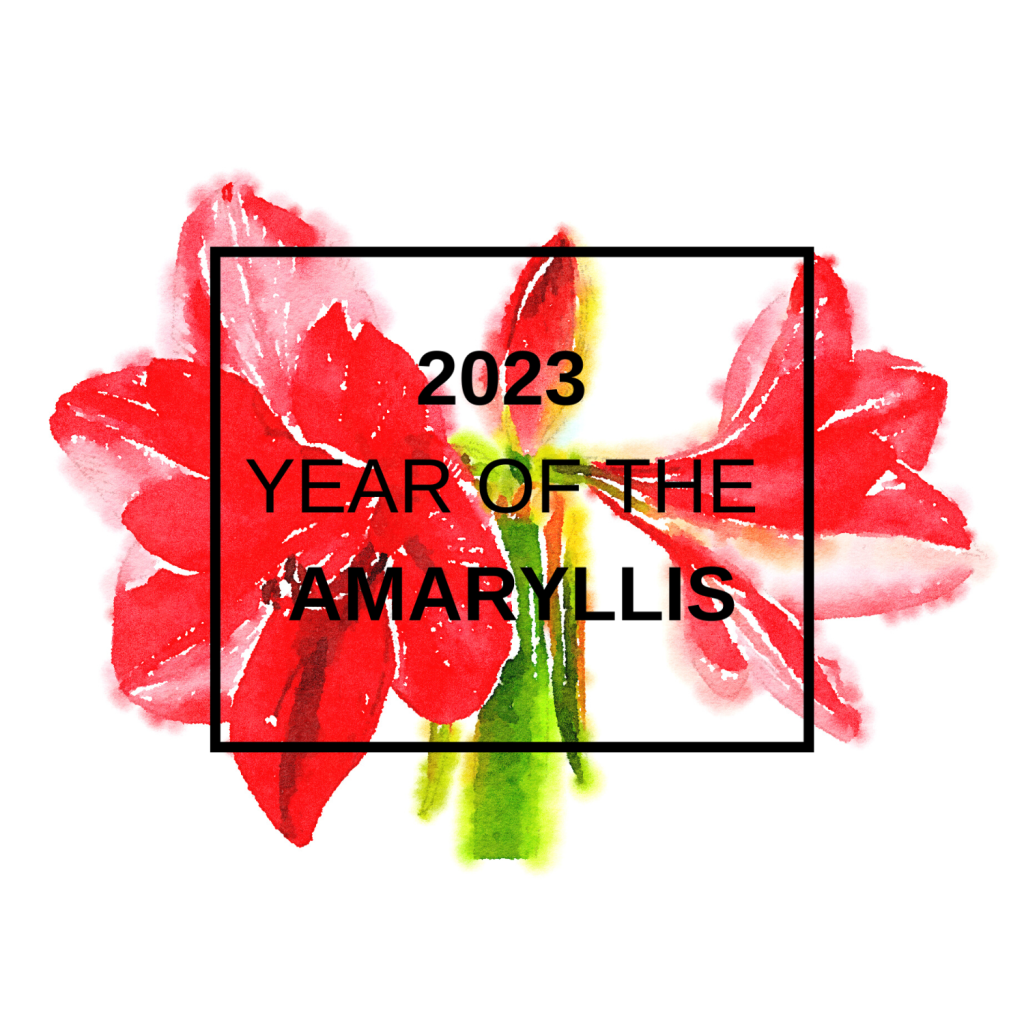
The Amaryllis you decorate your home with during the winter holidays is a Hippeastrum.
A member of the genus Amaryllidaceae, Hippeastrum bulbs are native to Central and South America and include 90 species and over 600 cultivars; these plants are commonly called Amaryllis.


In contrast, Amaryllis is a bulb native to South Africa with only one species, Amaryllis belladona, also known as “Naked Ladies” because of their pink flowers on stems without leaves.
For our “Year of the Amaryllis” program, we will focus on the Hippeastrum plants commonly referred to as Amaryllis.


Wintertime Bulbs
Amaryllis (Hippeastrum) offered in the late fall through winter are used as forced bulbs to decorate and beautify the inside of homes during the winter. These easy-to-grow bulbs are being propagated in many parts of the world today.
Garden centers, websites, and garden catalogs often share where their bulbs were grown, whether in the Northern Hemisphere, like Holland or in the Southern Hemisphere, like South Africa. Bulbs from South Africa available in the fall normally take 3–5 weeks to bloom, while the ones from Holland normally take 4–8 weeks to bloom. This information about bloom times may help you make appropriate choices when deciding which bulbs to purchase.
Which Amaryllis to Choose
Amaryllis is offered in assorted sizes, measured in centimeters in circumference (around the bulb). Larger bulb sizes normally produce more flower stalks or more flowers per stem. The heavier the bulbs, the more expensive it is. The largest size is sometimes called jumbo.
Speaking of choices, Amaryllis come in a wide variety of colors and flower formations thanks to the hybridizers who are continuing to create more forms and colors.
Single Flower Amaryllis


These are normally large flowers with six petals per flower; multiple stems and multiple blooms per stem; often one stem emerges at a time, giving a long bloom season, typically a month or more.
Some varieties to look for:
- Barbados — thick red petals with a bold white starburst.
- Gervase – variable coloration from flower to flower of white with pale pink, dark pink, red striped, and feathering.
- Picotee – elegant crisp white flowers with just a hint of a red edge around each petal.
- Red Lion – large, bright red flowers perfect for brightening up any room.
- Rilona – large peachy, apricot-salmon flowers; darker in the center.
Double Flower Amaryllis


Large flowers with additional petals found within the outside six petals. Some petals curve into the center of the flower, making it look more rose-like.
Some varieties to look for:
- Dancing Queen – Fully double red and white candy-striped flower with dark green leaves.
- Marilyn – a floriferous flower with lots of layers of pure white petals and a yellowish-green heart.
Hybridized Amaryllis
Hybridizers of these extremely popular bulbs continue to create more types of ‘Amaryllis’ (Hippeastrum), often with different shapes and petal forms. Some, with their pointy, thin petals, resemble spider legs.
- Bogota – fascinating, spider-type flowers; upper petals are deep red while lower petals are lighter with a touch of salmon.
- Evergreen – tropical, spider-type flowers that are an award-winning green, quite unusual for this group.


Planting Your Amaryllis Bulb
- Use a good potting mix that includes bark to help with drainage.
- Place your bulb in the container with the top 1/3 of the bulb above the soil.
- Water once; do not water again until there is a sign of some growth, and then water only sparingly.
- Amaryllis need lots of light. Select a location with as much light as possible and add grow lights if possible. If not using grow lights, place your container where there is the most amount of natural light after sundown. This will keep it from stretching to reach for more light.
- Once the flower stalk begins to form buds, water as needed. (Hint: Lift the pot once potted but before the first time you water. This will give you a feel for its weight without water. The top of the soil may feel dry but the weight of moist soil deeper in the pot, which makes it heavier, will help you know when the bulb needs to be watered).
- Once the flower has finished blooming, cut off the spent flower, leaving its green stem, which acts as another leaf.
Many good garden centers, catalogs, and websites offer ‘Amaryllis’ already in a container, ready to give as a gift. Some even have the bulb ‘waxed’ and growing.
What to do with Your Amaryllis After It Blooms
- Once your potted Amaryllis (Hippeastrum) flower has finished blooming, you should continue to leave it where it gets as much light as possible, watering when necessary. This will help it store enough starches and sugars in the bulb so it will rebloom the following year.
- Once the springtime warmth is in your area to stay, you can set your potted Amaryllis (Hippeastrum) outside to continue to work on creating next year’s flower. Mark your calendar to take the pot inside on September 1st; put it in a dark, cool place (closet; under the bed, etc.) so it can take a ‘nap’ for a couple of months. Then on November 1st, repot your ‘Amaryllis’ (Hippeastrum), water it, and give it light so you can enjoy it again.
- If you live in an area where the winter hardiness zone is 8-10, once the springtime warmth arrives, you can plant your Amaryllis (Hippeastrum) out in your garden. Many of them come back and bloom in the summer garden year after year. You’ll notice that they don’t grow as tall outside as they do inside. That’s because inside, they are ’s-t-r-e-t-c-h-i-n-g’ for light, and out in the garden during the summer, the days are much longer, and finding the light is easy.
All photo provided by the National Garden Bureau.