



Prepared by Patrick Ryan from a list by the Royal Geographic Society (www.rgs.org/schools).
As winter sets in here in the North, take a minute to admire the way native plants get through the colder months. Here are the adaptations with photographic examples of each. NOTE: This is not a complete list of forest plants. Thinks of this as a teaser to learn more about plants in your area.

1. Grow Close to the Ground
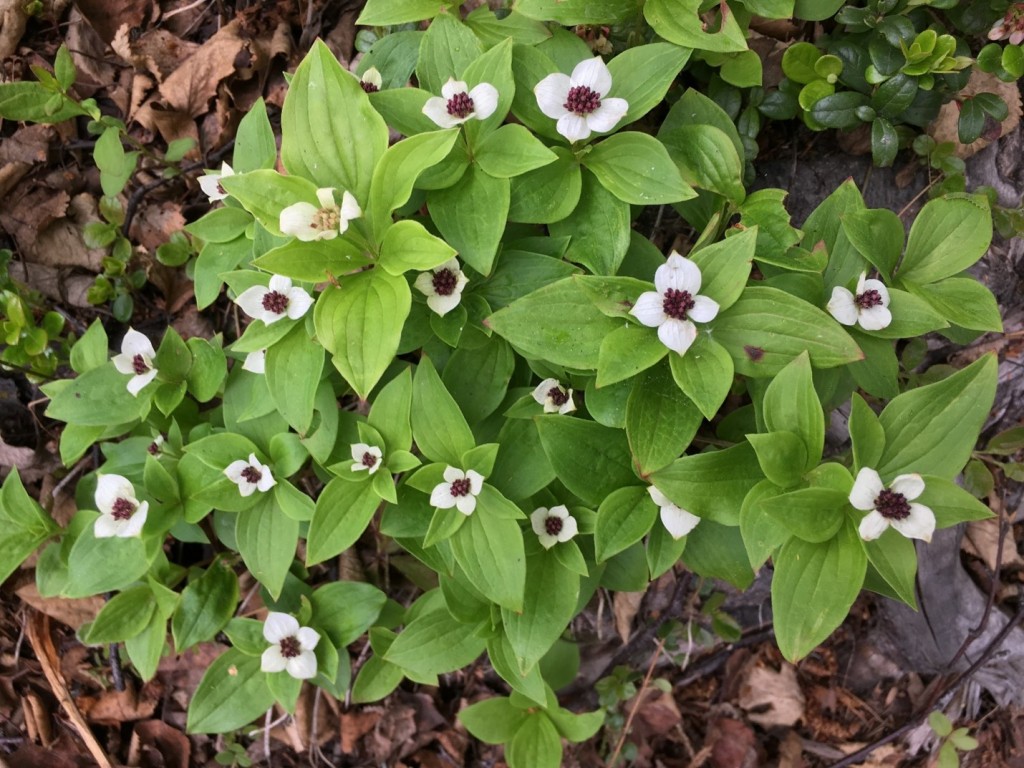
This reduces damage caused by wind and ice particles. Look to the forest floor for Canada Dogwood (Cornus canadensis), Lowbush Cranberry (Vaccinium vitis idaea) the Clubmosses (Lycopodium species), and Pink Pyrola (Pyrola asarifolia), whose shiny evergreen leaves will wait under snow to green up the forest floor in the spring. These plants are visible until we get several inches of snow.

2. Small Leaves
Conserve water which can be lost through the leaf surface (transpiration). Somewhat same as above, especially Lowbush Cranberry and Kinnikinnick (Arctostaphylos uva-ursi, AKA Bearberry)
3. Shallow Root Systems
Sallow root systems allow a plant to grow in the active soil layer and avoid the permafrost. Very noticeable with our larger trees: Spruce, Birch and Cottonwood. Roots growing right on the soil surface can make walking tricky in the woods, and trees may be more susceptible to blowing over in high winds.

4. Grow in Close Proximity to One Another
Each plant acts as a barrier for others from the wind and ice particles. This is quite apparent in the dense Spruce/Hardwood forest here. Even so, an errant wind may take down a random tree in the middle of a dense forest.

5. Stem, Buds and Leaves Are Covered in Small Hairs
These small hairs create a layer of insulation for protection against cold temperatures. The first plant I think of is Labrador Tea (Ledum palusris ssp groenlandicum). Ssp is the abbreviation for “subspecies” and you probably guessed that “groenlandicum” refers to Greenland.

6. Can Photosynthesize in Extremely Cold Weather Conditions
Some plants store energy despite a lack of sunlight for large parts of the year. Quaking Aspen (Populus tremuloides) and Willow (Salix species) have greenish-yellow bark that allows photosynthesis to continue in winter and produce sugar for energy. There are about 40 types of Willows in Alaska.

7. Develop and Produce Seeds in a Relatively Short Time
This allows for germination to be possible in a small favorable climatic window of time. Very noticeable in our short Summers here. Our Anchorage growing season is usually around 90 days (June, July and August). We sometimes get an early start in May and a short extension into September. Once the Fireweed blooms (Chamerion angustifolium), that is our traditional signal that Summer is over and many plants will be making fluffy “cotton” or interesting seed pods. See my previous post on collecting seed pods.

8. Ability to survive on bare rock (Lichen)
Some species survive where soil doesn’t exist. Lichens are a symbiotic partnership of a fungus and an alga. They’re neither plant nor animal. The fungus provides a structure for the algae to live in, while the algae provide food for the fungus. There are three main types of lichens: Foliose, Fruticose and Crustose. There are upwards of 500 species of Lichens in Alaska. Learn to recognize these alien-looking species when you are out enjoying Nature. You don’t have to be an expert. Just see how many you notice.