


Larry Hodgson has published thousands of articles and 65 books over the course of his career, in both French and English. His son, Mathieu, has made it his mission to make his father’s writings available to the public. This article was originally published in the newspaper Le soleil on May 2, 1998.
Nature did not make cacti and succulents on a whim. They are the product of a long evolution that took place simultaneously in different parts of the world and is still going on today.

Adaptation to Drought
Indeed, when a region becomes drier, the plants that inhabit it are forced to choose between adapting or dying. Many choose to adapt.
However, not all plants in dry regions become succulents. Some escape drought by learning to live at 100 miles per hour… and survive as seeds for decades until the rains return. This is the case with desert annuals, like the California poppy (Eschscholzia californica). Its seeds can stay buried for 70 years or more waiting for a good rainfall and then the plant sprouts, flowers, sets seed and dies… in less than two months.

Other plants protect themselves from drought in another way: they hide in the ground. Many bulbs, in particular, live in arid regions, growing and flowering when it rains, retreating below ground in dry weather.
Only a few plants brave the elements: succulents. Over millennia, their epidermis has thickened and become covered with wax, hairs and spines in order to reduce water loss. They have a surprisingly low number of stomata (breathing pores) and, furthermore, they only breathe at night, when the air is cooler and there is less evaporation. But what is most striking is the thickness of the stems and leaves: they are swollen, full of water, containing enough reserves to help them live through long months of drought.

Cacti vs. succulents
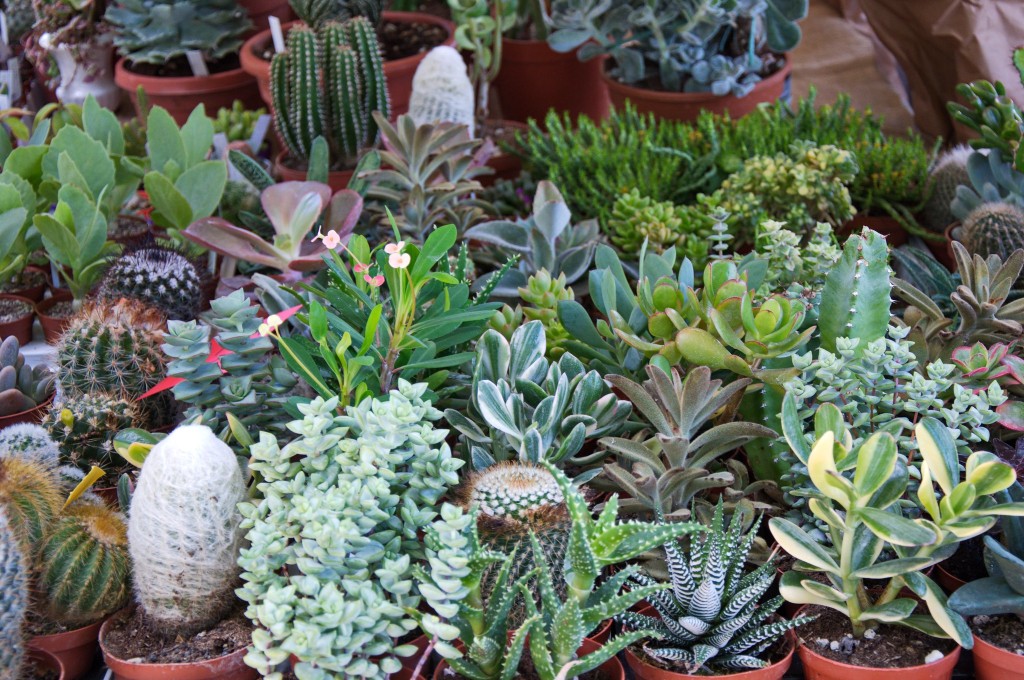
But where do cacti fit in? It’s simply a family of succulents among the many others that have adopted this kind of life. Indeed, there are the Crassulaceae and the Agavaceae (who doesn’t know the Crassula and the agave?) which are also families of succulent plants, without being cacti. And the Euphorbiaceae, which look almost identical to cacti, aren’t either.

Gene Spesard.
So how can you tell a cactus from a Euphorbia? All cacti have areoles, downy pads from which needles, flowers, fruits, new stems, etc. grow. Euphorbias and other succulents have many features in common with cacti, but do not have areolae: they are unique to cacti.