


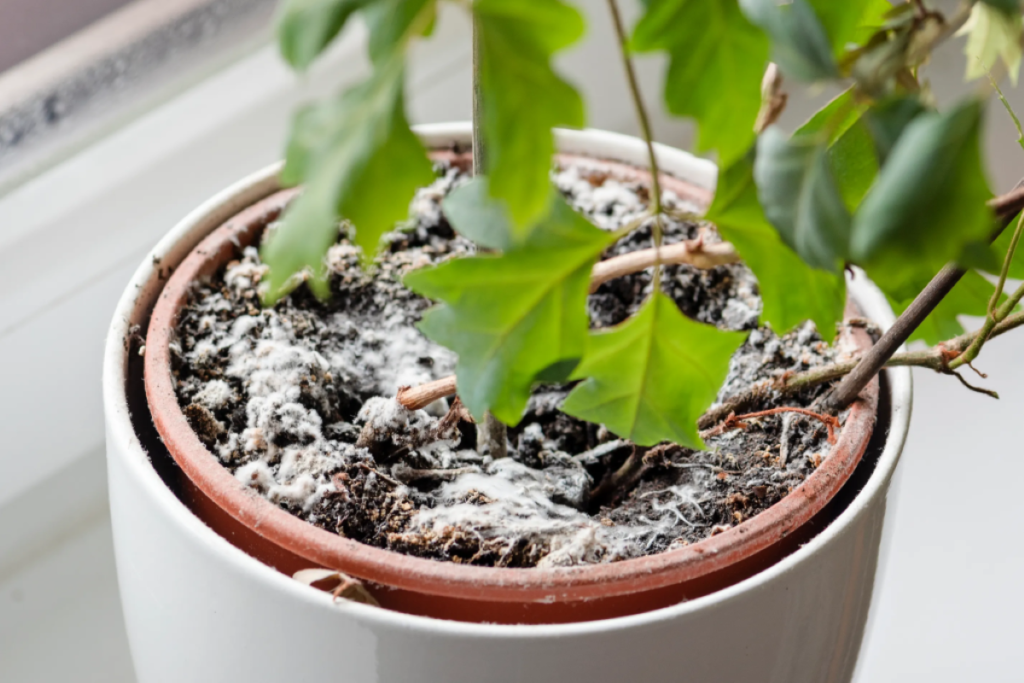
“I bought some soil a month ago and when I went to use it, there was white in it, what is that?”
I often see people ask questions about what’s in their potting soil that doesn’t look like potting soil. So here’s a roundup of some perfectly normal things that can be in your potting soil that, far from being a concern, are actually a pretty good sign.

Mycorrhizae
Sometimes soil is enriched with mycorrhizae and can look like this, even before you are in your pots. Don’t panic, this is a good sign.
These are beneficial fungi, of which there are estimated to be over 50,000 species. They occur naturally in the soil and can be purchased to add to yours as needed (when the same soil is reused in the garden from year to year for example).
Without going into detail, the “mushroom” as we know it is in fact the reproductive organ only. The individual itself is underground in the form of mycelium. It’s the famous white strands in the ground which can have the appearance of cotton wool, filament or carpet.
These mycorrhizalfungi (that’s a very expensive sounding word!) spread out underground in search of roots. Once found, they form a symbiosis (they become business partners!) The fungus uses the very long filaments of its mycelium to take minerals from the soil and transport them to the plant, while the plant, through photosynthesis, obtains sugar which it in turn shares with the fungus.

All this to say that your soil is probably very rich and will feed your plants very well. It simply has mycorrhizal friends already ready to form an alliance with it!
Fertilizer

My very first plant had these strange balls in the ground. My first reaction was to look at it under a microscope, open it up, and assume that the slightly slimy liquid inside was actually… a snail! I then watched and cherished another one of these “snails” for a few days before realizing it wasn’t moving at all. What a disappointment to discover that it was… fertilizer!
These capsules are made to dissolve over time to release their contents. Is it good for this or that type of plant? To that I say: fertilizer is fertilizer! Unless you have a carnivorous plant (which shouldn’t be in potting soil anyway) or another type of plant with very specific needs, you won’t have any problem with these snail fertilizer capsules!
Mold

If white forms on the top of the soil in your pots and it is not mychorise, there are two possibilities: either an excess of humidity has made your soil moldy (mossy aspect), or you have deposits of limestone (like sand or small hard rocks).
If you have mold, be aware that it occurs naturally in many soils, as do mycorrhizal fungi. The ones that make little filamentous bushes on the surface of the soil are saprophytic fungi (another word that pays off in scrabble). These are decomposers that can benefit your plants by recycling organic matter in the soil. They are composters of sorts.
These molds can appear on the soil of a plant whose substrate is always wet on the surface (like a tropical plant), or on the soil of your seedlings (which you probably water every day or so). It’s not harmful to human health, and you could leave it there. If you don’t like the look of it, you can simply remove it with a spoon and add more soil if needed.
Note that while some of these molds are somewhat beneficial, some can also make a very dense underground network of mycelium that can take away the draining properties of your soil. Others will signal root rot due to excess water. So be careful about how much white moss you tolerate.
Limestone

If the white forms hard crystals, no problem. It’s just lime residue from watering or even fertilizer. Once the water and nutrients are absorbed, the excess lime turns white and forms crystals. These are not harmful, but if you don’t like the sight of them, just remove the top layer of your soil.
Limescale is formed especially when the water is very hard. You may see it at the bottom of your shower. In the winter, roads turn white when salt is spread on them: this is also lime residue.
Perlite

There are different kinds of perlite, but it often appears as white rocks in the soil. It is mixed into the soil to aerate it and make it drain.

Perlite can also come in the form of Styrofoam balls. This is less environmentally friendly than rocks, but the goal is the same: to ensure good air and water circulation in the soil.
A Laidback Ladie’s Trick to Hide Imperfections and Reduce Watering
I’m not talking about a concealer, but almost! I’ve gotten into the habit of putting a little orchid soil on my plants. I don’t particularly like the look of bare soil so I cover it with a few shavings. It gives a more natural look, and it fixes the sometimes unsightly look of limestone or perlite.

Beware of overwatering, as the soil dries much more slowly with this aesthetic mulch. Even if the wood shavings are spaced far apart, the soil underneath can remain moist for weeks! This is obviously not suitable for all plants and you need a soil with good drainage, otherwise you’re risking root rot. When in doubt, a finger in the soil (past the mulch of course) will tell you if it’s time to water.
Have fun figuring out what those little white things in your soil are!