


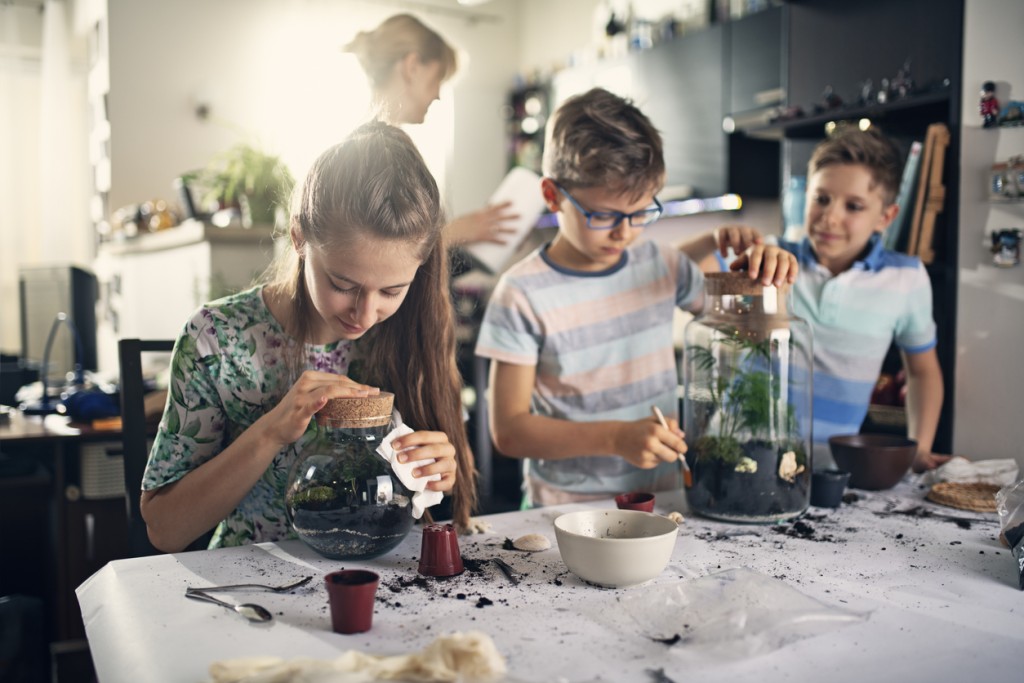
It’s well known that spring break is the best time of the school year, after Christmas vacation! And for parents or grandparents, it’s often a headache to find a balance between activities, rest, budget and efficiency!
In order to inspire you, I propose you some activities to do with your young and less young. How to have some good times, not spend a fortune in… and help you a little in your gardening, why not?)

1. Plan Your Garden
Draw your vegetable garden or flower beds on a sheet of paper or a board and ask your children to help you plan what will be planted where. Cut out a few pictures of vegetables or flowers that they can put in your garden design and use this as an opportunity to exercise their logic (or memory)! Depending on their age, give them more or less difficult directions to plan the perfect garden.
Some examples of constraints to give them:
- All herbs must be together
- Garlic shouldn’t be in the same place as in the previous two years.
- Plants that grow tall shouldn’t be on the south side to avoid shading other plants.
- Consider good or bad companions (whether you believe in them or not, the goal is to have fun!)
- Group together plants with different water requirements.
The possibilities for “instructions” are endless and if you have a large garden, it can be a real headache, even for you! Preparing can be a fun game… and useful!

2. Organize Your Seeds
A great craft project that teaches your kids that tidying up can be fun!
A binder, a box, scissors, construction paper… you know, leftovers from the year before that are lying around somewhere? Pull it all out, and make something to organize your seeds. Take a look online for inspiration, there are lots of great designs. Decorate, label, file: hours, even days, of fun!


3. Identify Seedlings and Plantings
Again, get creative! I’ve always loved crafts, and even if it’s too early to plant some plants, get a head start! Ask your kids what they would like to do: paint seedling pots? Make stick figures out of popsicles and write the name of vegetables on them? Paint rocks? Wood carving (for the pros!)

I know, I know, it’s not a child who painted these, it’s me… but I am a child in my heart!
You can outfit yourself for just a few dollars at the big box stores (it’s a kid’s DIY, no need to buy the expensive super products from a craft store!), by digging through your recycling bin, or even by looking outside at what nature has for you!

4. Buy Them a Plant
If your child isn’t that into DIY, they may want to have their own plant.

If you knew how I would have loved to have a plant in my youth… but I didn’t… so I asked for animals instead. I’m still waiting for my unicorn mom!
Taking care of a living being is a very common desire among young people. Not ready to own a pet? That’s fine. Offer your child a plant! Take them to a garden center and choose with them: make them aware of the needs of each plant and why a tropical that needs 80% humidity might not be the right choice for his room… Although maybe your project will be to build a terrarium…!

5. Play the Mad Scientist
One week is perfect to do a “scientific” experiment over a few days.
Show your kids the power of nature and teach them about patience at the same time: what more could you want? Look around the internet and you will find some very simple and fun experiments to do with your kids of all ages. Explain to them what is going on, or find an interesting video that talks about it.
Quelques exemples:
- Put the stem of a celery stalk in water with dye.
- Observe a freshly cut leaf in a glass of water in the sun and another in the dark: after 10 minutes, small air bubbles form on the leaf exposed to the light.
- Grow a fast-growing plant in a box with a hole that lets light in on one side only. Watch as the plant naturally finds its way there. You can even add a few obstacles to work around, or plug up the opening to make another one elsewhere.
- Plant the seeds you have in your pantry and observe the differences in leaves, stems, time required (sunflower seeds, chia seeds, pumpkin seeds, flax seeds, lentils, mustard seeds, cilantro seeds… I’m sure you have some edible seeds in your cupboards).
- Place a plant branch in a glass of water and watch as the roots appear.
- Plant different fast germinating seeds in a transparent container by sticking the seeds on the wall to observe the formation of the different roots.

Have a great spring break with your plants! Uh… with your kids!!! ;P