


Larry Hodgson has published thousands of articles and 65 books over the course of his career, in both French and English. His son, Mathieu, has made it his mission to make his father’s writings available to the public. This text was originally published in the magazine Fleurs, plantes et jardins in February 1998.
I have good news for everyone! I can already tell you that spring will be early… at least in the Hodgson household. Yet I am writing this in mid-October, almost five months to the day before spring officially begins. How did I know that spring would be so early?
No, I didn’t rely on the height of the beaver homes or the sayings of a fortune teller. I know that spring will be early in my house because… I always make sure that it is. In fact, I control the arrival of spring in my own backyard!


A Definition of Spring
Personally, I consider it to be spring when the first flower of the year appears. As soon as I see it, I don’t care if my yard is still covered with snow, if there is still a storm or two coming: it’s spring, period! And yet, at my place, I have, one year out of two, flowers before the end of March. It’s not because I live in Florida. My yard, located in Quebec City in zone 4 (zone 3 USDA), is even colder than the average for a residence in Quebec. So, how can I get flowers in March?

The Right Plant in the Right Place
My secret is that I do it ahead of time to ensure an especially early spring…and you can too.
First, look for the “early spring spot” on your property. Everyone has one: it’s that place where snow accumulates quite a bit, ensuring that the ground doesn’t freeze deep, but where it melts early. Be alert now: if you wait until mid-April, it will be too late to identify it. Your corner may be near the foundation of the house, next to the heat pump, but there is always a place where the ground thaws faster than anywhere else on the property.
The spot doesn’t have to be big. My “early spring spot” is located right next to the “south” wall of the house, where a huge snowdrift establishes itself each winter, forming a very effective barrier against the cold. It measures only a few square inches. Close to this wall, which always gives off a little heat because it is protected from cold winds by the snowdrift, the snow melts quickly. There is even a small space where the ground actually never freezes.
Your “Early Spring Spot”
When you have found your “early spring spot”, mark it with an orange flag. Then mark “Early Spring Spot” in your calendar, around the middle of September, because that’s when you’ll plant what will become your first spring flower.
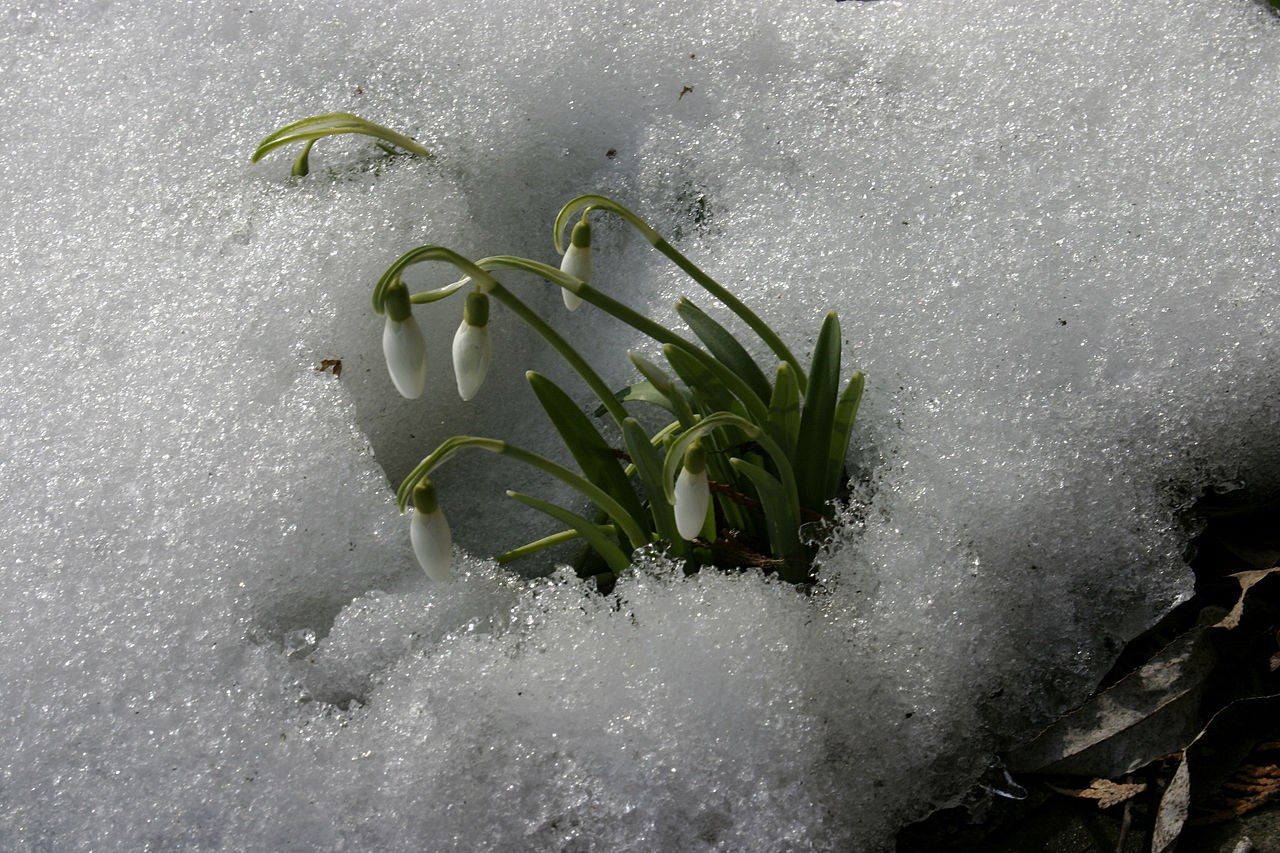
For a long time, my first spring flower was the snowdrop (Galanthus nivalis). It’s a small bulb that’s planted in the fall and, as the name suggests, one of the first to bloom when the snow melts. However, the snowdrop is white… and so is the snow. Not very flashy, is it? To catch a glimpse of the first flower of spring, I had to lie down on a snow bank, head down, to see a little white spot at its foot… at least it’s a flower. Since my arms are long enough, I can even pick the first snowdrops and make little bouquets of them. I can tell you that it looks great when you arrive at the office in March with flowers “that I just picked from my flower bed”. Everyone gives you the title of “green thumb of the office”, no further questions asked.

Earlier Than a Snowdrop?
Now I’ve found something better. It’s a flower that often appears a day or two before the snowdrop: the winter aconite (Eranthis hyemalis). No, you can’t make sprays of it, because it grows low to the ground. However, its buttercup-shaped yellow flowers are more visible against a snowy background than those of the snowdrop. Not to mention that a plant that shortens an already too long winter by a day or two is always welcome.
However, the real advantage of the winter monkshood is not in its coloring, but rather in the fact that it melts snow! In fact, this plant, like our native skunk cabbage, gives off enough heat to melt the snow around it. Fantastic, isn’t it?
As a laidback gardener, however, I have a question. How many winter aconites should be planted in a yard to melt all the snow so you never have to shovel again?