


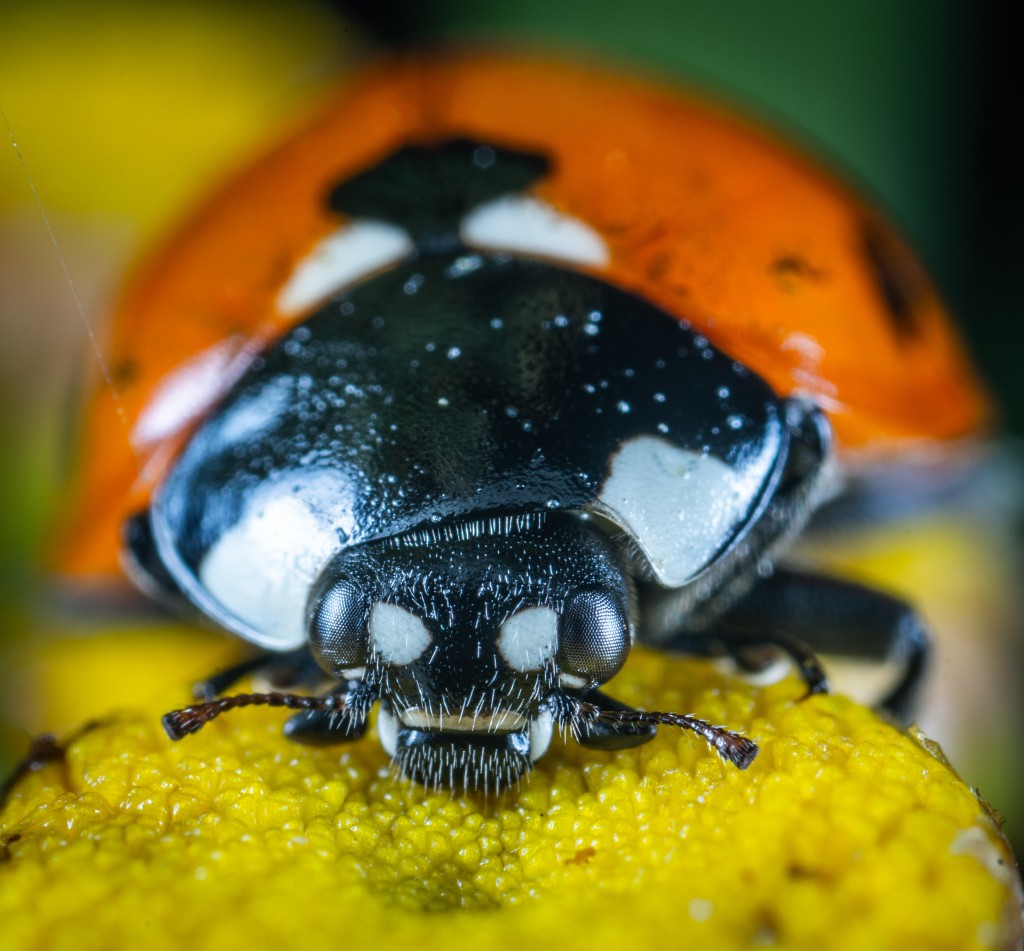
My post today isn’t very long, nor very informative. It’s more of an encouragement to all of you who are dealing with red polka-dotted intruders…my arch nemeses…the ASIAN LADY BEETLE.

When the Invader Invades
I’ve already talked about the balance in my house between ladybugs and thrips in the article How to Scare Off Thrips?
But, early in the spring, it’s THE time of year when I can be heard swearing in an ever more colorful way. We’re not talking about balance at this point, it’s a real INVASION.
Those darn lady beetles… Argh!

First of all, where do they come from? Clearly not from outside, everything is still frozen!
They spent the winter in my walls, hibernating, sleeping peacefully while benefiting from my heating… Little freeloaders!
Although they sleep, they can’t survive the extremely cold temperatures and that’s why many find a relatively warm place in the fall. The ones that fail, die during the winter (and I’m happy about that).
However, when the temperature rises in the spring, the sun warms the walls, and their cozy hiding place tells them it’s time to hunt for food, they don’t come out the way they came in. Why not? It’s still far too cold outside to go back in right away. Better to stay inside and annoy the humans!
The day we open the walls of my house, we will certainly find thousands of them, dead during their hibernation… It must help the insulation somehow!
So they come out of everywhere: moldings, light fixtures, ceilings. I swear there are no holes to get through, but they find them anyway. And they come out… and come out again… endlessly. I once counted the number of the darn bugs I was sweeping up… at least I tried… I gave up after 300…
Why Are There So Many of Them and What Are They For?
There are so many of them because they are DEMONS!

Like a hydra: you cut off one head and it grows two…
In fact, the real reason is in the ecology of the thing: as it’s an introduced species, it doesn’t have predators in Canada yet. It’s easy to understand why their numbers are so incredibly high. In comparison, native ladybugs are less likely to enter homes, are less aggressive, AND have predators.
The question, now that we understand why there are so many of them, is: why on earth did we introduce this pesky Asian Lady Beetle?
To do biological control in our agricultural fields.
What?
Biological control is the use of natural friends or enemies to benefit our crops. For example, planting the preferred plants of a pest to direct it to that “ disposable ” plant, rather than to our main crop. Or introducing snakes into fields to eat mice (a technique widely used in the United States).
Ladybugs are excellent aphid predators, which is why they were introduced. Is this better than using pesticides? This is debatable. The introduction of invasive species is in the top three of the worst environmental threats. So, in ecology, nothing is ever easy…

How to Get Rid of It?
Hahaha! That’s a good one!

Get rid of them? No way! There are always exterminators, traps, diatomaceous earth and prayers to the ladybug gods, but honestly, they’ll come back. Unless you plug up every little hole in your house, but then again, I think they can teleport in…
It’s an invasive species, by definition: it’s invasive and hard to get rid of. On a house scale, you can put a balm on it for a season or two, but they’ll come back. On a national scale, forget it, it’s too late to get rid of Asian lady beetles.
The only solution is to wait for them to integrate into our ecosystem.
Sometimes a species invades a habitat, and wipes out all the native species (the ones that are supposed to be there). Sometimes it manages to find a place that doesn’t bother others too much. The good news is that the Asian lady beetle isn’t a disaster that could completely destroy our natural environments. Phew! Some invasive species are worse than others…
The next step is that the problematic species becomes part of its environment: it finds itself a predator! And that’s the moment we’re looking forward to. Will it keep them out of my house? No. But there will be a lot fewer of them. That’s the balance of nature: it takes a while to adapt to a new situation, but eventually it happens (and when I say a while, it can be decades).
A Few Facts About Asian Lady Beetles:
- They can bite and it hurts. Strangely, they don’t seem to bite everyone: my spouse has never been bitten, but they come and bite me under my pajamas at night!
- They are a great aphid predator, so they’re beneficial in the garden and in your indoor plants. They consume many insect pests.
- They stink. The yellow liquid they let out when they are scared is not urine, as we used to pretend when we were young. It’s a form of defense: the liquid stinks and predators don’t want to eat them (honestly, would you?).
- They have four wings: two for flying and two for protection. The ones on top, the red ones with dots, are actually for protection. The other wings are hidden underneath and are folded.

- The number of points on their back? You can’t count them to tell their age.
- The white spots are not the eyes. In fact, they are not even on the head! The head is very small and a bit lower.
