


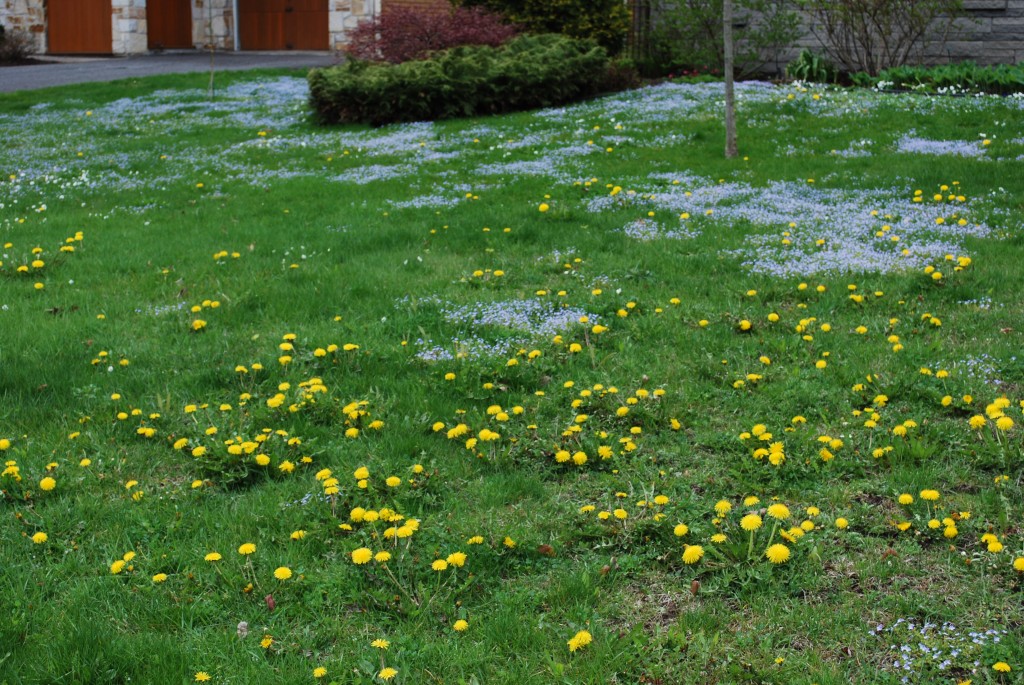
Lawns are very important in Quebec, as they are throughout North America, and are even subject to municipal bylaws. In our suburbs, houses must be set back from the road (usually 7.5 metres or 25 feet) and often the front yard cannot be fenced. This virtually widens the street and creates a sense of uniformity, but it also creates competition between neighbors and even conflict! The maintenance of our lawns becomes a kind of “civic duty”, because everyone becomes co-responsible for the image of well-being that we want to convey in the neighborhood. Not so long ago, the height of the lawn could not exceed 20 cm and several plants were forbidden. Fortunately, mentalities are changing, but a lawn that is different from the norm can be a subject of dispute and sometimes even of legal proceedings!

So when I started the greening of my lawn in the 1980s, I tried to have the best looking lawn in my neighborhood: that is, a dense, lush lawn… albeit with flowers for a few weeks in May! None of my neighbors complained about it. Of course, I worked hard at first, as I had a very demanding bluegrass lawn, but I soon found ways to get great results with less effort. So here’s what I’ve learned over the 30 years of my suburban life.
1. The Soil Must Be Dry
Don’t walk on the lawn until the soil is dry in the spring. In Quebec, with the melting of snow in April, the soil is soggy and this is a crucial time to avoid compacting it.
2. Check the pH
Check the pH by having a soil test done at a good garden center. It should be between 6 and 7. A pH that is too low or too high blocks the uptake of naturally occurring nutrients in the soil. Correct the acidity with lime if necessary. It is not necessary to do this every year.
3. Overseeding
Overseed bare spots as soon as possible with a low maintenance seed mix that contains ryegrass with endophytes (this prevents the invasion of chinch bugs), fescues, white clover and some Kentucky bluegrass. Biodiversity: it’s the most important thing! So, why not take advantage of the opportunity to introduce other small flowers that tolerate regular cutting and attract pollinators: violets, houstonia, creeping thyme? This last one tolerates drought the best and it is very pretty.

How do you do it? This is a little more work, but the results will be long term. Scarify the surface with a sharp-toothed rake or, on a large area, run a dethatching machine (scarifier) to break up the surface crust and create furrows through the lawn. Broadcast or spread the seed with a spreader. Cover the seeds lightly with a little compost. For best results with creeping thyme, buy small plants (1 for every 2-3 ft2) rather than seeds.

4. Topdressing
Topdress your lawn as needed: that is, spread a thin layer of compost (1/2 inch, 0.5 cm) in the most damaged areas and where you have over-seeded. If your lawn is in very poor condition, it may be necessary to topdress the entire lawn, but again, the effects are long term.

5. Cut Higher
Cut your lawn high: it’s the secret of a beautiful lawn! The longer the grass is, the more it is able to photosynthesize and have energy to produce deep roots and resist periods of drought: 8 cm (3 inches) high is the recommended height in continental climates. The denser the grass, the less room there will be for plants you don’t like. You can cut it shorter (5 cm) at the first and last mowings of the year, but for a flowering lawn, you may want to leave it longer.

6. Keep Your Grass Clippings
Grasscycling: leave grass clippings in place, as this enriches your lawn (you will need 25-50% less fertilizer) and protects the soil from drought. It also encourages decomposing organisms, such as earthworms, to eat the grass clippings, recycling them and aerating the soil at the same time. Use a mulching mower or plan your mowing route to go over the cut grass. It’s less work and more environmentally friendly than filling garbage bags, or even compost bags, because grass clippings cause headaches for compost site managers.

7. Fertilizer
Do you really need fertilizer? If you have used low maintenance seed with clover and are grasscycling, it won’t be necessary. But if you only have demanding grasses, then yes: you should fertilize in the spring. Of course, use 100% natural fertilizer. Check the three numbers (percentage of nitrogen-phosphorus-potassium) indicated on the bags: these three numbers must all be below 10 (like 8-2-3). If you are dealing with a contractor, ask them what N-P-K formula they use on your lawn.

Biodiversity and high cutting: these are the two key words for a dense lawn that resists well to drought and invaders of all kinds!
Currently, I have lived in the country for 20 years and have planted a low maintenance lawn, just enough to walk around the house and allow my grandchildren to play badminton or whatever. I have no bedbug or grub infestations. I do a little topdressing here and there to overseed bald spots after winter, but I never use fertilizer and we just mow the grass regularly. The rest of my land is a flower meadow where we mowed a few paths with a brush cutter and they became grassy walkways…of all kinds of plants that tolerate cutting. A real laidback gardener’s lawn!