


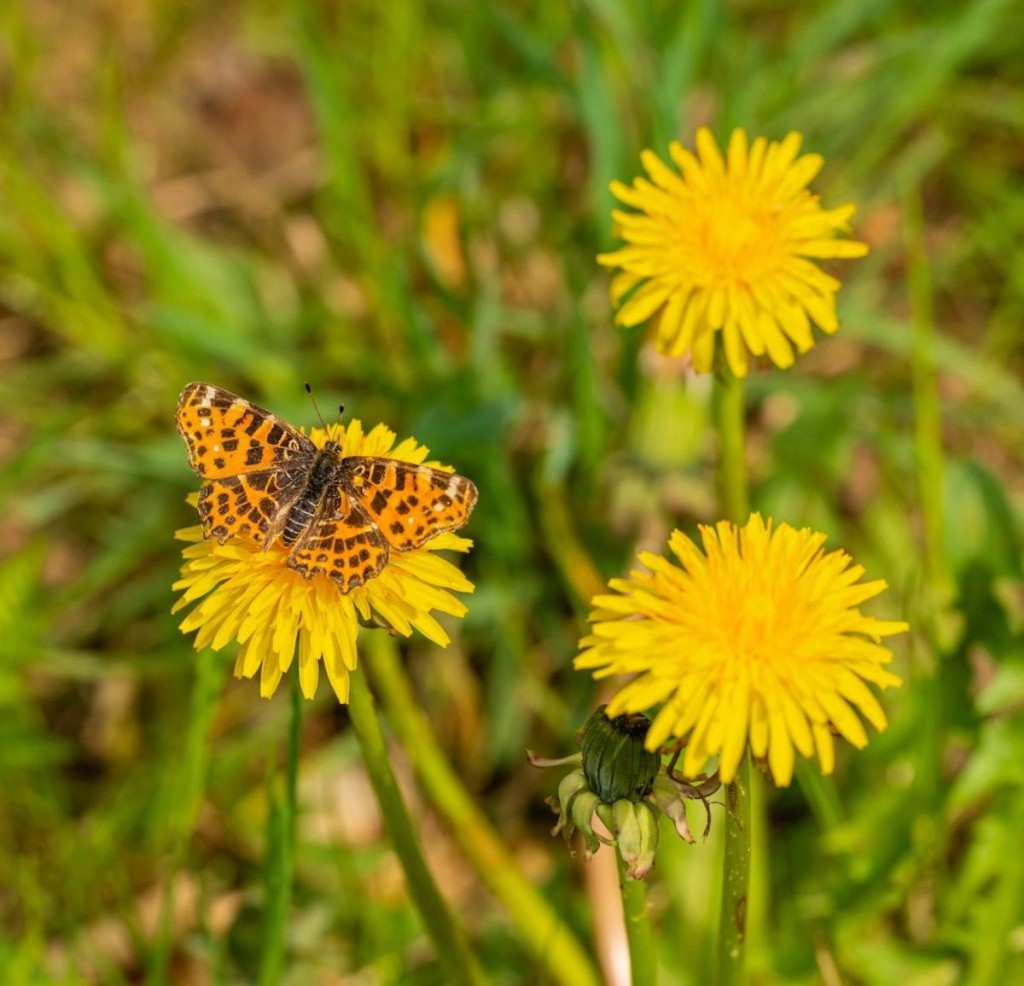
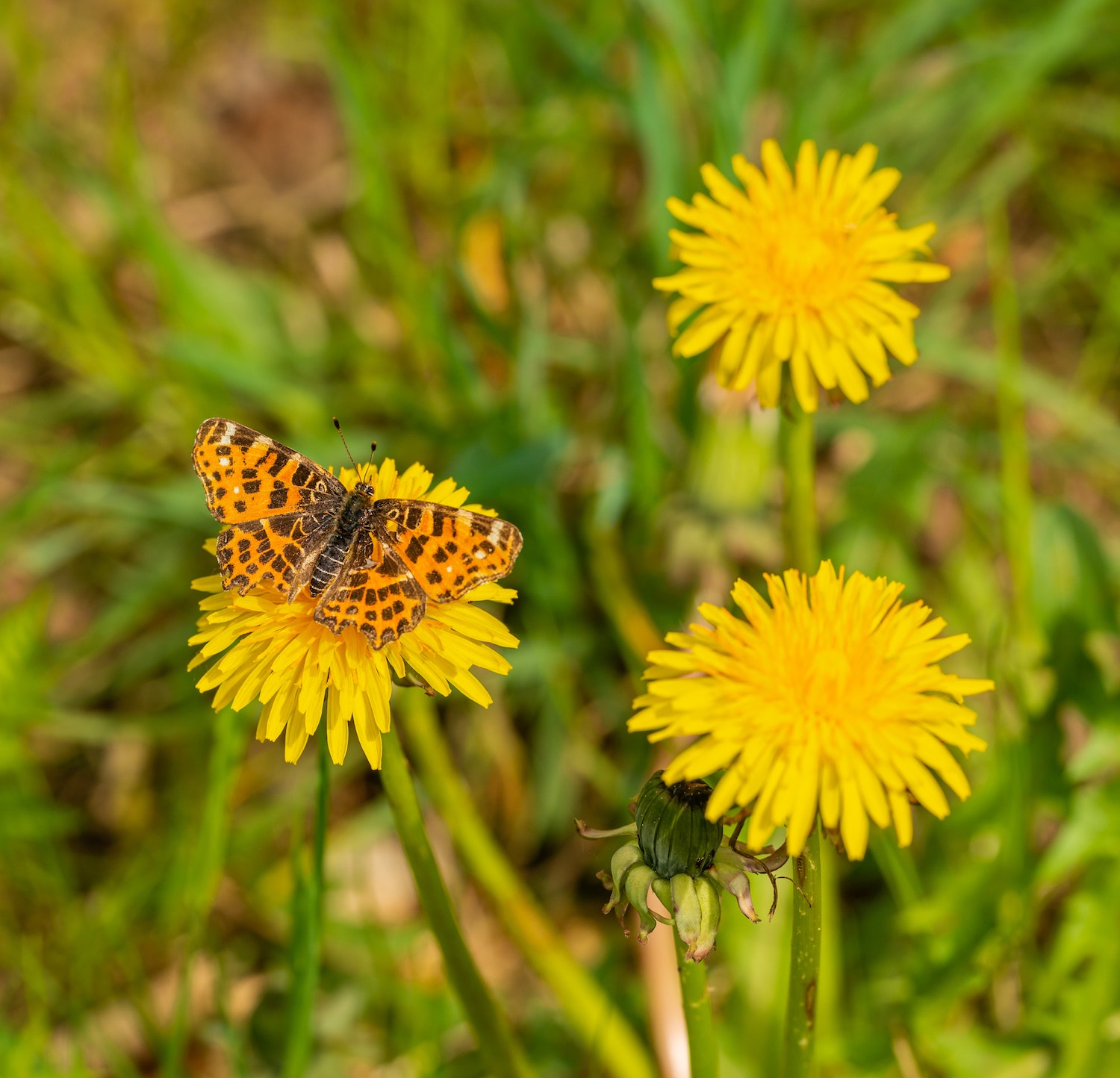
How the gardening world has changed in the last 30 years! “Organic” is now the watchword. Every mention of insecticide or herbicide is met with cries of scandal. And not only do we accept dandelions (Taraxacum officinale), but we even modify our habits to make room for them in our lawns! Who would have thought? It fills with joy the kid in me who used to come home with yellowed knees, much to the dismay of my parents who had to wash my stained pants.
You may be familiar with the Défi pissenlits (Dandelion Challenge), an initiative of Miel&Co that encourages individuals and organizations to delay mowing lawns to allow dandelions to bloom and thus feed our precious pollinators, such as bees, wasps, flies, butterflies, moths, hummingbirds, bats and others, who have very little to eat when they come out of hibernation in the spring. The destruction of natural habitats and pesticides are only two of the causes of the decline of pollinators and insects in general, hence the importance of taking action.
Times Are Changing
My father, Larry Hodgson, a great dandelion advocate, told me that when he was editor of the magazine Fleurs, plantes et jardins in the 1990s, he almost lost his job over this forbidden love. He had suggested that we let dandelions grow in our lawns and some industry players (who paid for ads in the magazine) called for his head. Fortunately for him and for us, Larry kept his head, and times have changed!
Something Other Than Dandelions!
However, there is more to life than dandelions. In her text The New Dandelion Challenge, Edith Smeesters suggests other plants, such as thyme (Thymus serpyllum) or white clover (Trifolium repens), that can be incorporated into your lawn for season-long flowering. Julie Boudreau has also compiled a list, Some of the Best Nectar-Rich Plants, with nectar bearing perennials, trees and shrubs that are a good source of nutrients for bees and butterflies, among others. That’s not to mention my own piece, A Spring Full of Flowers, for Pollinators. Why do I keep busting your chops with all these alternatives? Well, the truth is that dandelions are not really the best food source for pollinators.

An Incomplete Food
It is not the quantity of pollen produced by dandelions that is at issue, but its quality. Indeed, dandelion pollen contains an abundance of protein, but it is a protein of lesser value, lacking essential elements. Protein is composed of amino acids. However, the protein contained in dandelion pollen is low in certain types of amino acids, such as leucine and arginine. In addition, it is low in valine and isoleucine compared to the needs of bees. It is therefore an incomplete protein. A deficiency in these amino acids could reduce the brood-rearing capacity of honeybees.
I confess to taking a shortcut here by suggesting that all pollinators have the same nutritional needs as honeybees. In fact, not every pollinator has been studied. But providing a varied diet for disseminators can only have positive effects, especially when that food is flowers!
I am not suggesting that dandelions are bad for pollinators either! However, they do need a more diverse food source. No one would say that broccoli is not healthy, but eat only broccoli for months and you may feel the effects! It’s also worth mentioning that in some cases, dandelion pollen may be the only food source available at a given time or place, so it’s important. It’s a bit like fast food from the garden: it helps, but you shouldn’t eat it too often. A dandelion with that?

So why The Dandelion Challenge?
According to Miel&Co, “this movement aims to raise awareness of the importance of pollinating insects”. The dandelion is emblematic of spring flowering, especially in urban areas. Who hasn’t thumbed its flower into a friend’s face to tease them, or blown its fluffy ball to the four winds (including onto the neighbor’s lawn)?
For me, the dandelion is not only an emblem of the short summers of my childhood, it is also the perfect symbol to raise awareness of the importance of pollinators to the public and to organizations. You see, we’re talking about it now. Mission accomplished! And long live dandelions!