


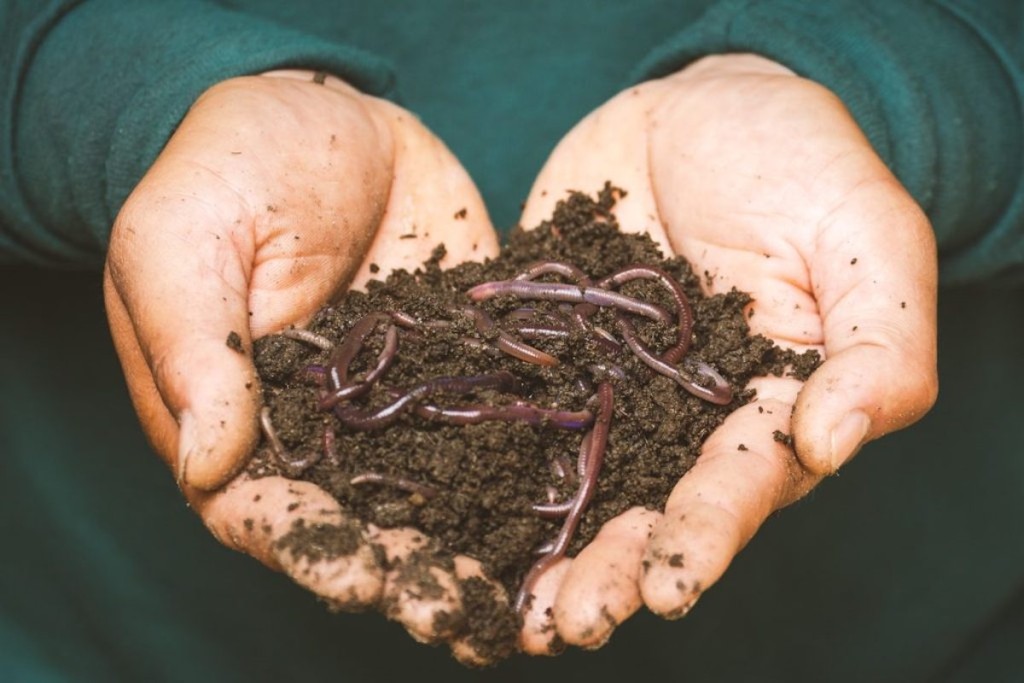
Chances are, if you’re an outdoor gardener, you come across lots of earthworms during the summer months. Little ones, big ones, short ones, long ones, pink ones, brown ones, beige ones… Have you ever noticed how many there are? Most of them stay hidden in the ground and you can’t even see them. It’s probably the bug you come across the most in your soil!
But is that a good thing? Frankly, we’re so used to seeing them that we assume their presence is normal, but is it really?

Earthworms: Invasive Exotic Species in Canada
Not a very exotic worm, you might say? And yet, they wouldn’t be here if it weren’t for the colonization of America some 500 years ago. Before that, there weren’t really any earthworms in North America.
Arriving probably in the form of eggs (which are tiny) with the French colonists, they discovered a soil rich not in gold, but in litter. They felt at home here and settled in. There are now 19 species, mostly European, in America.
So Much for the Exotic, but What About the Invasive?
The reality was that our soil was very, very rich in organic matter, as there were very few decomposers as efficient. As a result, the worms reproduced very well. But a worm is still a worm: its annual movement to colonize new environments is estimated at… 10 meters. This means that in 500 years, worms would have established themselves within a radius of… 5 kilometers. Not a very invasive prospect!
How come they’re practically everywhere, then? Even the boreal forest is beginning to have a few individuals!
Well, Gina bought some pretty flowers and planted them in front of her house in the Winnipeg, George went fishing in the Laurentians and got rid of his remaining worms by throwing them into the woods, Paulette went hiking in the Rockies with equipment full of mud and Gerald bought manure for his field in Niagara…
In all cases, worms or eggs were disseminated throughout the province, and then across the country. And since worms are highly adaptable, a small quantity of eggs is enough to colonize an entire environment. That’s the invasive side of the earthworm!

So what’s the answer to the thorny “friend or foe” question?
It comes in two parts.
Friend of Vegetables and Flowers
There’s no denying that the earthworm is a very useful worker in the garden. It digs holes and aerates the soil, makes it loose so that roots can sink deep into it, allows water to penetrate better and recycles organic matter into compost, making nutrients available to plants. Wow! A TRUE friend of the garden and flower beds.
The earthworm eats the soil, gobbling up soil, sand, bits of leaves, wood, bacteria, fungi and more. It then digests what is digestible and defecates the soil (rock particles, therefore non-digestible), but also all the nutrients necessary for plant growth.
A Natural Fertilizer
This “worm manure” is a natural, self-sufficient fertilizer for your garden. Is your plant losing leaves? Let the worms take care of it, and they’ll return the carbon to your plant in no time, enabling it to grow new leaves.
Boom! Magic! Nothing is lost, nothing is created, everything is transformed, as Antoine Lavoisier used to say… (wait, I’m googling this)… Antoine Lavoisier.
(But googling, I learn that he never actually said those words, so I’m a little disappointed. Frankly Antoine, you could have made it sexier than “[…] nothing is created, either in the operations of art, or in those of nature, and we can posit in principle that, in any operation, there is an equal quantity of matter before and after the operation; that the quality and quantity of the principles is the same, and that there are only changes, modifications.”)
Back to my verse, stop bothering me, Antoine!
The recycling work of these little laborers is so rapid that a leaf that fell in autumn, which took 3 to 5 years to decompose before the arrival of the earthworm, now only needs a few months to disappear.
The acceleration of this process, although very useful in the garden, has become a problem in the forest…
Enemy in the Forest
Where it is present, the impact of the earthworm has almost wiped out a layer of the forest floor in Canada: litter.
By rapidly recycling debris on the ground, the spongy, moist and poorly decomposed layer at the surface of the forest floor is being devoured. Yet many species have evolved with and need litter. By removing this important layer of plant debris, the health of the soil, the links between species and even the living environment of some are severely affected.

To give you an idea of the consequences of this troublesome neighbor:
- Drier, more exposed soil;
- Difficult to establish for young seedlings, especially in spring;
- Worms eat healthy seeds and young plants;
- They interfere with the beneficial links that fungi form with trees;
- They release much of the carbon trapped in forest soils into the atmosphere;
- Soil microbes travel with the worms, moving them to new environments where they could potentially cause harm;
- Many litter-dwelling species (such as insects, salamanders, toads, small mammals and even ground-nesting birds) lose their habitat;
- Animals that feed on prey in the litter are starved.
In short, a lot of damage for a single worm!
The next time you’re in the forest, take a look: do you see hard, dry, earthy soil, or soft, moist soil covered with all kinds of debris? Chances are you’ll find fewer worms (or none at all) playing in this beautiful humus than in the “clean” forest.

Different types of earthworms
Our 19 species are divided into three types.
There are those that live on the surface, in the litter on which they feed, and do not dig tunnels. They are called epigeic.
Those that dig networks of horizontal tunnels in the soil to a depth of 50 centimetres and feed by eating the soil and microorganisms found there are called endogeic.
These two groups are very useful in gardens and fields.
The third type of worm is undoubtedly the one that has the greatest impact on America’s forests. They dig a single vertical tunnel two meters deep where they bring leaves to feed. In other words, they “hide” the litter at a considerable depth, don’t stir the soil and only bring to the surface their excrement and… leaf stalks!
If you see what looks like the entrance to an anthill, but instead of a mound of sand, it’s leaf petioles and excrement, you’ve probably found a worm hole.

This worm is obviously not a nuisance anywhere in the world, and is even very useful in Europe, but as North American forests have evolved with a very thick layer of litter, its disappearance is problematic.
Luck or not, the species of worm often used for fishing is an anecium, since it is larger than the other types. As a result, they have spread rapidly through our forests. Think before you throw your worms into the woods after your fishing trip! In some places, it’s illegal to dispose of your bait by releasing it in the wild.

So What Do We Do?
As with many invasive species, the damage is already done. We can always prevent the invasion from continuing by being cautious about introducing them into new environments, but that’s about it. You can’t eradicate earthworms.
It’s important to be careful not to introduce new species. In the United States, it’s the Asian jumping worm that’s causing damage, and it’s slowly making its way up to Canada.
Fortunately, all is not doom and gloom. Some species benefit from the presence of worms, such as robins, which eat large quantities. Some plants also root more easily, such as the Jack-in-the-pulpit. Whether we like it or not, earthworms are now part of many of our ecosystems, so we might as well look at the positive!

Put Worms In Your Potted Plants… Yes, But No.
I see this question come up a lot. I understand that you want to have aerated soil full of worm manure for your houseplants, but it’s not a good idea. The worm might feel cramped in your pot, it might run out of food and attack your plant’s roots. It could even die and rot in your pot! Yuck.
No, really, unless you’ve got a MEGA potted planter with a good layer of mulch and frequently-renewed compost, this isn’t a good idea. In fact, if you have such a gigantic planter, chances are worms have already settled in.
So don’t try to force nature’s hand, and leave the worms to your outdoor plants – they’ll benefit far more than your coleus!