


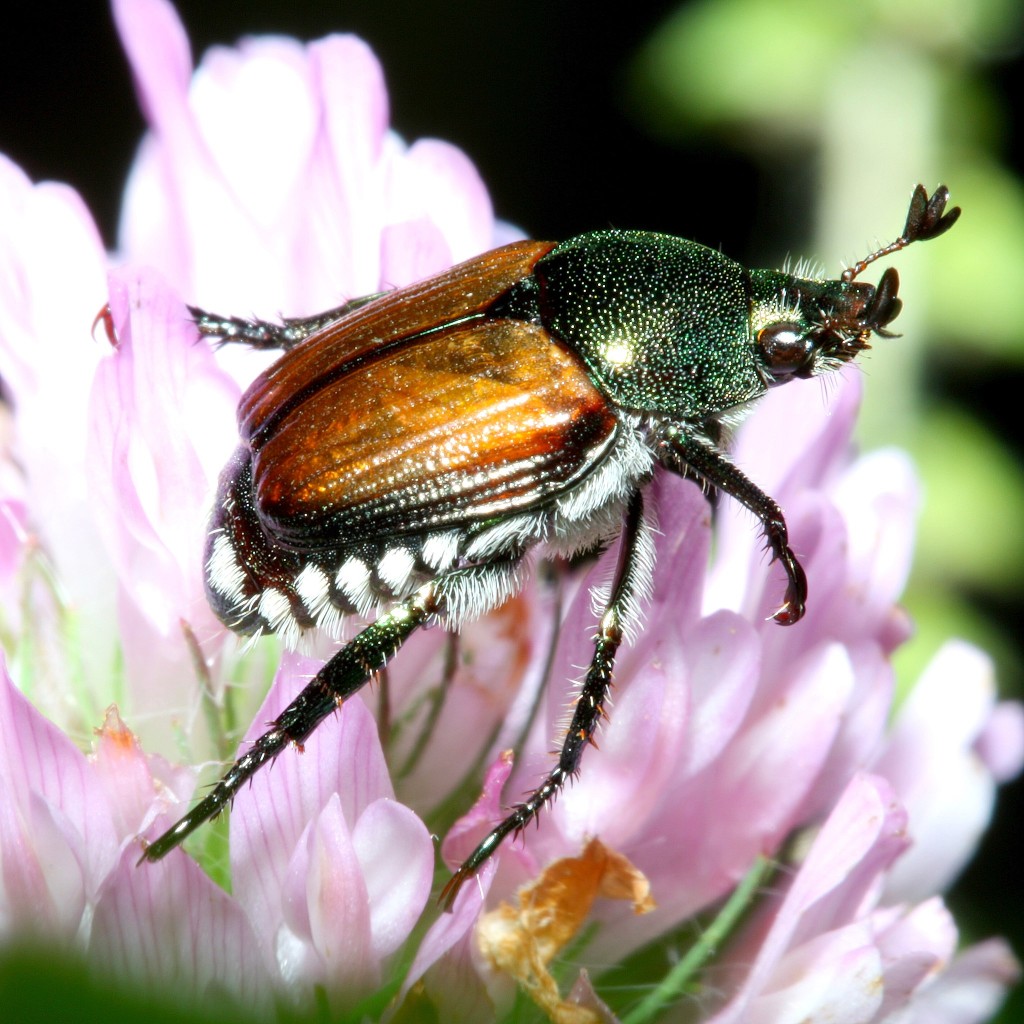
Accidentally introduced from Japan over a century ago, Japanese beetles (Popillia japonica) have become a veritable scourge for gardeners and farmers all over the American East Coast and, unfortunately, natural predators have not followed as quickly.
Japanese beetles
For those who haven’t heard of Japanese beetles yet: they’re beautiful, metallic green and brown insects (about 8 to 11 mm long, 1/4″) with 6 pairs of hairs arranged in a V shape on the underside of the abdomen. They belong to the Coleoptera family, and like ladybugs: they have elytra (hard wings) covering the second pair of wings.

But this invasive alien species is very voracious, especially as it forms colonies that attack a host of trees and shrubs. Japanese beetles feed not only on foliage, but also on flowers and fruit. They are particularly fond of fruit trees, berry bushes and roses, but can attack over 200 plant species.
They start to appear towards the end of June. Females lay eggs during the summer, preferably in grass lawns. Two weeks later, the eggs turn into larvae and then overwinter in the soil, 15 to 20 cm below the surface. These grubs come to the surface in spring to eat more grass roots, and pupate in early summer. The adults emerge in late June or early July, and the cycle begins again.

There’s no miracle cure for getting rid of Japanese beetles at the moment, but a combination of various strategies could help you get the upper hand. Alternatively, consider replacing the plants that most attract these beetles, as Larry suggested a few years ago.
Discourage Japanese Beetles From Laying Eggs in Your Home in July and August
- Avoid outdoor lighting at night, which attracts insects.
- Treat your lawn with a garlic maceration to confuse beetles: crush 2 or 3 cloves of garlic in a liter of boiling water, leave overnight, filter and spray the lawn repeatedly throughout the summer.
- Keep the grass long (3-4 inches, or about 8-10 cm), as it’s harder to lay eggs in tall, dense grass.
- Don’t water the lawn in summer, as dry soil is less suitable for laying eggs and, if the larvae are already present and the lawn is dormant, they can starve to death.
Control Them at the Larval Stage (White Grubs)
This is the most effective time to intervene, even if the worst of the damage has passed and you won’t see the effect until next summer. You need to act at the larval stage to reduce the number of adults that will emerge next spring!
- From mid-August to mid-September, treat turf with beneficial nematodes when the larvae are still small and most vulnerable. The soil must be waterlogged at the time of application. Water before and after application, and keep the soil moist for 4 to 7 days. Treat preferably on overcast days, as sunlight can kill nematodes. This product should not be used in spring, as the soil is too cold (below 15°C) and the larvae are too hardy. Nematodes are available from garden centers, and the box should be kept refrigerated at 4°C until use.
- Treat the lawn with the new BTG (Bacillus thuringiensis galleriae), which has been on the market for 3-4 years: these are bacteria that attack white grubs (beetle and chafer larvae). It can already be used when the soil is at 10°C in spring, but will be more effective in late summer when the grubs are very small. Here too, water well after applying the granules.
- Protect and encourage natural predators such as toads, birds, shrews…
Control Them at the Adult Stage
In recent years, many pheromone traps have been sold to catch these adult insects in summer, but it has been found that this attracts even more of them, even when the traps are placed at a safe distance from their favorite food.
Here are a few other simple tips:
- Put adults in a small bucket of soapy water early in the morning, while they’re still a little lethargic.
- Use a handheld vacuum cleaner to capture them and empty the contents into soapy water.
- Early in the morning, spray insects with insecticidal soap or Neem oil: this natural oil acts by blocking the insects’ respiratory openings. You’ll probably need to do this several times!
In a vegetable garden, you can cover affected plants with a floating fabric before the first beetles appear.

These control methods also apply to chafer beetles, especially in the larval stage, since European chafer beetles do most of their damage when they are in the grub stage in our lawns. We need to intervene at the end of summer, before the grubs come back, big and fat, next spring!
A Very Interesting Experiment With Parasitoid Flies
If you have a crop that attracts Japanese beetles by the thousands, here’s a success story that should interest you: the Vignoble de l’Orpailleur in Dunham, Montérégie, has been developing methods of natural pest control using beneficial insects and mites for several years, under the direction of Jacques Lasnier of the Ag-cord Research Institute Inc. To control Japanese beetles without pesticides, this researcher uses small parasitoid flies called Tachinidae Istocheta aldrichi. They lay their eggs just behind the beetle’s head. These parasitoid flies, originating in Asia, migrated from the United States to our regions, where they were introduced in the 1930s.

After hatching, the larva penetrates the insect and feeds on the beetle’s interior, and within a few days the beetle dies. The fly larva forms a pupa which remains inside the Japanese beetle until the following spring, when it emerges in its adult form (fly). It then begins its biological cycle all over again. Since 2014, tachinid fly populations have increased exponentially at Vignoble de l’Orpailleur, contributing to a considerable reduction in Japanese beetle populations.
This type of pest control is undoubtedly the solution for a pesticide-free future in both agriculture and horticulture.