


A few weeks ago, my sister-in-law asked me to come and look at her garden. She needed some advice. The flowerbed at the front of her house was full of weeds, and she didn’t like the path to the front door, or the old stone wall. Time to start again!
Her main question was: what plants should I put in so as to have as little maintenance as possible? She and my brother are often outdoors in the summer, and they have very active children who have to be transported here and there. In short, they don’t have much time to maintain their garden. No problem!
My father, Larry Hodgson, has dedicated his career to making gardening as simple as possible, so that we can enjoy beautiful flowerbeds without sacrificing all our free time. There is such a thing as an almost maintenance-free garden. Let’s take a look at a few perennials that, according to him, are not only easy to maintain, but are hardy and will last for decades.

Bear’s Breeches
Acanthus hungaricus
Dimensions: 75-120 cm (24″-48″) haut x 80 cm (32″) large
Exposition: soleil, mi-ombre, ombre
Soil: well drained
Flowering: July-September
Hardiness: 4 (USDA 3)
Uncommon in our gardens, this is a perennial with a long flowering period. Its cut foliage comes out early in spring and remains attractive until autumn.

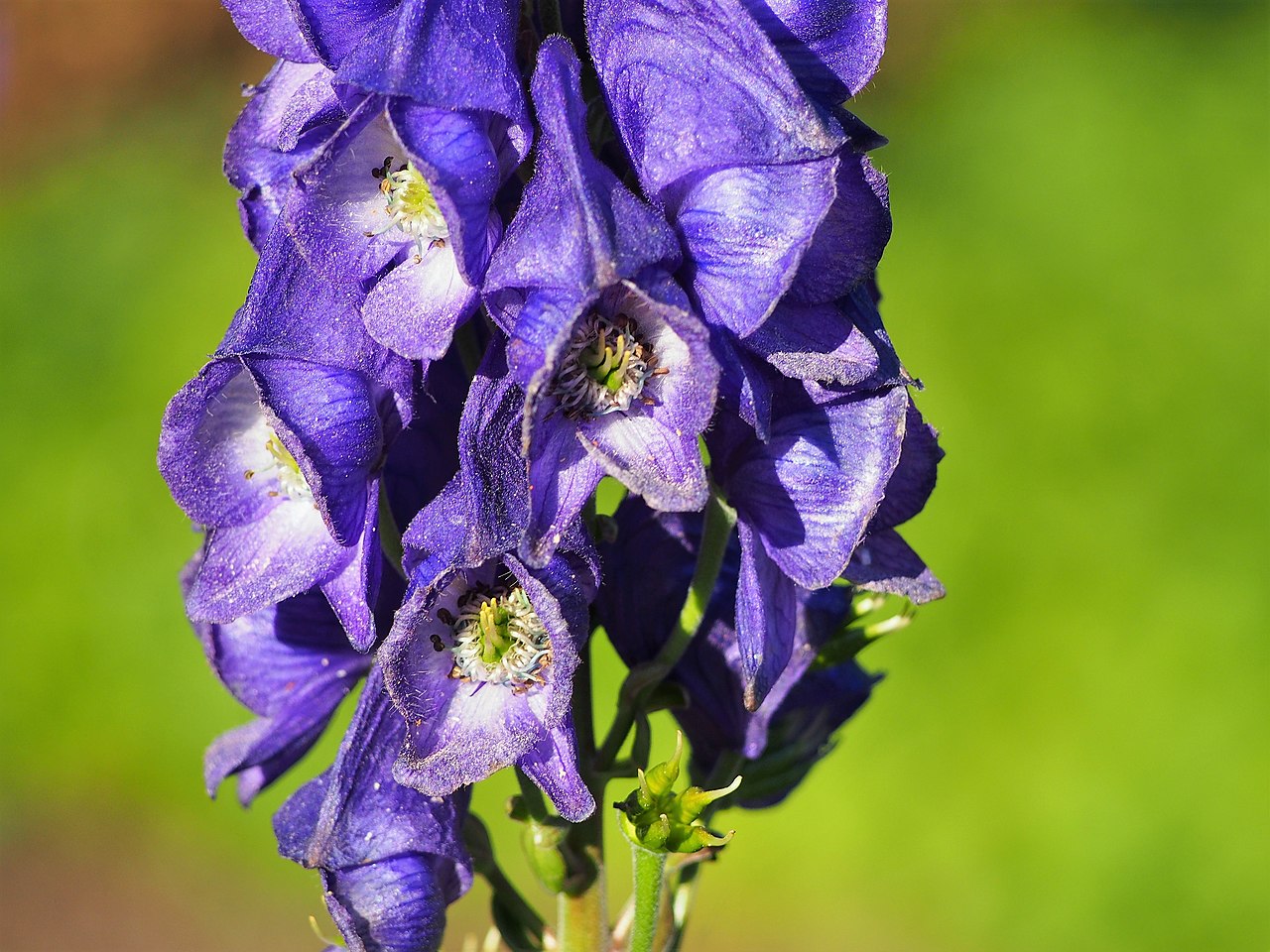
Wolfsbane
Aconitum
Size: depending on cultivar, 60-180 cm (24-72″) high x 40-90 cm (16-36″) wide
Exposure: sun, partial shade, shade
Soil: well drained, moist, rich in organic matter
Flowering: according to species
Hardiness: 2 or 3 (USDA 3 to 7)
Recommended species and cultivars: A. × cammarum ‘Eleanora’, A. × cammarum ‘Pink Sensation’, A. × cammarum ‘Eleanora’, A. carmichaelii ‘Arendsii’, A. napellus ssp. vulgare ‘Albidum’
An easy-to-grow, resilient perennial, wolfsbane can live up to 40 years.

Bluestar
Amsonia
Size: depending on species, 40-100 cm (16-40″) high x 40-120 cm (16-48″) wide
Exposure: Sun, part shade
Soil: ordinary, well-drained, moist
Flowering: June-July, depending on species
Hardiness: depending on species, 3-5 (USDA 3 to 9)
Recommended species and cultivars: A. tabernaemontana, A. hubrichtii
One of the few plants with truly blue flowers. It remains attractive after flowering thanks to its pointed, willow-like leaves and sturdy stems. Its main attraction is its golden-yellow autumn color.

Wild Indigo
Baptisia
Size: depending on species, 25-200 cm (10-78″) high x 60-200 cm (24-78″) wide
Exposure: sun, part shade
Soil: well drained, dry
Flowering: June-July
Hardiness: depending on species, 2, 3 or 4 (USDA 3 to 9)
Recommended species and cultivars: B. australis, B. alba var. alba
With its violet-blue flowers, Wild indigo resembles lupine, a close relative. A large perennial, it acts as a shrub. Slow to establish, it is nevertheless almost permanent.

Bleeding Heart
Lamprocapnos spectabilis, Dicentra spectabilis
Dimensions: 60-120 cm (24-48″) high x 90-120 cm (36-48″) wide
Exposure: sun, part shade, shade
Soil: well drained and deep
Flowering: May-June
Hardiness: 2 (USDA 3 to 9)
Recommended species and cultivars: L. spectabilis (Dicentra spectabilis), L. spectabilis ‘Gold Heart’.
A classic in our gardens, but what a bloomer! This perennial forms small, heart-shaped flowers. Plant it where it won’t be seen, as it often goes dormant and its leaves turn yellow in summer.

Gas Plant
Dictamnus
Dimensions: 60-90 cm (24-36″) high, 90 cm (36″) wide
Exposure: sun, part shade
Soil: well drained, deep, rich
Flowering: June-July
Hardiness: 3 (USDA 3 to 8)
Recommended species and cultivars: D. albus purpureus
Although slow to mature, gas plants can last over 75 years! Their flowers, borne in spikes, are orchid-like with an orange fragrance.

Daylily
Hemerocallis
Size: depending on cultivar, 15-200 cm (6-78″) high, 15-90 cm (6-36″) wide
Exposure: sun, part shade
Soil: all
Flowering: depending on species, June-October
Hardiness: depending on species, 2 or 3 (USDA 2 to 9)
Recommended species and cultivars: H. ‘Elfe Marie-Antoinette’, H. ‘Frans Hale’, H. ‘Malija’ Golden Zebra™?, H. ‘Autumn Minaret’, H. ‘Stella de Oro’, H. ‘Apricot Sparklers’, H. ‘Berrub’ Ruby Stella, H. ‘Black Eyed Stella’, H. ‘Buttered Popcorn’, H. ‘Catherine Woodbery’, H. ‘Chicago Apache’, H. ‘Going Bananas’, H. ‘Happy Returns’, H. ‘Just Plum Happy’, H. ‘Little Grapette’, H. ‘Moses’ Fire’, H. ‘On and On’, H. ‘Pardon Me’
Daylily flowers last only one day, hence the name “daylily”. There is usually more than one bud per stem. With flowering times ranging from three weeks to several months, depending on the species and cultivar, they have a reputation for being very easy to grow.

Hosta
Size: depending on cultivar, 10-120 cm (4-48″) high, 15-180 cm (6-72″) wide
Exposure: sun, part shade
Soil: moist, well drained
Flowering: July-August
Hardiness: 3 (USDA 3 to 8)
Recommended species and cultivars: H. plantaginea, H. ‘American Hero’, H. ‘August Moon’, H. ‘Big Daddy’, H. ‘Blue Mouse Ears’, H. ‘Empress Wu’, H. ‘Fragrant Bouquet’, H. ‘Krossa Regal’, H. ‘Liberty’, H. ‘Patriot’, H. ‘Bailey Langdon’, H. ‘Praying Hands’, H. ‘Sagae’, H. ‘Sum and Substance’, H. ‘Striptease’.
Available in a wide range of sizes and foliage colors and shapes, hostas adapt to a variety of conditions, from dry shade to full sun. Take care to choose slug-resistant varieties.

Peony
Paeonia spp.
Size: depending on cultivar, 30-150 cm (12-60″) x 60 x 90 cm (24-36″)
Exposure: depending on cultivar, sun, part shade
Soil: well drained, rich
Flowering: late spring
Hardiness: 3 or 4 (USDA 3 to 8)
Recommended species and cultivars: Paeonia daurica ssp. mlokosewitschii, P. obovata, P. tenuifolia, P. lactiflora ‘Angel’s Cheeks’, P. lactiflora ‘Bowl of Beauty’, P. lactiflora ‘Cheddar Gold’, P. lactiflora ‘Clair de lune’, P. lactiflora ‘Coral Charm’, P. lactiflora ‘Coral’n Charm’, P. lactiflora ‘Dandy Dan’, P. lactiflora ‘Gold Standard’, P. lactiflora ‘Ilini Warrior’, P. lactiflora ‘Kansas’, P. lactiflora ‘Krinkled White’, P. lactiflora ‘Madame de Verneville’, P. lactiflora ‘Many Happy Returns’, P. lactiflora ‘Paula Fay’, P. lactiflora ‘Hawaiian Coral’, P. lactiflora ‘Salmon Chiffon’, P. lactiflora ‘Scarlett O’Hara’, P. lactiflora ‘Sea Shell’, P. lactiflora ‘Walter Mains’, P. lactiflora ‘Westerner’, P. ‘Bartzella’, P. ‘Julia Rose’, P. ‘Scarlet Heaven’.
In addition to their beautiful spring flowers, the foliage of herbaceous peonies remains dome-shaped after flowering and attractive.

Great White Fleeceflower
Persicaria polymorpha (Polygonum polymorphum, Koenigia alpina var. alpina)
Dimensions: 1.2-2.5 m (4-8′) x 1.2-2.5 m (4-8′)
Exposure: sun, part shade, shade
Soil: rich, cool
Flowering: June-October
Hardiness: 3 (USDA 4 to 9)
Larry Hodgson’s favorite perennial because of its shrub-like size, bamboo-like stems, prolonged white bloom, versatility and hardiness.