


Larry Hodgson published thousands of articles and 65 books over the course of his career, in both French and English. His son, Mathieu, has made it his mission to make his father’s writings accessible to the public. This text was originally published in Le Soleil on August 21, 1993.
It’s a curious fact of human nature: we never seem to appreciate what we have, but always covet what others do. This is true in everyday life… and just as true in the garden. Take the goldenrod as an example…
Here in Canada, where goldenrod (Solidago) grows wild in profusion, we treat this plant as a “weed” and pull it from our gardens and fields. We also give it the epithet – and without reason – of “allergy causer”. In fact, there’s probably not a single flower bed in 100 where this wildflower can be found. And yet…
Let’s transport ourselves across the Atlantic to Europe, where goldenrod is not indigenous. The story is very different. Indeed, this beautiful foreigner from America is loved, adored and exalted. “The most spectacular of autumn flowers”, says a French specialist. “A mixed border without goldenrod? Impossible!” exclaims a British horticultural writer. Crosses are made to develop varieties with earlier flowering, more compact growth and more varied coloration. This home-grown “weed” is a big star overseas!

A Persistent Myth
One of the most persistent myths about goldenrod is that it causes hay fever. This belief originated with our ancestors who, seeing that this allergy began every August at the same time as the goldenrod started to flower, attributed the cause to the goldenrod. Today, we know that late summer seasonal allergic rhinitis is caused not by goldenrod, with its showy flowers, but by ragweed (Ambrosia), with its barely noticeable greenish flowers. For goldenrod pollen to cause an “atishoo!” (because it’s possible), you’d have to bury your nose in the flower cluster, because its pollen is too heavy to travel with the wind, unlike the light pollen of ragweed, which depends on the wind for pollination.
But even if goldenrod weren’t falsely accused of being allergenic, it’s unlikely to be given any attention, as it’s too common in the wild. After all, neither would we appreciate the wild aster, which flowers at the same time as the goldenrod… until it came back to us from Europe with its credentials and in the form of improved hybrids. It is now one of the most popular autumn-blooming perennials.

Description
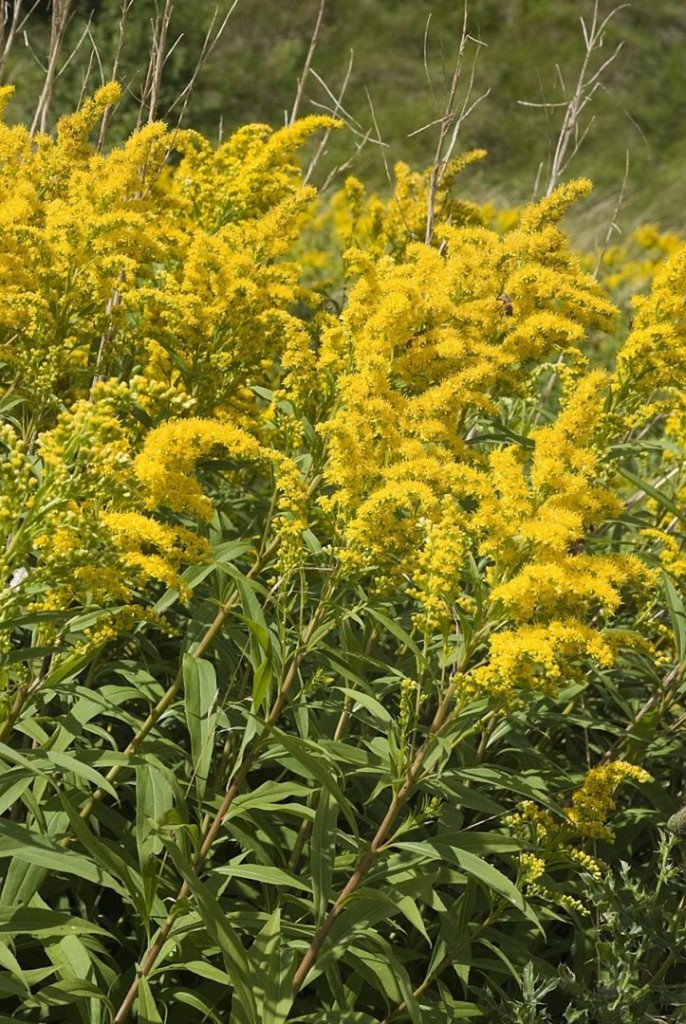
Everyone has seen the goldenrod, as it grows just as much in the countryside, in fields and on the edge of woods, as in vacant lots in the city; but perhaps you’ve never stopped to try and distinguish it from other “weeds” (or wildflowers, depending on your point of view), it’s a highly variable plant, as there are over 125 species, many of them native to Canada, but always with yellow flowers in clusters that only bloom in autumn. The flower is often shaped like a light plume.
The plant is generally quite tall – 1 m to 1.25 m (36-48’’) – and is ideally suited to the garden background, where its autumn yellow flowers steal the show just as other garden plants begin to fade. It’s also an excellent cut flower and can be dried to decorate homes in winter.

Easy to Grow
Goldenrod is very easy to grow. Sun or half-shade, dry or moist soil, rich or poor… it adapts to everything. Once transplanted to your garden, goldenrod is easy to propagate: simply divide as needed in spring. Not to mention its rich nectar content for insects.
“No man is a prophet in his own country”, as the saying goes, and this is certainly true of the goldenrod, an underrated but magnificent star! Now it’s up to us to discover its many facets.