


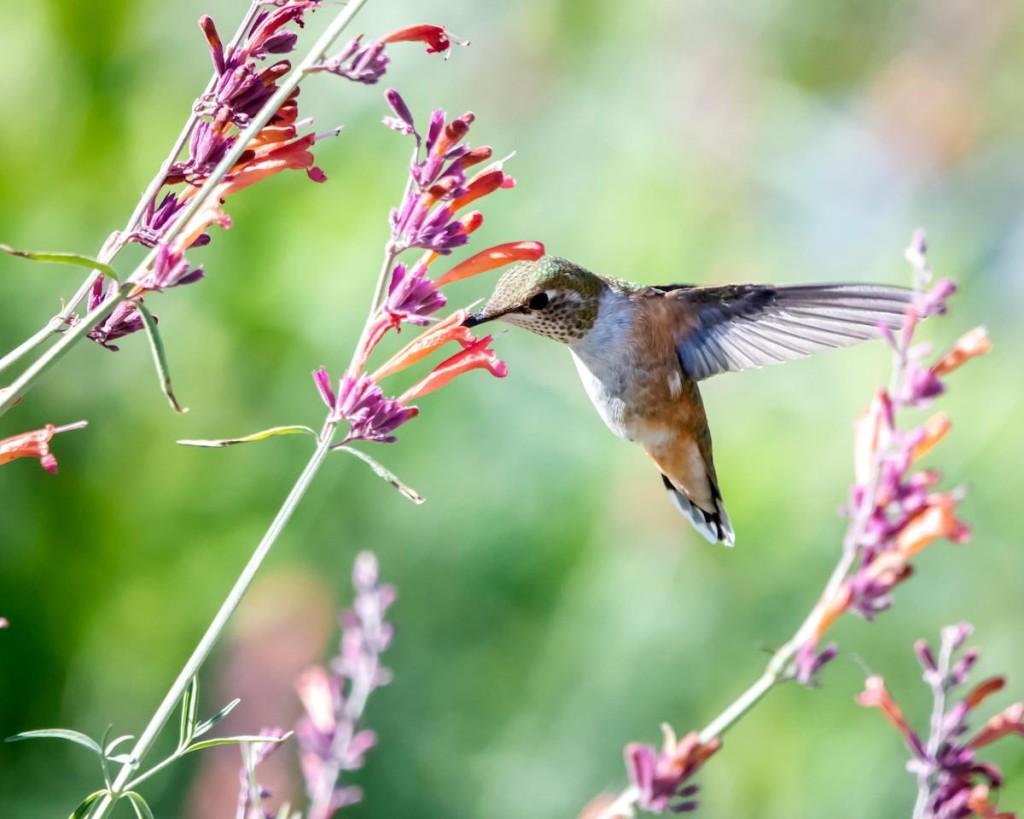
I am, and always have been, an environmental gardener. I’d like to pretend it’s because, in the wisdom of my worldview, I see the terrible damage caused by pesticide abuse and don’t want to contribute to that scourge, but, honestly, it’s not that at all. It’s that I’m afraid.
Fear of Pesticides
It’s true! I’m scared to death of pesticides, both chemical and biological (don’t try to make me believe that pyrethrum is less dangerous than malathion, just because it’s of plant origin!) I’m barely willing to use insecticidal soap (as I wash with soap every day, I hope it’s safe!) in the most urgent cases! When I see people standing on their lawns in shorts, t-shirts and sandals, bareheaded, spraying a product so dangerous that the instructions suggest covering the whole body, wearing a mask and washing clothes separately, I can’t believe their temerity. I’d rather parachute: it seems a lot safer. How brave these people are!

What’s more, it’s not just the one who treats who’s brave, but their whole family. Imagine, immediately after the treatment, their children go off to play on the lawn, their dog goes to relieve itself and their wife hangs out the washing on the line (O.K., let’s not be sexist… the couple, together, hang out the laundry on the line)… over the contaminated lawn! I think that’s brave without any common sense! Even braver are those who treat their apple trees and vegetables. It’s one thing to roll around in a poison, but to eat it on purpose – how daring!
Gardening Without Pesticides
Fortunately for fearful people like me, it’s easy to garden without using dangerous pesticides. What’s more, the gardens of people who don’t use pesticides are often more attractive than those of people who do.
The Example of a Herbicide-Treated Lawn
Take, for example, the case of a lawn regularly treated with herbicides. It’s true that there are fewer weeds, but the lawn is yellower than that of the neighbor who doesn’t treat, and there are more patches of dead or weak grass. It’s just a question of degree (broad-leaved weeds absorb more herbicide than narrow-leaved grasses).

So, to green up and bring back the weak patches, more fertilizer is applied. And because we apply so much herbicide and fertilizer, the balance of the lawn is disturbed and unwanted insects, generally well controlled by predatory insects and birds on an untreated lawn, proliferate. An insecticide treatment is then needed to contain them. Then begins the “courageous gardener’s vicious circle”: the more he treats, the more he has to treat.
Personally, I prefer to live with a few weeds in the lawn. Since I’m too timid to treat with herbicide, my lawn is naturally very green and I don’t have to apply fertilizer often. This is even truer since, being too lazy to pick them up, I leave the grass clippings in place, which automatically supplies the lawn with mineral elements. And I’ve never had any major problems with insect pests. I blame this on the “laidback gardener’s vicious circle”: the less he treats, the less he has to treat. Isn’t it funny how lazy you can get when you let nature take care of things?
The Flower Bed and Vegetable Garden
It’s the same in the flower bed and vegetable garden. Since I’m far too afraid to treat, animals proliferate, both good and bad. I have tons of ladybugs. Birds too! And so a real war begins, deadly as it can be, between the good guys and the bad guys. Fortunately, the good guys almost always win. Even when the bad guys seem to be on the verge of winning, and my nasturtiums are full of aphids, for example, if I can just wait around for another day or two, the aphid colony always diminishes, sometimes attacked very visibly by ladybugs or hummingbirds, sometimes for no particular reason at all.

“The natural balance”
It’s funny, but we call this war “natural equilibrium”, unlike chemical treatments, which look a lot like ethnic cleansing!
In any case, deadly or not, natural balance requires little intervention and, as a laidback gardener, I’m only too happy to encourage it… by avoiding, among other things, planting disease- and insect-prone vegetation. For example, there’s no way I’m planting hybrid tea roses, world-renowned for their total lack of disease or insect resistance, in my flower beds. I’m far too afraid of all the pesticides that would have to be applied to keep them alive. If I plant roses, they’ll be varieties recognized for their ability to resist everything.
Let’s summarize. So my yard is greener than my neighbor’s and needs less work too, and that’s just because I’m afraid? Come to think of it, I might as well be afraid!
Larry Hodgson published thousands of articles and 65 books over the course of his career, in both French and English. His son, Mathieu, has made it his mission to make his father’s writings accessible to the public. This text was originally published in Fleurs, plantes et jardins magazine in April 1999.