


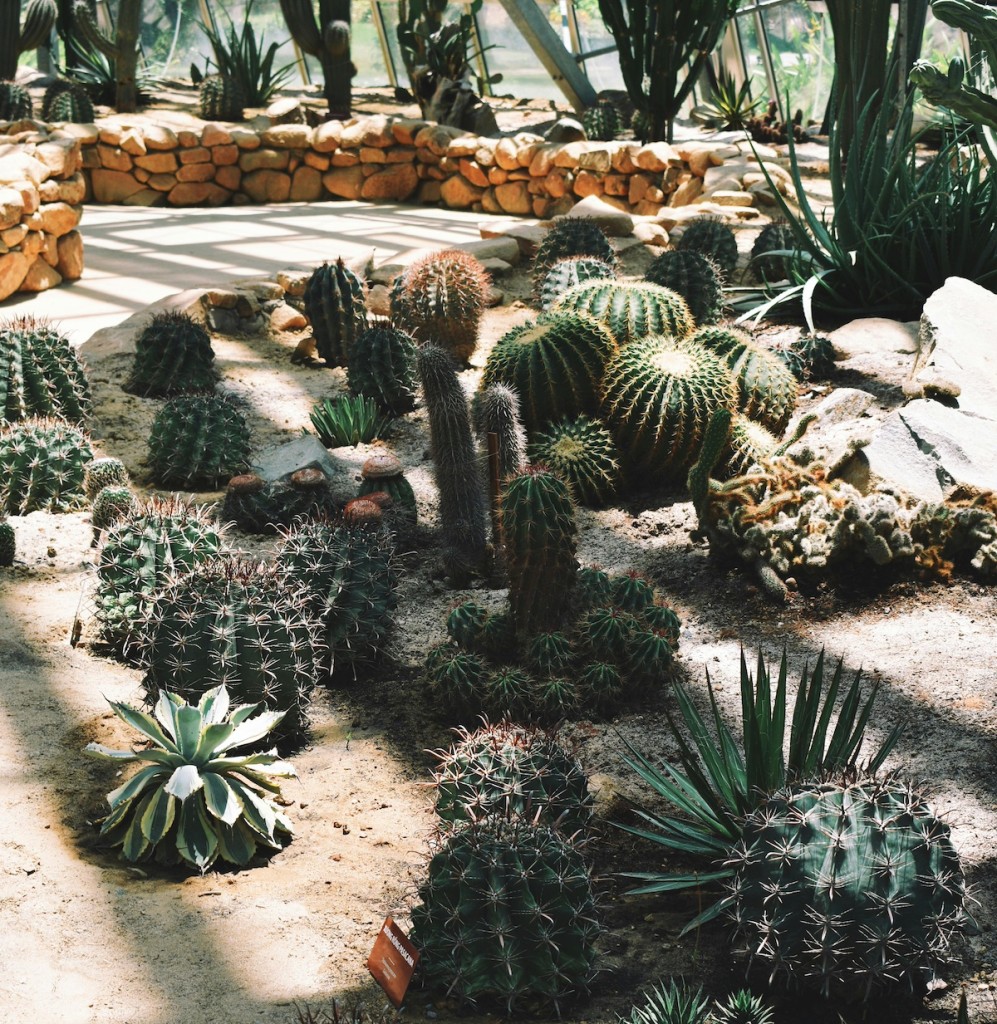
In the course of their evolution, many plants have become accustomed to a dry climate by storing water in their tissues, resulting in exaggeratedly swollen stems or leaves. These plants are known as “succulents”. They are found in all dry regions of the world. This group includes members of several very different families. The Crassulaceae family, for example, includes the popular “jade plant”, Crassula ovata, as well as succulents used in gardens such as Sedum. The Euphorbiaceae family has developed a whole series of succulents, such as the crown of thorns (Euphorbia milii). The Agavaceae family is famous for its agaves (Agave) and yuccas (Yucca).

Cactaceae
One family in particular stands out in this respect: the Cactaceae, or cacti. This family, native to the New World (one species can be found in Africa and India), is a specialist in swollen stems: most cacti no longer have leaves, but rather spines. Cacti come in a wide range of shapes – balls, candles, snowshoes, spaghetti, etc. – but they’re different from any other plant. But they can be distinguished from any other succulent plant by the little tuft of hairs called an aureole found at the base of the spines. No other plant has an aureole. Since cacti form a family, we can say that all cacti are succulents, but not that all succulents are cacti!

So Many Varieties!
There are over 2000 species of cactus in some 90 genera. Some are hardy up to zone 3 (zone 4 USDA), but most are subtropical, preferring warm summers and cool to cold winters. They can have large, showy flowers or small, insignificant ones… on the other hand, most cacti are grown more for their beautiful shape and coloring (thanks in particular to the often abundant thorns and hairs) than for their flowers.

Growing Cacti… in Brief
Cacti are easy to grow. However, cultivation varies according to species. For example, the Christmas cactus (Schlumbergera), from the rainy jungles of Brazil, does not tolerate the same conditions as Copiapoa, native to the Chilean Atacama desert, where it has not rained in living memory. In general, however, cacti require full sun, a drop in temperature in winter and fairly abundant watering in spring and summer, sparingly in autumn and winter.
Larry Hodgson published thousands of articles and 65 books over the course of his career, in both French and English. His son, Mathieu, has made it his mission to make his father’s writings accessible to the public. This text was originally published in Le Soleil on April 19, 2008.