


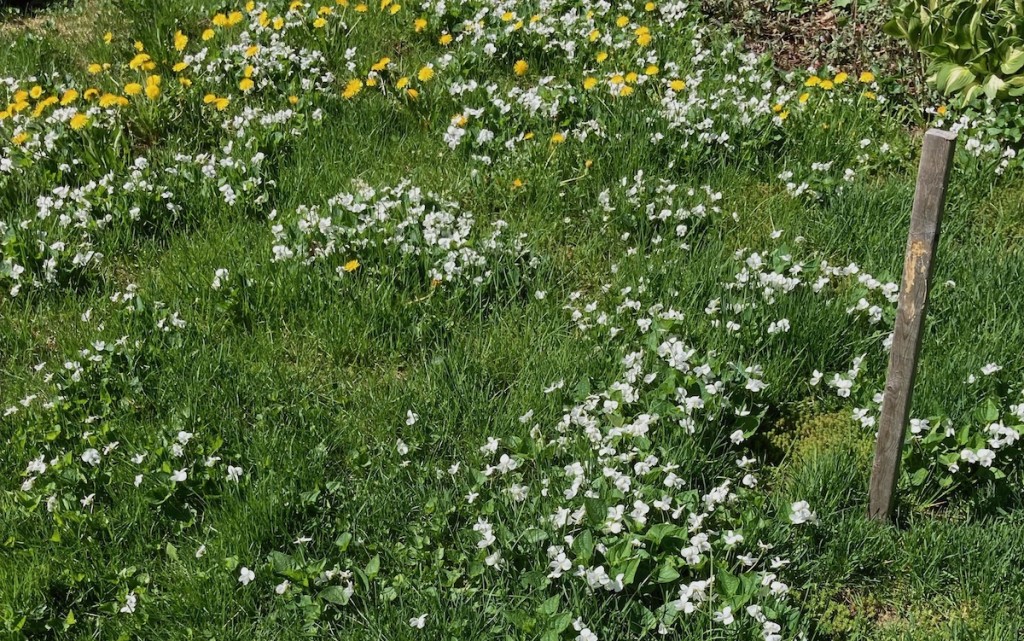
Following the launch of the Dandelion Challenge in 2021 (Quebec’c version of No Mow May), several municipalities have launched campaigns suggesting that we should not mow for the whole month of May. I already wrote about this last year, but I think it’s worth mentioning again, as it’s not always a good idea to suspend lawn mowing for a month in spring. At least if you want to maintain a versatile grassed area that can withstand trampling for all kinds of family, sporting or social activities.
Nuances of the Dandelion Challenge
If the lawn is left to grow too long, children won’t be able to play ball, and the mower won’t be able to pass. Equipment may have to be rented and all the grass cuttings collected. A radical cut is harmful to the lawn. It’s better to cut regularly to maintain a dense surface.

What’s more, if you stop mowing the lawn for a month, it won’t really encourage pollinators. You’ll just get long grass that will deprive sun-loving lawn flowers, including dandelions, of light! The goal of the Dandelion Challenge is to delay cutting and let spring flowering plants bloom before they go to seed. The average dandelion flowering period is just 2 weeks. This period depends on the region you live in: in northern areas, it may be at the end of May, and you may not need to mow before then. But in Montreal and other places where the climate is milder, we generally start cutting the grass at the beginning of May, and even earlier in California!
Flowering Plants for Your Lawn
I love dandelions and encourage you to let them bloom in your lawn, but bees still need flowers all season long. The ultimate goal of this campaign is to encourage biodiversity. I therefore encourage you to let all kinds of small flowering plants live in your lawn, and even to introduce them, as they will provide pollen and nectar throughout the season: thyme, clover, houstonia, Canada fleabane, etc. I encourage you to let them bloom in your lawn. With the exception of the last two species, these are plants introduced to Quebec. But lawn grasses and dandelions aren’t native either. In fact, the natural vegetation where I live is mixed forest!
Ed: Make sure any plants you introduce into your garden are not exotic invasives in your areas and prefer native plants when possible.

Lawns haven’t always existed, even in Europe. They were reserved to the wealthy, who could afford the labor to cut these unproductive spaces. Lawns became more popular when the lawnmower came onto the market in the mid-19th century. But it was with the advent of chemical fertilizers and pesticides in horticulture in the 1960s and 1970s that we came to demand perfectly uniform lawns. I knew a time when it was forbidden to let dandelions and many other “wild” flowers bloom in certain municipalities.
Biodiversity Starts in Your Lawn
Fortunately, we’ve come a long way since then! Thanks to the rise of environmental awareness in the 1980s and the arrival of a new generation of young people in all spheres of society at the turn of the century, the tide is now turning more and more towards a lifestyle and facilities that are much closer to nature.
The Dandelion Challenge and No Mow May campaigns bear witness to this desire to break away from monocultures and opt for more natural landscaping. But the best slogan would be “Biodiversity: it starts in your lawn”!
