


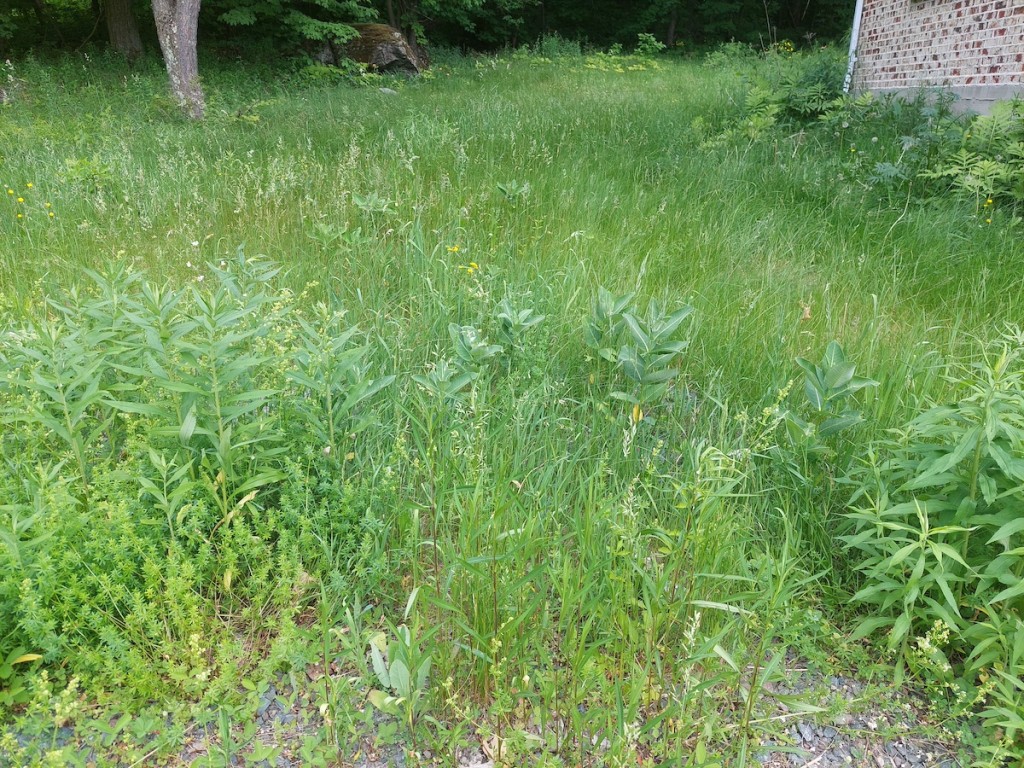
You know me, I love nature. I make a point of letting my lawn grow to support all kinds of plant and animal life, and this year I decided to let nature take over completely. My front yard is about an acre of lawn… It takes a long time to mow, and it doesn’t do anyone any good to keep it as a lawn.
Recently, however, I’ve come across a tricky situation. My wildflower-filled wasteland is disturbing the neighborhood, and I’ve been told so with more or less sensitivity.
Outdated Regulations
After consulting the municipality, I was astounded to find that the standards for lawn maintenance are totally at odds with respect for biodiversity. And yet, we’re in the countryside and there’s literally a field full of cows right next door! If it’s like that in the country, what are the rules in town?

After doing some research, I discovered that not all municipalities have the same regulations regarding lawn length. In my case, it’s expected to stay under 30 cm (12 inches), but in some municipalities it’s 15 cm (6 inches). That’s ridiculously short if you consider that it’s the maximum. To avoid spending every weekend on your lawnmower, you really need to cut flush with the ground!
A Wind of Change
But I’m happy to say that in some places, there are no longer any regulations on the maximum length of the lawn. Each citizen is free to choose what to do with his or her land: a carpeted lawn that turns yellow in July, or a pretty wasteland full of life. This is notably the case in Nicolet and in certain Montreal boroughs where differentiated mowing is practiced, i.e. street edges and certain parts of parks are maintained, while the rest is left as fallow land. Nearby Magog is also planning to revise its city bylaws this fall.
As we say in Quebec, “the lips must follow the boots”. Many towns, villages and municipalities boast of being “green”, of wanting to plant their spaces and invite biodiversity into their homes. The milkweed planted in parks to attract monarchs is constantly touted. And yet, when I try to let anything grow on my property, like milkweed, to attract monarchs, snakes, mice and insects, I’m told I can’t do it.
Frankly, where’s the logic in that?

What Your Lawn Does for YOU
In addition to biodiversity, there are other advantages to letting plants grow. Is your home hot? Is your outdoor soil dusty? Are there lots of flies and mosquitoes?
Guess what! Yes, long grass is the solution!
Vegetation cover has been shown to regulate soil temperature at depth: more than a metre (3 feet) deep, the temperature of the soil changes according to the length of the vegetation cover. During the day, the soil is cooler, and at night, it stays warmer. This means less stress for your plants and underground life in general, and a cooler, more controlled environment in summer.
Is it too hot in your yard? No wonder if you mow every week! It’s like turning on the heated seats in your car. With a long lawn, you’ll gain a few degrees of coolness. Imagine what it would be like with a wild lawn!
I consulted several studies and, although I couldn’t find any conducted in Quebec, I could see that there can be a difference of up to 10 C° (18?) at 10 cm (4″) depth between a short and a long lawn.

Secondly, long grass doesn’t dry out as quickly as short grass. It keeps the soil moister, enabling the grass to stay green, even in drought conditions. Bonus point: when the soil is dry and the grass short, the slightest gust of wind causes the soil to crumble and blow away, covering your terrace, leaving children’s feet dirty, and eventually causing holes in your yard.
Another point
You and your garbage cans make excellent lunches for “nasty” insects. The predators of these insects need a large hunting ground with hiding places and fresh air: your little green carpet is not at all viable for them.
When I talk about biodiversity, I’m laughed at, so here are some more “accessible” advantages. My driveway carpet is never muddy, and my dogs love to lie in the long, cool grass when they accompany me to the garden. Do they go into the shade of trees further away? No! The ground is cool enough for them to be comfortable everywhere. Well… not now that I’ve had to spend $50 on gas for my tractor to cut the whole front of the house…


My land, my values, my beliefs
In short, I’m disgusted with the massacre I had to make. You’ve got kids playing in the lawn, you like the grass cut: PERFECT, cut it. But my home is my home, and I intend to make my own choices and put forward my own values.
You can be sure that I’ll be consulting the municipality to see if we can follow in the footsteps of visionary cities that allow islands of biodiversity. (Sounds ridiculous, doesn’t it? “Allowing” biodiversity…) In the meantime, you should know that a magnificent wild hedge will be growing all around my property: pretty bushes and trees that will hide the view of my horrible property from the rest of the world.
I usually like to end on a positive note, a touch of humor or something to think about, but I don’t know…
Ah yes! I’ve got it: I’m going to end with my city’s slogan. Are you ready?
Living in nature.
Ironic, isn’t it?