


Stinging nettle (Urtica dioica L.) is a herbaceous perennial native to Eurasia that has now spread throughout the world. A few species of stinging nettle are native to the St. Lawrence maritime region, but stinging nettle is rather rare in Quebec, whereas it can be found on every wasteland in Europe. It has a rather bad reputation as an invasive and stinging plant. In fact, the leaves and stems are covered with stinging hairs that break off at the slightest contact, injecting a substance into the skin that causes a burning sensation. These effects are short-lived, however, and can be quickly neutralized by other plants applied to the affected area, such as plantain or mint.

Urtica dioica, commonly known as nettle, is not generally classified as an invasive alien species in Canada or the United States. There is one native species (Urtica gracilis) that is widely distributed in North America and cannot be considered invasive. The introduced European subspecies (Urtica dioica subsp. dioica) is present in some areas, but generally does not exhibit invasive behavior that aggressively displaces native flora.
However, it is considered problematic in certain regions. In Canada, notably in British Columbia, the introduced subspecies Urtica dioica subsp. dioica is found in the south-western part of the province, including the Greater Vancouver area, where it can spread aggressively. In the United States, stinging nettle is recognized as a Category 3 invasive plant in West Virginia, where it generally does not affect ecosystem processes, but can out-compete native plants in heavily disturbed areas, spreading slowly or not at all from these sites.
An Edible and Medicinal Plant
Despite this unpleasant characteristic, it is an edible and medicinal plant with many virtues that have been known since the dawn of time. I’ve been pampering a small patch of it in my garden, and it makes wonderful soups as early as April, long before the vegetables in my garden are ready to harvest. Warning: don’t plant nettle in your vegetable garden, as it is a very invasive plant due to its rhizomes, but it can be controlled by mowing all around it and not letting it go to seed.
Nettles can be cooked like spinach, and when they’re very small, they don’t even sting. Later, I have to wear gloves and harvest only the leaves. Nettle is very rich in protein and contains, among other things, vitamins A and C and minerals such as calcium, potassium and silica. It’s a plant much prized by herbalists for its many medicinal virtues, but that’s not what I want to talk about in this gardening blog!
Nettle Slurry: Maceration or Fermentation?
After my spring soups, I use nettles to make a purin from June onwards. It’s a well-known fertilizer in Europe, and is even sold in garden centers! There are different ways of doing it, and even a little confusion if you take the time to watch the various videos on the Internet. Most gardeners, like me, make nettle maceration.

Maceration
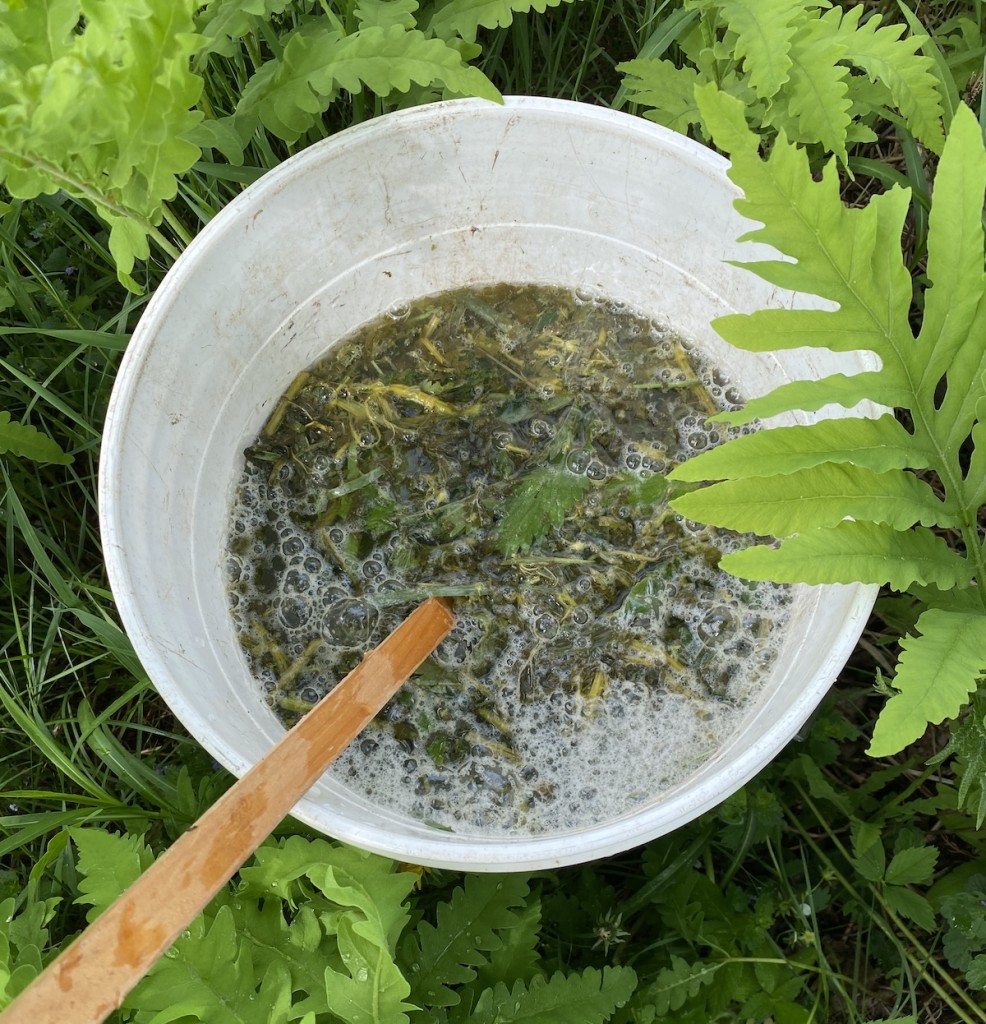
For maceration, the recipe is simple: I harvest 1 kg of plants and macerate them in around 10 liters of water (approximatly 1 pound per gallon, the quantities can be doubled or tripled, of course). I use a large bucket, with a lid because the decomposition doesn’t smell very good, and after a few days it bubbles! I stir it daily with a stick and when it stops bubbling, it’s ready to use! It takes about 10 days at 20-25°C (68-77°F) in the shade. I then filter the mixture coarsely through a burlap bag and dilute the liquid in a ratio of 1 part macerate to 10 parts water before watering the base of the greediest vegetables in my garden, i.e. tomatoes, squash, cucumbers and so on.
This fertilizer contains a lot of nitrogen and potassium and must be used quickly, as it doesn’t keep for more than a week. Still, it’s excellent in early summer on growing vegetables, but before fruiting, as it will mainly encourage foliage production.

Fermentation
If you look on the Internet for more information, you’ll discover that there’s another method. In fact, to obtain a “real” nettle purin that doesn’t smell bad, can be sprayed on growing plants and can be kept for a long time, you need to ferment it. But fermentation is an airless process (like making sauerkraut), which is not the case with maceration. So you need a container that can be hermetically sealed, filled to the brim with a mixture of nettles and water (always 1 kg of plants for 10 liters of water), and left to ferment unopened. After 15 days at 20-25°C, the result is a clear, odorless liquid that can be stored for up to 3 years in a cool, dark place. This is probably what is sold in the shops in Europe.
In short, I can’t wait to try it out next summer! I’m sure our European readers will be able to tell us more and share their experiences?
In the meantime, enjoy fresh nettles to make delicious soups, or dry them for winter tea.
