


Lawns are in the news a lot this year, as they are ubiquitous in all landscaping schemes, especially in North America. However, its predominance is increasingly being called into question because of its negative impact on the environment, such as consumption of water, fertilizers and pesticides, noise pollution, production of greenhouse gases (GHGs), and so on.
A few weeks ago, I met two university researchers interested in the environmental management of lawns: Raphaël Proulx, a professor at UQTR (Université du Québec à Trois-Rivières), and Laura-Jeanne Raymond-Léonard, who is doing her PhD on the biodiversity of urban soils at UQAM (Université du Québec à Montréal).
They gave me some very interesting information about the “Dandelion Challenge” and “No-Mow May”. These campaigns have been very popular in recent years, and some homeowners have even decided not to mow for the entire summer season. This has led to disputes between neighbors and even fines in some municipalities. Yet recent studies have shown that reducing the frequency of mowing, or even suspending it for the whole summer, offers multiple environmental advantages over a regularly cut lawn. Of course, you also have to stop spreading fertilizers and pesticides! This is what we call extensive management (versus traditional intensive management with weekly mowing).


The Benefits of Extensive Management of Green Spaces
The researchers found that in these areas, which were mowed less frequently or not at all for the whole season, the following results were observed:
- Increased plant diversity;
- More pollinators;
- An increase in invertebrates (insects, earthworms, etc.);
- Fewer undesirable organisms (grubs, chich bugs, etc.);
- The disappearance of ragweed;
- Lower ground temperature;
- Increased soil moisture;
- GHG reduction (CO2 sequestration) ;
- Less noise and maintenance costs.
This approach can easily be applied in large green spaces where little or no one walks, such as on large country estates, along bicycle paths, under hydro-electric lines, on steep slopes, etc.

If you’re trying this out on a large plot of land, I suggest mowing paths through your “meadow”. This demonstrates a certain amount of control over the situation, and allows you to get a closer look at the life that thrives in this environment. Alternatively, if you have particularly ticklish neighbors, you could also plant a hedge along the edge of the public thoroughfare. Choose shrubs that attract birds or produce edible fruit to kill two birds with one stone (but seriously, don’t kills birds, feed them!).
At the end of the season, you’ll still need to get yourself a brushcutter or a well-equipped tractor for larger areas, or hire a specialized contractor to mow your meadow if you don’t want to see birch and other pioneer trees grow in. In general, the forest wants to reclaim its place in Northeastern North America.

Justified Fears or Not?
Among the fears raised when we stop mowing, there are two that come up often: ragweed and ticks.
- There’s no need to worry about ragweed proliferation in an unmowed lawn, as it’s an annual plant that takes root in bare soil. As soon as permanent vegetation is in place, ragweed disappears, as it needs bare soil to germinate.
- Fear of ticks: In Trois-Rivières, Raphaël Proulx’s team searched for ticks in sunny urban meadows and didn’t find a single one. However, as ticks prefer shady, damp environments, they can technically be found in very long grass. Raphaël Proulx and his team also noted a greater abundance of small rodents in urban meadows, the latter being reservoirs of Lyme disease. So keep your eyes peeled! Personally, as a precaution, I still wear long clothing and insect repellent (without DEET) when I’m working outdoors.
And in a Residential Setting?
Can you stop mowing all summer long in a residential area without irritating the neighbors? This is where the bickering is going to start! It’s the confrontation between the baby-boomer generation, who have manicured their lawns all their lives, and the younger generation of homeowners, whose environmental values are more developed than those of their parents!
To raise awareness among your neighbors, it’s a good idea to tell them about your project and put up a small poster: “Biodiversity experiment underway”, for example. What’s more, most cities that encourage this approach require that a border be mowed along the street to prevent tall weeds from falling onto the public highway.


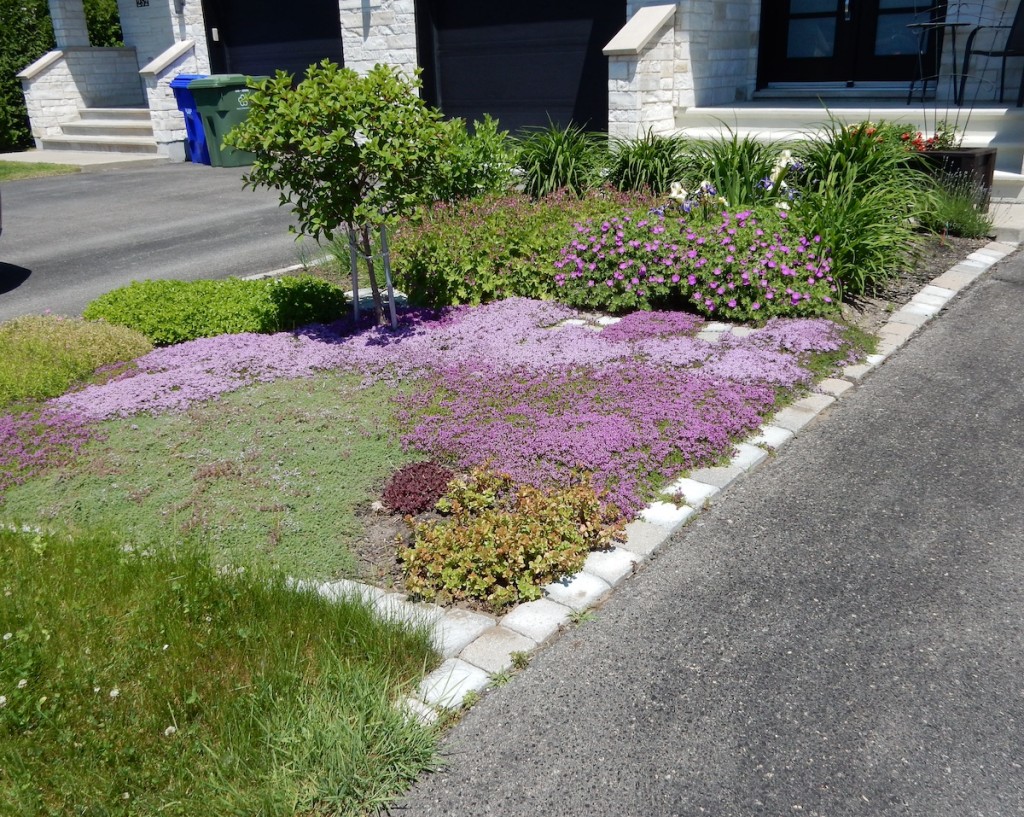
In any case, if you want to avoid weekly mowing in the city, I think it’s best to remove your lawn and gradually install other types of landscaping to see if you like the result, and above all to make sure it’s beautiful (albeit non-traditional), otherwise it will be very difficult to convince your neighbors to approve such an approach.
Share Your Lawn
For example, I like the David Suzuki Foundation’s “Lawnshare” campaign, which involves reducing the amount of grass you use in favor of more natural landscaping adapted to your environment. If you’re interested in this kind of experiment, I suggest you visit their website for a very detailed technical guide.


I can see this approach very well in the front garden and on small urban plots: a few perennials or shrubs will be much easier to maintain than a mini lawn that’s not even worth buying a mower for. But if you have young children or like to keep a space mowed regularly for all sorts of reasons, a lawn with biodiversity is a good compromise for the environment.