


Personally, I hope to stay in my home for the rest of my life. Condo living? Not for me, I hope! So I’m already preparing my land for my old age… while I still have the health to do so.
What does it mean to “prepare your land for old age”? It means reducing maintenance as much as possible so that the land can be maintained with little or no intervention. In other words, becoming a laidback gardener.

Bye Bye Lawn!
The number-one enemy of future retirees is the lawn. Even if all other maintenance is neglected, it must at the very least be mowed, or you must have the budget to have it mowed by someone else. The more grass there is on the property, the more maintenance is required, especially if it’s on a slope, which makes it not only difficult, but perilous to maintain. So, ideally, you’ll reduce the grassed area as much as possible, starting with places where the mower has difficulty getting through or doesn’t get through at all (slopes, near walls, stones, tree trunks, etc.). In my case, there’s no grass in front of the house and only a small, perfectly flat patch at the back (my dog’s wee-wee area). Mowing the lawn has gone from a 3-hour burden with a big machine to a 10-minute mini-promenade with a manual mower.
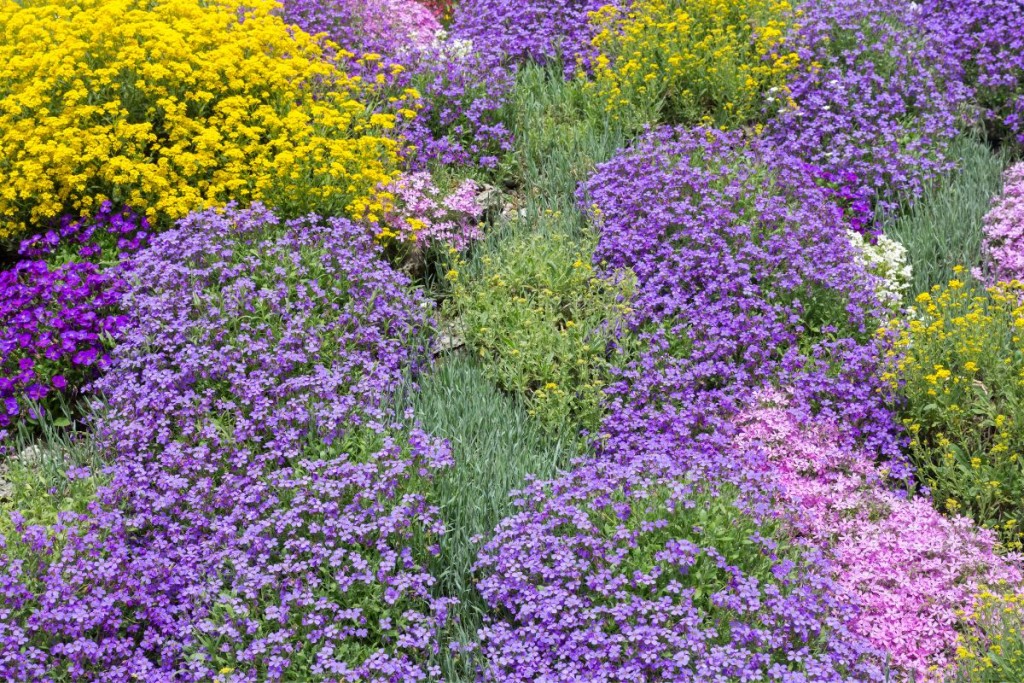
But replacing a lawn takes time, effort and money. That’s why I suggest starting right away, even in your forties. Gradually cut back the lawn to create flowerbeds and plantings of trees, shrubs and ground cover. All these plantings require more effort to install than lawns, where you simply roll out a carpet of greenery, but require much less care once established. Rather than having to work weekly, as is the case with lawns, which require frequent mowing, maintenance can be limited to a few efforts in spring and none in summer.

Say Goodbye to Cedar Hedges and Ball Shrubs
You should also eliminate (or never plant) any plant that necessarily requires pruning. At 75, will you still be able to trim a cedar hedge even once a year? And forget about pruning shrubs and trees into balls: that’s for people under 40! In short, avoid strictly ornamental pruning, as well as pruning caused by poor plant selection. Where you need to prune now, because a tree or shrub is obstructing a window, front door, driveway, etc., remove the offending plant. There are many small shrubs that hide what you want to hide without blocking anything. Plant some.

Looking for a hedge? Don’t forget that most municipalities have a maximum height of 1.8 m (6 feet) for hedges, and that thuja, the plant most commonly used for hedges in our region, reaches 10 to 12 m in height (30-40 feet). Do you see the problem? Fortunately, there are shrubs that naturally grow to less than 1.8 m in height (alpine currant, dwarf physocarpus, arctic willow and dwarf honeysuckle, to mention just 4 of the hundreds of varieties of dwarf and moderate-sized shrubs adapted to the region). Plant them in rows and you’ve got your hedge.
What to Replace Grass and Pruned Shrubs With?
Few plants require less maintenance than trees, shrubs and conifers left to their natural state. Make them the foundation of your landscape, rather than the lawn. If you can mulch at their base, you’re essentially maintenance-free. Of course, you need to look for varieties that are known for their resistance to insects and disease, that are hardy here, that won’t overwhelm the available space and that are well adapted to your particular conditions (sun or shade, rich or poor soil, wet or dry, etc.). Fortunately, there are trees, shrubs and conifers to suit any combination of conditions.

If mulch isn’t your thing, there are plenty of ground cover plants that can take their place. And once established (again, all plants, even the sturdiest, require maintenance for the first few years), a good ground cover requires no further upkeep and is even “self-cleaning”: leaves that fall underneath them thread their way through their foliage to decompose, making it difficult for weeds to sprout. Good ground covers for shade include asaret, tiarella, hosta and spotted geranium; for sun, thyme, bearberry, creeping juniper and various sedums.
For More Color, Flowerbeds
The future retiree doesn’t have to limit himself to ground cover and trees, shrubs and conifers. He can also create flowerbeds. But always ask yourself: what plants are suitable for a low-maintenance bed? Annuals are great for starting a bed, but replacing them every spring is demanding and expensive. Replace them with long-lasting, maintenance-free perennials, of which there are thousands of varieties.

Avoid plants that have particular problems and need attention. Don’t plant slug-prone hostas, for example, but rather varieties that are not affected. Discard peonies that require stakes and replace them with the many cultivars that don’t, etc. Over time (which is why I suggest you start right away), you’ll find out which perennials grow on their own without any maintenance and which are demanding. Follow the old Chinese saying: to be a happy gardener, find what grows well and plant lots of it.
What About Off-Season Maintenance?
Contrary to popular belief, flowerbeds don’t need “autumn cleaning”: the less you do, the better the plants grow! In spring, a quick pass with pruning shears is all that’s needed… and even then, if the bed is well established and full, you can do without. After all, the regrowing plants will soon hide the branches still standing from the previous year’s plants.
There’s one final limitation that a lot imposes on an aging homeowner: winter snow accumulation. Snow removal is said to be particularly risky for seniors. In that case, you’ll need to set aside a budget to hire a snow-clearing service… unless the heated pathway makes an appearance!
As you can see, the idea that maintaining a property is demanding and that you have to resign yourself to a life in a condo is false. But, as any financial advisor will tell you, you have to plan for retirement. Start now, work down the maintenance, and your property will become a peaceful and welcoming place to retire!
Larry Hodgson a publié des milliers d’articles et 65 livres au cours de sa carrière, en français et en anglais. Son fils, Mathieu, s’est donné pour mission de rendre les écrits de son père accessibles au public. Ce texte a été publié à l’origine le 19 août 2006 dans Le Soleil.