


Few people like spiders. Instead, they inspire fear and revulsion, just like earwigs, sowbugs and millipedes. It has to be said that they are often portrayed in a negative light in popular culture: they are associated with dark places or horror scenes in films, or with witchcraft as in Halloween festivities.
They’re thought to be dangerous. But while all spiders on the planet are venomous because they possess a venom that paralyzes their prey, this venom does not work on humans. At least for most of the 52,000 known species, since only a dozen or so possess a venom that can lead to medical consequences. These few species are not found here in Quebec or even Canada. Fear of spiders is widespread, but don’t confuse it with arachnophobia, which is an uncontrollable and disproportionate reaction, even to the sight of a simple image.
Personally, I’m not afraid of spiders because I know they’re very useful in the garden, but I don’t want them in my house and I won’t let them run over me just yet. However, my view of these little creatures has changed considerably since two unusual characters visited my home.

Very Interesting Visitors
This summer, I invited Gilles Arbour, a talented naturalist and photographer, to come and take insect photos in my vast flower meadow, and he asked if he could bring along his friend and partner at Natureweb.com, Pierre Paquin, a renowned arachnologist. They arrived with ingenious homemade harvesting equipment. The first is a beating net, a kind of upside-down umbrella connected to a container, which they walked between the flowers and bushes, banging on the vegetation. The second is a sieve, which they used to collect specimens from the forest litter. This is a large tube of fabric, separated in the middle by a coarse filter to separate leaf litter from the small organisms that swarm in the humus.
Then they sorted it all out on a piece of cloth on the floor, and I could see them taking the little critters in their hands and letting them run down their arms. I’m not quite there yet, but I realize that the fear of spiders is mostly linked to a lack of knowledge and false beliefs.

A Few Facts About Spiders
Spiders have been a real discovery for me since that visit. First of all, I had no idea there were so many of them on the planet: 52,228 spider species described worldwide, divided into 135 families. In Canada, there are 1,413 species and 43 families are known (Paquin et al. 2010b) and in Quebec, the fauna includes 708 species in 34 families (Paquin & Dupéré, in prep.). In comparison, mammals number some 5,000 species in 150 families.
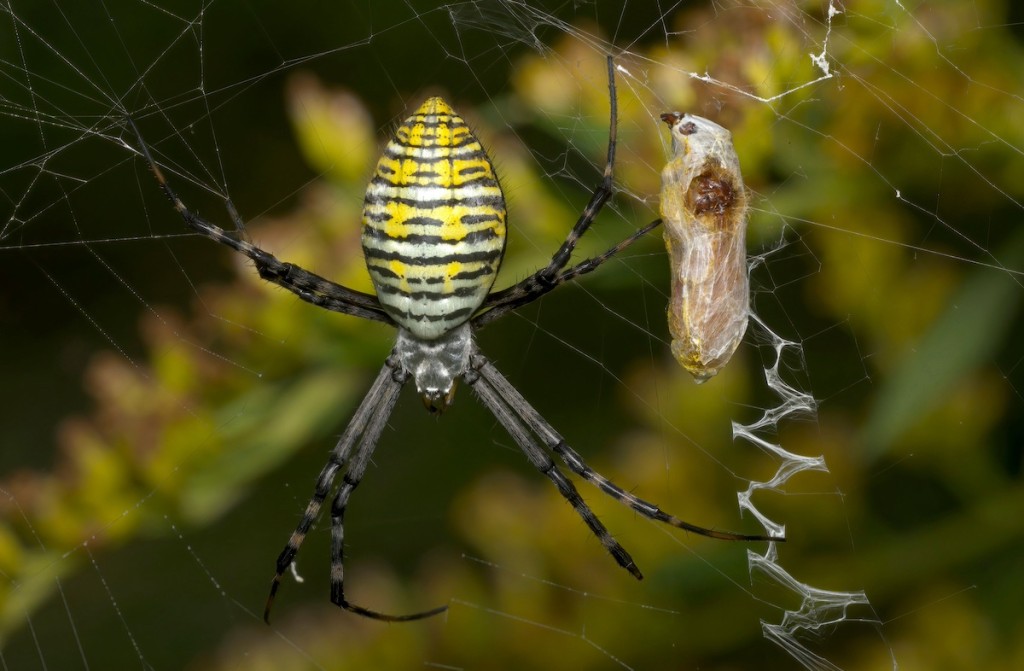
The spider’s body is divided into two parts: the cephalothorax, with eight legs, and the abdomen, with spinnerets at the rear. It is through these appendages that they secrete silk, which is used to produce threads for moving around, weaving webs, entangling prey and making egg sacs. Unlike insects, they have no wings or antennae. They generally have eight eyes, but some species in Quebec have six.

Some Misconceptions About Spiders
- They don’t sting because they don’t have a dart, but all species can bite with their hooks (mouthparts) as this is how they catch their prey. Most species, however, are too small to pierce the skin.
- They rarely bite, unless they feel cornered by clumsy handling, for example.
- They are predators that feed on insects, not vertebrate blood.
- Swallowing a spider during the night is an urban legend that makes arachnologists laugh a lot, especially if you put forward a precise number of specimens ingested in a year.
Precious Allies in the Garden
Spiders are valuable allies in the garden, and it’s in our interest to protect them. They cause no damage to plants, as they are predators, whether in the vegetable garden, the orchard, or in our flower beds. On the other hand, they are extremely useful in the fight against real crop pests, as they feed on a wide variety of insects such as mosquitoes, flies, aphids, mealybugs, whiteflies, butterflies and their caterpillars (such as the cabbage maggot), etc. This helps to reduce the need for pesticides.
Spiders react quickly to changes in their environment. A sudden increase in their numbers may indicate an overpopulation of insects. Spiders themselves are a source of food for other animals, such as small mammals and birds. In addition, spiders can help pollinate flowers by moving from plant to plant in search of prey. The presence of spiders is one of the signs of a healthy garden.

How to Encourage Spiders in the Garden?
To encourage the presence of spiders in your garden, here are a few simple things you can do:
- Ban the use of all chemical products that harm biodiversity
- Keep fallow areas or use differentiated mowing in your lawn
- Leave spider webs in place when you see them
- Cover the soil with mulch
- Leave piles of stones or old low walls in place
- Don’t destroy the egg sacs that house the next generation of predators
- Grow a variety of melliferous plants to attract foraging insects… and prey for spiders.
Here are a few beautiful spiders that I’ve collected at home or that are common in our gardens.


Pierre Paquin, biologist and arachnologist, and Gilles Arbour, naturalist and photographer, bring you the beauty, richness, ingenuity and complexity of the living world through photography, blog posts and research on Natureweb (French only).