


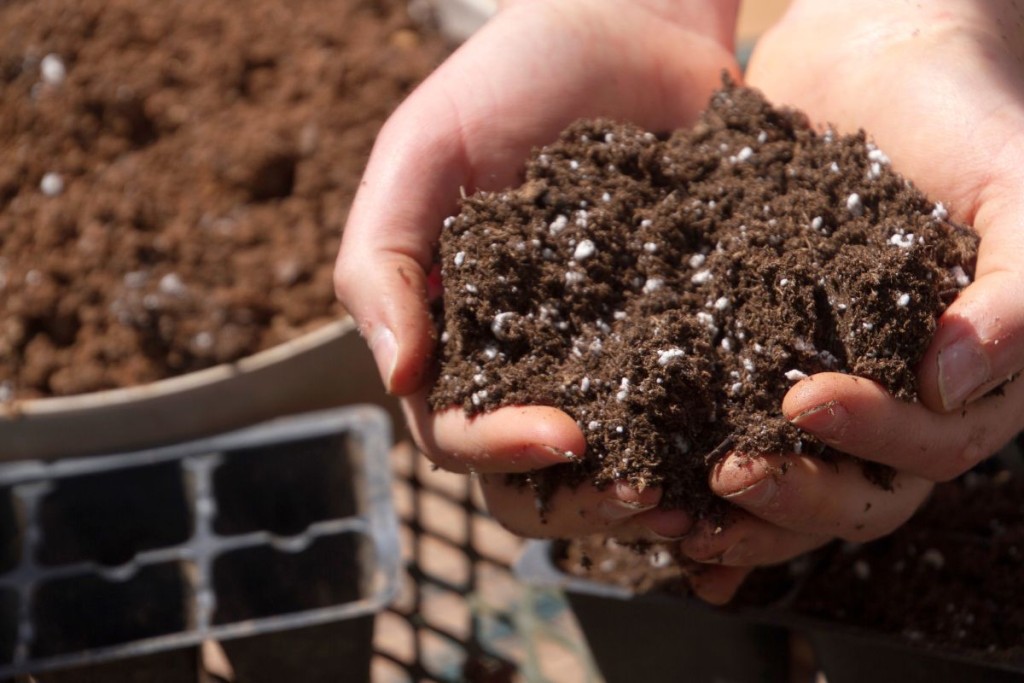
If you’re like me, you garden in containers: on a patio, balcony, or in a section of your yard that doesn’t allow for in-ground planting. In my case, it’s simply because I don’t have a yard. Sometimes it’s because the soil is contaminated or simply because you want to add greenery to a paved area. And for others, health or accessibility reasons make raised beds, pots, or grow bags more practical.

Whatever the reason, many of us grow plants in containers, which is a different approach from gardening in the ground.
Growing in the Ground Versus Growing in Containers
In an open-ground vegetable garden, the soil is alive: it contains minerals, insects, microorganisms, worms… and all these creatures work together to aerate the soil, drain water, and break down organic matter. Potting soil, on the other hand, is much poorer in biological life.
This means that the nutrients it contains initially—or those that are added—can easily be washed away, unlike those in well-structured soil. Even if it is organic, potting soil is still an artificial substrate that quickly becomes depleted. It therefore needs to be maintained differently.

In fact, container gardening—whether for seedlings, houseplants, or outdoor plants in pots or bags—is one of the few situations where I use fertilizer. This is to compensate for low microbial activity and rapid nutrient loss. Otherwise, I stick to compost and organic mulch.
What Should You Do With Last Year’s Potting Soil?
A question that often comes up in spring: what should we do with last year’s potting soil? Should we throw it all away and start from scratch? Rest assured: no! That would be a huge waste of organic matter… and money! Fortunately, you can recondition the soil, i.e., restore it to a condition suitable for growing plants.

Initially, most potting soils sold in Quebec are made from sphagnum peat moss, sometimes coconut fiber, with the addition of perlite or vermiculite to lighten the mixture and improve drainage. Occasionally, a little compost and fertilizer are also added. Since peat is naturally acidic, a little lime is usually added to balance the pH.
But over time, several things happen: the potting soil decomposes, compacts, and loses its structure. Nutrients are depleted or washed away by rain, and the pH can become acidic again. In short, it is no longer the same potting soil you bought.
Get Ready
The best time to recondition your potting soil is in the spring, a few weeks before sowing or transplanting. This ensures that you are well prepared to welcome your new plants.
Here is what you will need:
- Add some new potting mix to restore volume, lightness, and structure to the mixture. Personally, I use an all-purpose potting mix—the same one I use for my indoor plants, seedlings, and outdoor containers. That said, there are also specialized mixes for each use, if you prefer.
- Well-decomposed compost, rich in microorganisms and nutrients, to reactivate biological life in the container. If you buy it, choose a compost that does not contain peat moss. Pure compost is what you want!
- A slow-release organic fertilizer that will feed your crops for several months.
- Tools for mixing everything together: a shovel, a fork, or simply your hands, depending on the amount of soil to be mixed.
Inspect Your Potting Mix
Before starting a new season, take the time to check the condition of your soil. You should check for compaction, moisture retention, drainage, and the presence of mineral salts.

Compaction
Use a small hand trowel (or transplanting trowel) and insert it into the soil. Your fingers won’t go deep enough to judge properly. If the trowel resists, it’s a sign that the soil has become compacted. It should be fairly easy with a little pressure. In this case, you’ll need to dig it over thoroughly, add compost or some new soil, and remove 10 to 30% of the old soil if necessary to lighten it.
Drainage
Water normally and observe. If water remains on the surface for a long time or takes a long time to drain through the pot, drainage is insufficient.
Accumulation of Mineral Salts
There may be a whitish or gray crust on the surface of the soil, often visible in spring, which indicates an accumulation of mineral salts—residues from soluble fertilizers or watering (there are minerals in the water). Scrape and remove the top layer (about 2 to 3 cm or 1″), then rinse thoroughly with water to remove any remaining residue.
Acidity
To measure pH, it would be a bit absurd to have a soil analysis done in a laboratory for each container. It is easier to use an electronic tester or a chemical test kit. The electronic tester (or pH probe) is inserted directly into slightly moist soil and gives a quick reading, although the accuracy varies depending on the quality of the device. The chemical kit involves mixing a sample of soil with distilled water, then adding an indicator solution and comparing the color obtained to a chart. This method takes a little longer, but is often more reliable than inexpensive probes.

Reconditioning Your Potting Soil
Whether your potting soil is compacted or poorly drained, the solution is the same: remove 10 to 30% of the soil. This used soil can be composted or simply spread in the garden, directly on the ground. Then add a mixture of about 1 part compost to 5 parts potting soil, mix well, and incorporate a slow-release organic fertilizer. Finish by moistening everything. And there you have it, your soil is reconditioned!
If your test reveals that the pH is too acidic (below 6), you can correct this by adding a small amount of dolomitic lime (or crushed limestone), following the manufacturer’s recommendations. Crab powder, which is rich in calcium, can also be used to correct the acidity of the soil, while stimulating microbial life thanks to its chitin content. This will help bring the pH back to neutral.
After planting, you can also cover the soil with mulch: shredded leaves, straw, shredded wood, etc. This helps retain moisture, protect the soil surface, and limit weeds. I particularly like to use shredded leaves that I harvest in the fall. I place them directly on the surface of the soil in my containers. Usually, by the following fall, they have mostly decomposed… just in time to add a new layer!
What Should I Do if I Have Perennials or Shrubs in My Container?
If you grow perennials or shrubs in pots, regular maintenance of the potting soil is also important. Each spring, inspect your containers. If necessary, remove about 5 to 10 cm (2 to 4 inches) of soil from the surface (without disturbing the deep roots), replace it with a mixture of compost and new potting soil, add a slow-release organic fertilizer, then mulch and water generously. Every 3 to 5 years, you may need to repot partially or completely to improve drainage and give the roots more space, much like you would with indoor plants.

What Next?
During the season, continue to monitor water retention, drainage, and the appearance of salt on the surface. For plants that require a lot of nutrients (tomatoes, squash, etc.), you can add a little fertilizer mid-season. Also, keep an eye on the health of your plants: a weak or diseased plant can be a sign of depleted soil.
In short, there’s no need to start from scratch every spring or buy new bags of potting soil. With a little care, you can breathe new life into your substrate… and your crops!