


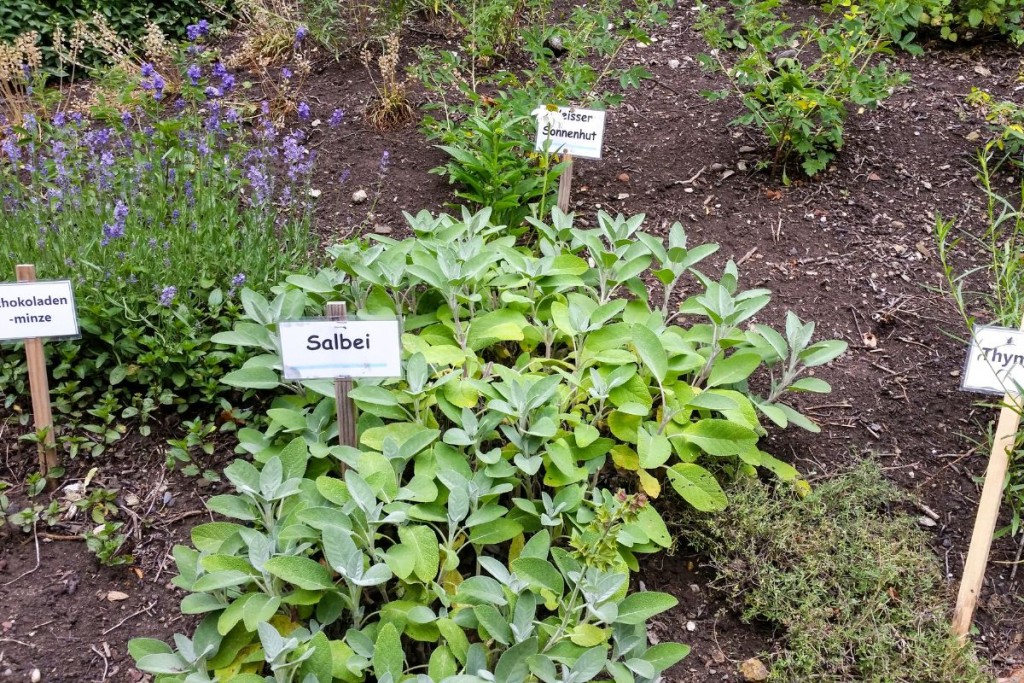
I confess! I am a label addict! In my eyes, there is nothing more beautiful than a flower bed with beautiful white labels, each carefully identifying the plants that reside there. Obviously, it is not the whiteness of the label that impresses me, but the information written on it. When I visit a garden, even if it’s the most beautiful in the world, if there’s nothing to identify the plants, I can’t help but feel a little disappointed, because for me, visiting a garden should be more than just a pleasure for the senses, but also an opportunity to learn. As a result, many “landscaped” gardens leave me rather cold, while I literally “freak out” in a botanical garden where all the plants have names.

Of course, I try to do the same thing at home. And, indeed, my most recent flower beds look a bit like military cemeteries, except that instead of rows of white crosses, there are labels. The effect is all the more striking because, over the years (and with my gradually declining eyesight), my labels are getting bigger and bigger.
The Quest for the Perfect Label
Unfortunately, I haven’t yet found the ideal solution for identifying plants. In fact, I currently use white plastic labels after trying almost every other option available. They may not be perfect, but at least they’re inexpensive! I buy my labels not by the dozen, but by the thousand (after all, I have several thousand different plants crammed into my flower beds). That’s also why I gave up colored plastic labels: they cost twice as much… and are just as ugly!

So I tried all sorts of things. Wooden labels didn’t last long: they rot before your eyes. For a long time, I cut labels out of bleach and fabric softener bottles, but no matter how much I washed and rewashed, I couldn’t get enough bottles to meet my needs. What’s more, cutting them out was hard work for my hand muscles. This wasn’t the case with labels made from aluminum plates (and given my size, you can imagine that I would have had no trouble eating all the pies I needed to make them).
Metal Labels
What’s more, the writing was theoretically permanent. In fact, you didn’t write with ink, but by pressing down with a pencil to indent the letters. A good idea, isn’t it? There was one drawback, however: the thin aluminum of the pie plates oxidized almost as quickly as wood when in contact with the ground.
I must admit that I have never used the metal labels sold for this purpose, which I assume do not rust. They often cost more than the plant they identify! In botanical gardens, they seem to have systems for stamping or engraving metal or plastic labels. Again, due to the cost (and the time it takes to make them), I’ve never tried them.

My most recent step was to abandon pointed plastic labels, as they turn yellow and break after only one or two years, and switch to T-shaped labels, which seem to be more durable after two years of testing. They are also more expensive, but at a thousand at a time, the cost price is very reasonable.
The Challenge of Writing: Indelible…
However, you also need to write on these labels. Here, as elsewhere, I have gone through a lot of trial and error. Most “permanent” pens are not permanent, at least not outdoors. Their ink fades over time. I have found that with a good old pencil, the letters last for years. On the other hand, when the label yellows or gets dirty, the graphite becomes less and less legible. My latest discovery is a UV-proof indelible pen. Two years later, it’s still working very well. I’ll let you know how it goes in 10 years.

But the most shocking thing about all this isn’t the broken labels and fading writing. No, the worst thing is that some of them have disappeared! The small pointed labels may stick well in pots, but they stick out of the ground in the garden. I don’t always understand why, although I wonder if it’s the same phenomenon that causes outdoor plants to lose their labels during the winter. The T-shaped labels seem to withstand this better… and, what’s more, I’ve gotten into the habit of pushing them deep into the soil.
The Botanical Microchip
You can probably guess that after all these experiments, I finally came up with a solution that was both attractive and effective for identifying my plants. What if I carefully inserted a microchip inside each one? That way, I could walk around the garden with my “wireless computer,” point to any plant I wanted, and know everything about it in an instant! Better still, I should even be able to understand what I’ve written! Because, you see, my handwriting is often completely illegible.
So, I’m calling on all inventive readers out there: all I need is a tiny chip the size of a grain of rice… and it shouldn’t cost more than $3 to $5 per plant. I look forward to hearing from you.