


I have to tell you something that happened to me recently and made me think about the limits of our tolerance in the garden. We discovered a nest of ground wasps right in one of our garden boxes, between two cucumber plants, and at first we said, “Well, let’s try to coexist peacefully!”
Spoiler alert: it didn’t work. And now I have a new understanding of the term “difficult neighbors”!

Why I Wanted to Play Diplomat With Wasps
Listen, I’m not some unicorn princess who lives in a fantasy world where everyone is friends: I had very good reasons for wanting to keep my new roommates! First of all, wasps are excellent predators in the garden. A single colony can eat tons of harmful insects in a season—aphids, caterpillars, beetle larvae, you name it.
Plus, while young wasps need to be fed prey, adults feed on nectar and are excellent pollinators in the garden. Luckily, my vegetable garden has everything they need: harmful insects to eat and vegetable flowers in need of love, just waiting for a visit from pollen-covered insects.
I could already see myself as an enlightened, environmentally responsible gardener, living in harmony with nature… I was quite proud of myself, frankly, in my utopian world of butterflies and rainbows…
Except that there’s a big difference between solitary wasps (which are generally quite peaceful) and social wasps (which have VERY strong opinions about who has the right to wander around THEIR territory). And guess which ones we came across? The social ones, of course! The territorial ones. The “don’t-touch-my-nest-under-your-cucumbers-or-I’ll-sting-you” ones!
Having a Green Thumb… or Getting Your Thumb Bitten While Gardening!
At first, everything was going pretty well. We watched them come and go, admired their work, and felt very “National Geographic.” But as soon as we got a little too close to their nest to weed around our cucumbers… Ouch! First sting. Then second. Then third.
Apparently, eastern yellowjackets (Vespula maculifrons, probably what we had) are highly territorial. And pulling a few weeds a meter away from their home… That’s considered a full-blown invasion!

Ces guêpes-là s’installent au printemps quand la reine sort de son hibernation. Elle trouve un beau petit coin où la terre est à découvert et relativement sèche (comme nos boîtes à jardin bien drainées et sans paillage – parfait pour elles !), creuse une chambre souterraine, et commence à pondre.
Contrairement aux guêpes aériennes qui construisent leurs nids avec de la pâte de bois mâchée (d’où l’aspect papier), les guêpes de terre créent une chambre creusée dans le sol avec des tunnels. C’est comme une fourmilière, mais pour guêpes! Ensuite, elles peuvent fabriquer un nid, mais étrangement, c’est assez difficile de trouver des informations là-dessus… c’est comme si certaines en faisaient, et d’autres pas! Peut-être que ça dépend du sol, ou que tous ceux qui ont voulu déterrer un nid pour les étudier ont réalisé que ce n’était pas du tout une bonne idée!
This Well-Hidden Nest
The good news? They don’t usually stay in the same place for more than a year. The colony collapses with the first frosts, so be patient… winter will come!
Except that all the experts who say, “Be patient, winter will take care of your problem,” clearly don’t have a nest in their cucumber plants!!!
If I want to eat this winter, I have to stock up! Otherwise, my family will starve to death during the long, cold winter, with no way to feed themselves! There’s no way I’m missing my gardening season. It’s a matter of survival, you know!
Okay, I’m exaggerating a little: there is a grocery store in my village…
If you leave them alone, wasps are relatively tolerant. You can walk around other parts of the garden without any problems. They go about their business, we go about ours, everyone’s happy. (Hence my idea of cohabitation in the first place.)
BUT. And it’s a big “but.” As soon as you get close to their nest, it’s a different story! Accidentally kick the side of the box? Sting. Weed too close to the entrance? Sting. Water—oh no!—my cucumbers? Sting. Look in their direction suspiciously? OK, I’m exaggerating a little, but you get the idea!
The Divorce That Cost Me Half My Cucumbers (Or How to Convince the Neighbors That We’re the Village Lunatics)
Once we had made the decision to get rid of our unwanted roommates, we had to get equipped. And let me tell you, we didn’t do things by halves!
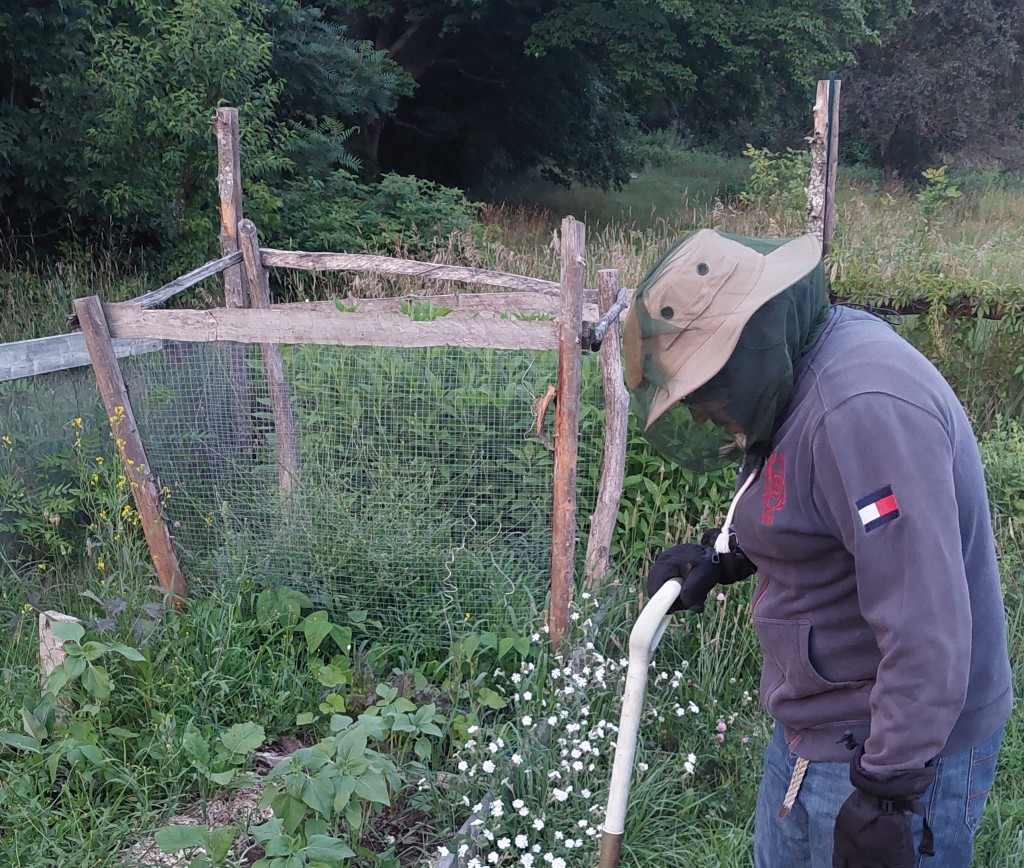
You have to strike in the evening when the wasps are less active—that’s when they’ve all returned to the nest and are less alert. So we geared up as if we were going to the moon:
- Two pairs of pants (because one isn’t enough when you’re playing with angry wasps!)
- Hat with insect net to protect your face
- Thick ski gloves (yes, even in the middle of summer!)
- Rubber rain boots
We looked like two astronauts lost in a vegetable garden, but at least not an inch of skin was exposed!
Armed with our arsenal—me with my wasp spray and my partner with a shovel—we headed for the battle zone. The plan: spray, shovel, spray, shovel again, and dig until we couldn’t see anything moving.
We had to sacrifice one of our cucumbers in the process (a moment of silence for its loss), but in the end, we dug until there was no sign of life. The next morning, we kicked the turned soil: nothing moved. Victory!

Irony, Plot Twists, and Lessons Learned
Well, where the story gets really interesting is that we then discovered a SECOND wasp nest on one of our young serviceberry trees! We decided to leave that one alone—the dogs never go near it, and the birds eat all the fruit anyway!

One week later: I have to be honest, our “victory” was premature! The wasps came back and settled in exactly the same place. Apparently, what we destroyed the first time was probably just a tube and not the main chamber. So there were a few survivors who managed to resettle. We’re going to have to put our astronaut suits back on… Did you hear me sigh through your screen?
Just goes to show, destroying an underground nest is harder than it looks! Unlike aerial nests, which you can see and remove in one go, these nests hide their true extent from us.
I’m definitely not an exterminator… But I’m not giving up hope!

What did I learn from this whole experience? First, that coexisting with certain species has its limits. Although they can be beneficial for pest control and pollination, if you can no longer garden in peace, sometimes you have to make difficult decisions.
Second, that not all wasps are created equal—solitary wasps are generally harmless, but social ones… that’s a different story!
And finally, that nature sometimes puts us in our place! We are just another species, victims of our neighbors’ defenses… even the smallest ones! Because even if it’s “just a sting,” it hurts like heck!
Next year, if we have new “tenants,” I’ll assess their intentions better before playing diplomat! And I won’t leave any bare ground in the spring either! Another good reason to mulch the garden and plant densely.
How about you, have you ever had any adventures with ground wasps? Let me know in the comments if you managed to defeat them!